- English
- ePUB (mobile friendly)
- Available on iOS & Android
eBook - ePub
Neglected Areas of Piano Teaching
Information
Subtopic
MusicEarly Lessons in Phrasing
There is no reason why beginning students cannot learn how to add expressive phrasing to music, regardless of the tempo or style of a piece, and especially in fast passages. For an easy way to teach phrasing, have students think of phrases as musical sentences. I have beginners read prose or poetry aloud, watching for punctuation marks, commas and periods, which are similar to phrase indications in music. In the first reading of a poem students speak without expression, but the second time through they add inflections.
After two readings of a poem I discuss the subtle improvements in nuances with students and relate these concepts to music. On the third reading of the poem, to avoid sounding mechanical, students vary the tempo. I compare this uneven pace of the voice to the steady ticking of a metronome and note how deviations from the metronome are similar to rubato in music.
I introduce musical phrasing using Béla Bartók’s Mikrokosmos, Volume 1, (example 24) having students shape the piece with added crescendos and diminuendos, just as they added expression to the poem. In the second phrase the peak of the crescendo deliberately falls on a descending note to convey the idea that not all crescendos rise in pitch.
Conversely I included, for additional practice, a rise in pitch for one of the diminuendos as well as twice as many crescendos and diminuendos within the same framework of two four-measure phrases, as shown in example 25.
An expressive piece, such as “Melodie” from Robert Schumann’s Album for the Young, is ideal for developing phrasing skills in early-intermediate students. Schumann divides the opening two four-measure phrases into four two-measure phrases. To help shape the melodic line, I added crescendo and diminuendo markings to measure three followed by another diminuendo (example 26).
For this passage the pattern of crescendos and diminuendos can be altered to create yet another interpretation (example 27). Both examples will help students play a crescendo that falls in pitch and a diminuendo that rises in pitch.
The left-hand accompaniment should help the right hand highlight the tune by briefly playing out the accompaniment. In the second line of “Melodie”, accents on the first beats of measures 5, 6 and 7 call for a diminuendo over notes that fall in pitch. To avoid a bumpy effect a slight fermata, combined with a gentle stress on the accented notes, helps to smoothly articulate the phrase without over-accentuation. Switching the musical focus to the left hand during the right hand rests on beat four will encourage students to interpret the phrase musically, as shown in example 28.
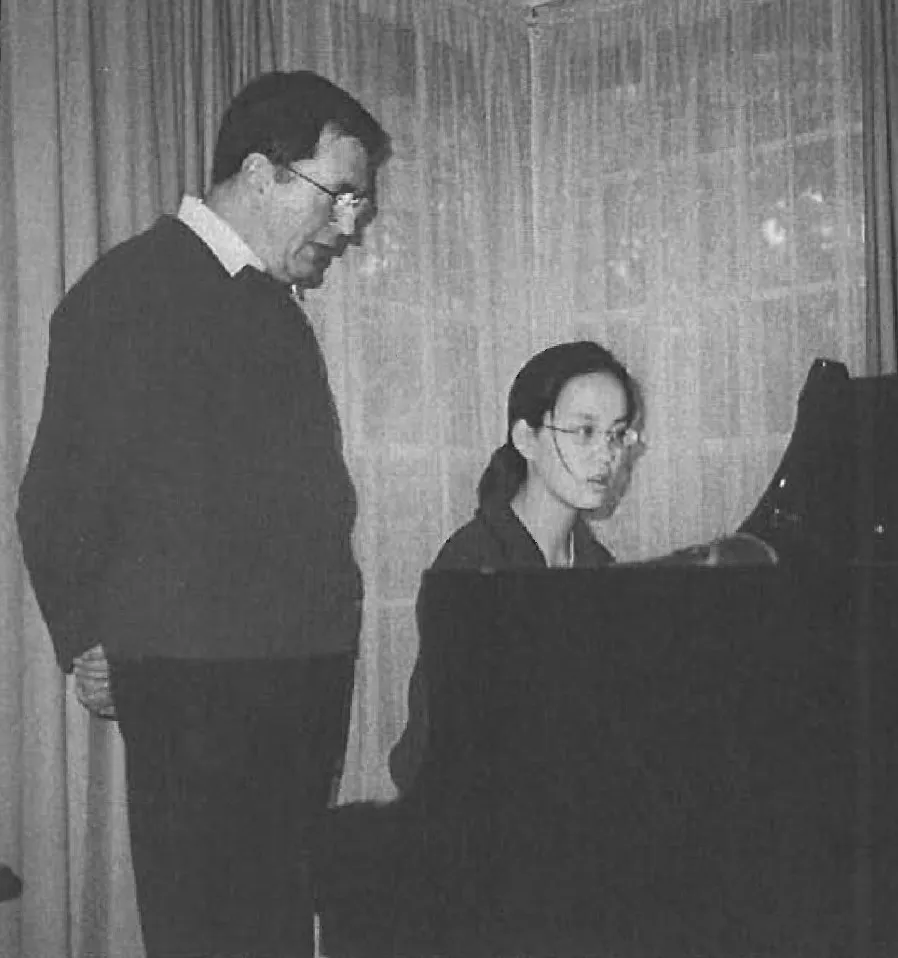
Pieces by the American composer Robert Muczynski are well suited to intermediate-level students interested in atonal music. His work Diversions, Op. 23, lacks a tonal center and has no overall phrase marks. Students have to take some initiative in phrasing the piece. A considerable amount of musical detail is already present – slurs, tenutos, accents, crescendos, diminuendos and staccatos – to give a good start for a musical interpretation, as you can see in example 29.
To highlight phrase structure I show students how to use a small pause at the point where one phrase ends and another begins; the music will sound overly phrased if the pause is too long. A number of slurs and phrases in this piece start on up-beats, which take attention away from a mechanical performance. Even if this were not the case, it is generally true that some stress and sufficient length should be added on up-beats. Some contemporary composers omit dynamics, phrase marks, time signatures or bar lines, leaving these to the player to add.
Unmusical phrasing of fast passages may stem from the unmusical way students practice scales and technical studies. St...
Table of contents
- Cover
- Title Page
- Copyright Page
- Contents
- Trevor Barnard – A biography
- Preface
- Basic Pedaling Techniques
- Equal Training for Both Hands
- Early Lessons in Phrasing
- How Soft is Soft?
- Keyboard Stiffness
- Cross-Rhythms
- Developing technique into musicality
Trusted by 375,005 students
Access to over 1.5 million titles for a fair monthly price.
Study more efficiently using our study tools.
Frequently asked questions
Yes, you can cancel anytime from the Subscription tab in your account settings on the Perlego website. Your subscription will stay active until the end of your current billing period. Learn how to cancel your subscription
No, books cannot be downloaded as external files, such as PDFs, for use outside of Perlego. However, you can download books within the Perlego app for offline reading on mobile or tablet. Learn how to download books offline
Perlego offers two plans: Essential and Complete
- Essential is ideal for learners and professionals who enjoy exploring a wide range of subjects. Access the Essential Library with 800,000+ trusted titles and best-sellers across business, personal growth, and the humanities. Includes unlimited reading time and Standard Read Aloud voice.
- Complete: Perfect for advanced learners and researchers needing full, unrestricted access. Unlock 1.5M+ books across hundreds of subjects, including academic and specialized titles. The Complete Plan also includes advanced features like Premium Read Aloud and Research Assistant.
We are an online textbook subscription service, where you can get access to an entire online library for less than the price of a single book per month. With over 1.5 million books across 990+ topics, we’ve got you covered! Learn about our mission
Look out for the read-aloud symbol on your next book to see if you can listen to it. The read-aloud tool reads text aloud for you, highlighting the text as it is being read. You can pause it, speed it up and slow it down. Learn more about Read Aloud
Yes! You can use the Perlego app on both iOS and Android devices to read anytime, anywhere — even offline. Perfect for commutes or when you’re on the go.
Please note we cannot support devices running on iOS 13 and Android 7 or earlier. Learn more about using the app
Please note we cannot support devices running on iOS 13 and Android 7 or earlier. Learn more about using the app
Yes, you can access Neglected Areas of Piano Teaching by Trevor Barnard in PDF and/or ePUB format, as well as other popular books in Media & Performing Arts & Music. We have over 1.5 million books available in our catalogue for you to explore.