- English
- ePUB (mobile friendly)
- Available on iOS & Android
eBook - ePub
Information
Subtopic
Acting & AuditioningAnthony Meindl
Founder, Anthony Meindl’s Actor Workshop
“What I teach is so simple, it’s just not easy.”
Anthony Meindl is a master acting coach and founder of Anthony Meindl’s Actor Workshop, which has locations in Los Angeles, New York, Atlanta, Chicago, Santa Fe, Vancouver, Toronto, London, Sydney, and Cape Town. His philosophy is radically different from the status quo. He doesn’t use scene objective, sense memory or any of the standard 20th century approaches that most acting schools take as their foundation. Instead, he emphasizes living truthfully in imaginary circumstances. He’s the author of At Left Brain Turn Right, BOOK THE F*CKING JOB! and Alphabet Soup for Grownups.
Alumni include Shailene Woodley, Ruby Rose, Pom Klementieff, Emma Kenney, Camilla Cabello, Trevante Rhodes, Brianne Howey, Sierra Capri, and Jenna Dewan.
| Bonnie Wallace: | Your approach to acting is really different from the standard ones. Can you explain your philosophy a little bit? |
| Anthony Meindl: | Yeah. It’s so weird because I’m reading John Cassavetes’ Lifeworks book right now. For people, who don’t know, John Cassavetes was really the forefather of independent cinema. He and his wife Gena Rowlands, maybe young audiences would know her from The Notebook. She played the mom. It was directed by their son, Nick Cassavetes. |
| Anyway, he was really the trailblazer of exploring just living on camera for American directors in the ’50s, ’60s, ’70s. The opening quote of his book is, “Life class is the best acting class.” That’s what I teach. Even Stanislavski who came up with many different ways to try to get actors to be real, said, “I just do whatever I have to do to make people stop acting,” basically. Right? | |
| I think the truth about acting is that we come up with all these words, and definitions, and theories, and concepts, and names for something that is as simple as you and I right now, just listening and talking. The heart of it is all listening. I think people get stuck on the mechanics of something, but we’re not fixing the inner workings of a car. We’re not mechanics. You don’t have to be a mechanic. Mechanics are for mechanics. We just have to try to tell the truth, which is very, very difficult. I find that if we do away with a lot of the things that put people in their heads, they’re already more predisposed to do it naturally. | |
| I’m just not invested in calling it something because I find that whether they’re painters, or writers, or actors, or singers, it’s literally about the person igniting their art through themselves, so that’s what I teach. Be you, really, which is really very difficult to be. | |
| Bonnie Wallace: | I love that. We were talking earlier, and I shared with you my own philosophy about acting, which is that the actor’s soul, their spirit, is like the light that shines through the stage light gel, and the gel is the character. |
| Anthony Meindl: | That’s a beautiful way of articulating it. Gary Oldman says something similar: “The characters that you’re playing are just basically prisms of yourself. That’s all it is.” He says, “When it says that a character is crying in the script, or you go and see the movie and you see a character crying, it’s not the character crying. It’s me, Gary Oldman, crying.” That’s the big leap that I think more and more actors are starting to have. |
| That’s Gary Oldman and he’s been around forever. You start to see that distillation of it, the talking about it in a way that moves beyond the concepts, and you can see very clearly that you can’t become someone else. The physics make that impossible. | |
| Bonnie Wallace: | Well, there’s a kind of psychosis to that, too. You really are still you. |
| Anthony Meindl: | That’s a good point. |
| Bonnie Wallace: | The crying is where you are. I watched my daughter do a very emotional scene a couple of weeks ago. You could tell her whole body was involved and engaged in those feelings and those emotions. It was real. Her body was experiencing it in a very real way. The tears were real and that was her, crying. That wasn’t really her character. |
| Anthony Meindl: | Well, I guess another way of thinking about it is when we’re watching them, the final edited program, movie, TV show, theater, whatever, the piece, the play, we’re involved in the story so we’re seeing the character ... the storytelling is occurring through the person playing the character. When we surrender to the circumstances in the story, then it’s a subjective experience. Right? |
| We’re imprinting on whatever it is that we’re watching, filling in the blanks of who we think these people are or aren’t. That, to me, is where a lot of the character development really occurs. When you’re watching your daughter and you know that she’s crying, if I don’t know your daughter and I go watch the movie and I see her crying as “the character,” yes, of course, I’m watching the story unfold, and she’s doing it authentically, so I surrender to that narrative but it’s still her. It’s not Dove. It’s Dove as Julie. It’s Dove as Sabrina. It’s Dove as whatever the character’s name is. | |
| I think those are huge light bulbs. You know what I mean? I had a guy last night in intro class where he’s never taken an acting class before. Again, he’s got concepts of it ... He gets up and he tries to show us the idea of a guy who’s nervous or a guy who is ... right? He’s acting. | |
| Bonnie Wallace: | T... |
Table of contents
- Title Page
- Copyright Page
- Dedication
- Contents
- Gratitude
- Introduction
- Zak Barnett
- Diane Christiansen
- Marnie Cooper
- John D’Aquino
- Patrick Day
- Judy Kain
- Anthony Meindl
- Eric Morris
- Lisa Picotte
- Mae Ross
- Scott Sedita
- Marcie Smolin
- Epilogue: COVID-19 note
- Contact
- A Note on Offerings and Pricing
- Glossary
- About the Hometown to Hollywood Podcast
- About the Author
Trusted by 375,005 students
Access to over 1.5 million titles for a fair monthly price.
Study more efficiently using our study tools.
Frequently asked questions
Yes, you can cancel anytime from the Subscription tab in your account settings on the Perlego website. Your subscription will stay active until the end of your current billing period. Learn how to cancel your subscription
No, books cannot be downloaded as external files, such as PDFs, for use outside of Perlego. However, you can download books within the Perlego app for offline reading on mobile or tablet. Learn how to download books offline
Perlego offers two plans: Essential and Complete
- Essential is ideal for learners and professionals who enjoy exploring a wide range of subjects. Access the Essential Library with 800,000+ trusted titles and best-sellers across business, personal growth, and the humanities. Includes unlimited reading time and Standard Read Aloud voice.
- Complete: Perfect for advanced learners and researchers needing full, unrestricted access. Unlock 1.5M+ books across hundreds of subjects, including academic and specialized titles. The Complete Plan also includes advanced features like Premium Read Aloud and Research Assistant.
We are an online textbook subscription service, where you can get access to an entire online library for less than the price of a single book per month. With over 1.5 million books across 990+ topics, we’ve got you covered! Learn about our mission
Look out for the read-aloud symbol on your next book to see if you can listen to it. The read-aloud tool reads text aloud for you, highlighting the text as it is being read. You can pause it, speed it up and slow it down. Learn more about Read Aloud
Yes! You can use the Perlego app on both iOS and Android devices to read anytime, anywhere — even offline. Perfect for commutes or when you’re on the go.
Please note we cannot support devices running on iOS 13 and Android 7 or earlier. Learn more about using the app
Please note we cannot support devices running on iOS 13 and Android 7 or earlier. Learn more about using the app
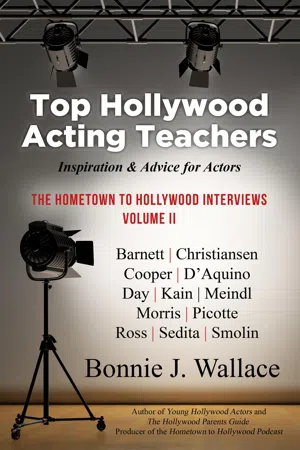
Yes, you can access Top Hollywood Acting Teachers by Bonnie J Wallace in PDF and/or ePUB format, as well as other popular books in Media & Performing Arts & Acting & Auditioning. We have over 1.5 million books available in our catalogue for you to explore.