- English
- ePUB (mobile friendly)
- Available on iOS & Android
eBook - ePub
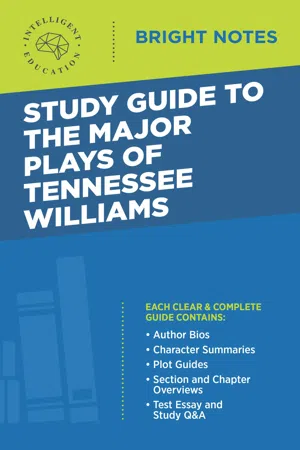
Study Guide to the Major Plays of Tennessee Williams
Trusted by 375,005 students
Access to over 1.5 million titles for a fair monthly price.
Study more efficiently using our study tools.
Information
Topic
Study AidsSubtopic
Study Guides
TENNESSEE WILLIAMS
INTRODUCTION
He was born on March 26, 1911, in the Episcopal rectory of his grandfather in Columbus, Mississippi. Christened Thomas Lanier, he was the second child and first son of Cornelius Coffin Williams, a traveling salesman for a shoe company, and Edwina Dakin Williams, the daughter of the local rector.
When young Williams was eight years old, his father was promoted to a managerial position with his company’s subsidiary in St. Louis. Leaving the rural, leisurely life in Mississippi, the family moved to St. Louis. For Williams, and for his older sister Rose, the uprooting was violent. Throughout his adolescence and youth the family lived in a succession of small apartments which were a far cry from the comfortable home of his childhood. A sensitive youth, his life became increasingly interior. He was extremely close to his mother and sister, but felt little affection for his father, whose bluntness and rough manner alienated the boy.
EARLY INTEREST IN WRITING
When Williams was eleven years old, his mother bought him a typewriter, and from that moment he began to turn out works of fact and fiction by the carload. Once he began writing he did not stop for a day. Poems, vignettes, sketches and short stories flickered to life. His abundant imagination had found the perfect means for expression. After graduating from high school, he entered the University of Missouri, where he spent two years as a journalism major. By now it was 1932, the height of the Depression, and Williams’ academic career came to a halt when his father withdrew him from college and shuttled him into a position as clerk with his firm. Williams’ three years with the shoe company were probably the most difficult and unhappy of his entire life. The drudgery was endless and his anguish was intensified by his inability to find time to pursue his writing. Unable to write during the day, he tried to write in the evenings and into the night. Finally the inevitable happened: the combination of long hours of work he hated and long nights of subsistence on coffee and cigarettes took its toll. He suffered a breakdown. Fortunately, he recovered rapidly and was sent to his grandparents’ home, now in Tennessee, to convalesce. That summer, Williams wrote his first play, a comedy called Cairo! Shanghai! Bombay!, about two sailors on shore leave who become involved in a series of riotous adventures. It was presented at a small summer theatre and its warm reception encouraged the young writer to continue with playwriting.
Free of the shoe company, he enrolled at Washington University, St. Louis, where he hoped to complete his education. His imagination fired by writers like Anton Chekhov and D. H. Lawrence, he turned out a second play, The Magic Tower, which was produced in 1936 by a local theatre group. He entered the senior class at Washington University and joined a dynamic group of young actors and writers called The Mummers. Stimulated by his association with this exciting and invigorating troupe, Williams wrote two more dramas, a one-act pacifist play called Headlines, and a full-length drama entitled Me, Vashya!, which dealt with a munitions maker who during World War I sold his products alternately to the highest bidders.
FAMILY TROUBLES
Despite his newly discovered vocation, Williams’ final year at Washington University was a dismal one. His general apathy for the classroom was one reason. Another was his issue with the school over a matter of policy. But something much more serious than school setbacks was preying on his mind during the years of 1936 and 1937. The relationship between his parents was becoming increasingly hostile. In a few years it would disintegrate into a separation; now it made home life difficult. In the midst of this friction and despair another catastrophe was evolving. Rose Williams was succumbing to mental illness. The anguish Williams felt at this was almost unbearable. She had been almost his exclusive companion during childhood and the ties between them were intensely close. Nine years later, after Rose was hopelessly committed to an institution, Williams would pay his most moving tribute to her in his semi-autobiographical drama, The Glass Menagerie. But in 1936, in the midst of extreme despair, Williams turned to his writing with an almost demoniac intensity. Candles to the Sun, a violent story of the exploitation of Alabama coal miners, was too strong for the stomachs of many critics when it was produced by the Mummers, although it received a generally enthusiastic response from audiences in St. Louis.
INITIAL SUCCESS AND FAILURE
In 1937 Rose was sent to an institution and Williams’ final tie with his home and family was broken. He had been dropped from Washington University more from a lack of interest than anything else, but as autumn came around he again became determined to complete college. Feeling he needed a change of atmosphere, he enrolled at the University of Iowa, where he wrote three plays. The first, The Fugitive Kind, was sent act by act to the Mummers in St. Louis who produced it in 1938. It dealt with the dredges of humanity and was replete with stock characters including the beautiful but “lost” heroine. Williams’ other two plays at Iowa were written for the late Professor E. C. Mabie’s seminar in playwriting. Spring Storm was a play very specifically about love. Not About Nightingales, begun at Iowa and completed in St. Louis during the summer of 1938, was about a prison riot based upon an actual occurrence at the time. The Mummers were eager to produce it but the Depression had finally taken its toll. In financial straits, they were unable to go on and they disbanded before they could stage the play.
In the spring of 1938, Williams received his Bachelor’s degree from the University of Iowa. He returned to St. Louis for a few months, then journeyed to New Orleans where he hoped to join the W.P.A. Writers’ Project. He was unsuccessful but he remained in New Orleans during the autumn and winter of 1938. He felt thoroughly at ease in the Bohemian atmosphere of the old city, and he marked what he felt to be his newly found liberation with a change of name. He dropped the name Thomas and dubbed himself Tennessee. That winter he wrote one-act plays dealing for the most part with the individual’s struggle for freedom in the face of hopeless odds. Almost all these short plays manifested an acute social consciousness on the part of their author.
The turning point in Williams’ life presented itself quite unobtrusively. Through a small article in a paper he learned that the Group Theatre in New York was sponsoring a playwriting contest. He submitted his four long plays, Candles to the Sun, The Fugitive Kind, Spring Storm, and Not About Nightingales, together with a group of his one-acters which he named American Blues. Not only did Williams win an award from the Group Theatre for the American Blues selection, but, more importantly for him, he won the admiration of theatrical agent Audrey Wood, whose friend Molly Day Thatcher was one of the Group Theatre’s judges. Miss Wood contacted the young writer and he became her client. While he continued to write she began to see what financial assistance she could get for him. She succeeded admirably, obtaining a Rockefeller grant enabling Williams to come to New York. In New York he enrolled at the New School for Social Research, where John Gassner and Theresa Helburn were conducting a playwriting seminar. It was here that Williams completed a play which he had begun earlier, Battle of Angels. With Gassner’s help, the Theatre Guild took an option on it and prepared to open it in New York in the winter of 1941. But after an unsuccessful pre-Broadway engagement the drama closed in Boston and Williams’ first big opportunity ended in failure. He was to wait five years for another chance. In the meantime he continued to write. He turned out short stories and poems, some of which were published in small literary magazines; he revised Battle of Angels; and he worked on new plays. He completed a one-act drama about the last days of D. H. Lawrence, which he titled I Rise In Flame, Cried the Phoenix. Early in 1942 he completed a full-length play called Stairs to the Roof, which is a fantasy about a young man who liberates himself from the drudgery of a job with a shirt manufacturer very similar to the shoe company in which Williams had worked. He also wrote a play in collaboration with a friend, Donald Windham. It was called You Touched Me! and was based upon a short story of the same name by D. H. Lawrence. To support himself while writing, Williams took a variety of odd jobs from a night elevator operator to a waiter in an all-night cafe. He roamed from New York to Florida, living a hand-to-mouth existence as he sought new material and new inspiration. In the spring of 1943, through the efforts of Audrey Wood, Williams obtained a position as a scriptwriter for Metro-Goldwyn-Mayer Studios in Hollywood. But he soon found that he did not care for his new vocation. He listlessly worked on a few scenarios, but spent most of his time on an original screenplay titled The Gentleman Caller. He submitted it to the studio but it was rejected, so he refashioned it into a stage play and renamed it The Glass Menagerie.
The play was optioned to producer-director-actor Eddie Dowling, who cast the aging Laurette Taylor in the role of the mother and himself as the narrator, Tom Wingfield. At first nothing seemed to go well. There was bickering among the members of the company, Miss Taylor seemed to be unsteady in the part, and as the troupe arrived in Chicago for the pre-Broadway opening in December of 1944, a pall of gloom seemed to hang over everyone. But on opening night, December 26, the pall was dispelled in a burst of theatrical radiance. Miss Taylor gave a luminous performance and the critics were lavish in their praise of her and of the play and its author. Even after this auspicious beginning, hard luck continued to haunt The Glass Menagerie. Despite the glowing reviews, the play failed to draw audiences and the producers decided to close it. But again the press came to the rescue. The Chicago drama critics exhorted the public to attend the new drama, and slowly at first, and then in increasing numbers, the public attended. By the end of its third week in Chicago, The Glass Menagerie was playing to full and enthusiastic houses. On March 31, 1945, the play opened in New York to immediate critical and popular acclaim, and on April 1, after more than fifteen years of continual effort and disappointment, Tennessee Williams was being hailed as an overnight success.
FURTHER SUCCESS AND THE PULITZER PRIZE
With The Glass Menagerie an established hit, Williams and Donald Windham began to prepare their collaboration, You Touched Me!, for Broadway. It opened only six months after The Glass Menagerie. The latter was still enjoying a successful run, and You Touched Me! paled considerably by the inevitable critical comparison. A slight play, without the depth of characterization found in The Glass Menagerie, You Touched Me! managed a modest run of a few months. But Williams was already immersed in work on two new dramas, Summer and Smoke and The Poker Night. He finished them almost at the same time and retitled The Poker Night as A Streetcar Named Desire. It opened first, on December 3, 1947, and confirmed the talent and promise inherent in The Glass Menagerie. Unanimously hailed by critics and audiences alike, it was subsequently awarded both the Drama Critics’ Circle Award and the Pulitzer Prize, and it established its creator as the leading American playwright of his generation. Summer and Smoke opened in October of 1948 to a mixed critical reception. Like You Touched Me!, it had the misfortune to open when it could still be compared with a Williams success still playing on Broadway. It had a moderate run, and Williams, disappointed, returned to his writing.
He continued to work on Battle Of Angels, which, since its failure in Boston, eight years before, had become a kind of private obsession with him. He wrote a few short stories which he collected with some earlier ones into a volume called One Arm. In a few years a second collection of stories entitled Hard Candy would also be published. Two new works evolved out of a few months’ time he spent in Italy. One was a novella called The Roman Spring of Mrs. Stone and the other a play, The Rose Tattoo. Williams had written the latter with the tempestuous Italian actress, Anna Magnani, in mind, but she was unable to perform in it (although she later played in the movie version). The drama, which opened on February 3, 1951, was a moderate success. In 1953 Williams tasted failure in his cruelest professional reversal since the collapse of Battle of Angels. His most ambitious undertaking, Camino Real, was a flop on Broadway. Since A Streetcar Named Desire six years before, his works had been greeted with diminishing enthusiasm by critics and audiences alike. Williams was plagued by doubts. He was not getting younger and to all apparent purposes he had attained his artistic peak six years previously. The following year was a difficult one for the playwright. He continued to write but could not shake the feeling that possibly all his efforts were in vain. He again returned to Battle of Angels, determined to justify the drama which he felt had never been given a fair chance. He also began to write a play based upon one of his short stories. During the summer and autumn of 1954 this play became his main project. He called it Cat On A Hot Tin Roof. When he completed the first version he showed it to director Elia Kazan, who had staged A Streetcar Named Desire and Camino Real. Despite reservations about the final act (which was revised in the Broadway production) Kazan was enthusiastic and took the directing assignment. Cat On A Hot Tin Roof opened in March, 1955, to critical and popular acclaim. It garnered Williams his second Pulitzer Prize and reestablished him as one of America’s most vital and powerful dramatists.
In 1956 Williams accomplished the feat he had hoped to for sixteen years. He at last brought Battle Of Angels to Broadway. Much of it was rewritten and it also had a new title, Orpheus Descending, but it remained in essence the same play Williams had written in 1939. Its fate was somewhat better than that of Battle Of Angels, but it was neither a critical nor a popular success. Williams was bitterly disappointed. He had invested more of himse...
Table of contents
- Front Cover
- Title Page
- Copyright Page
- Contents
- 1) Introduction to Tennessee Williams
- 2) The Glass Menagerie
- 3) A Streetcar Named Desire
- 4) Cat on a Hot Tin Roof
- 5) Orpheus Descending
- 6) Summer and Smoke
- 7) The Rose Tattoo
- 8) Camino Real
- 9) Suddenly Last Summer
- 10) Sweet Bird of Youth
- 11) Period of Adjustment
- 12) The Night of the Iguana
- 13) Essay Questions and Answers
- 14) Bibliography
Frequently asked questions
Yes, you can cancel anytime from the Subscription tab in your account settings on the Perlego website. Your subscription will stay active until the end of your current billing period. Learn how to cancel your subscription
No, books cannot be downloaded as external files, such as PDFs, for use outside of Perlego. However, you can download books within the Perlego app for offline reading on mobile or tablet. Learn how to download books offline
Perlego offers two plans: Essential and Complete
- Essential is ideal for learners and professionals who enjoy exploring a wide range of subjects. Access the Essential Library with 800,000+ trusted titles and best-sellers across business, personal growth, and the humanities. Includes unlimited reading time and Standard Read Aloud voice.
- Complete: Perfect for advanced learners and researchers needing full, unrestricted access. Unlock 1.5M+ books across hundreds of subjects, including academic and specialized titles. The Complete Plan also includes advanced features like Premium Read Aloud and Research Assistant.
We are an online textbook subscription service, where you can get access to an entire online library for less than the price of a single book per month. With over 1.5 million books across 990+ topics, we’ve got you covered! Learn about our mission
Look out for the read-aloud symbol on your next book to see if you can listen to it. The read-aloud tool reads text aloud for you, highlighting the text as it is being read. You can pause it, speed it up and slow it down. Learn more about Read Aloud
Yes! You can use the Perlego app on both iOS and Android devices to read anytime, anywhere — even offline. Perfect for commutes or when you’re on the go.
Please note we cannot support devices running on iOS 13 and Android 7 or earlier. Learn more about using the app
Please note we cannot support devices running on iOS 13 and Android 7 or earlier. Learn more about using the app
Yes, you can access Study Guide to the Major Plays of Tennessee Williams by Intelligent Education in PDF and/or ePUB format, as well as other popular books in Study Aids & Study Guides. We have over 1.5 million books available in our catalogue for you to explore.