A searching account of nineteenth-century salvage anthropology, an effort to preserve the culture of "vanishing" Indigenous peoples through dispossession of the very communities it was meant to protect.
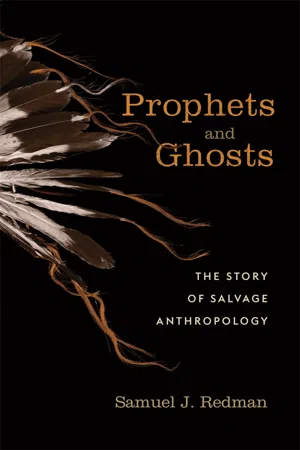
In the late nineteenth century, anthropologists, linguists, archaeologists, and other chroniclers began amassing Indigenous cultural objects—crafts, clothing, images, song recordings—by the millions. Convinced that Indigenous peoples were doomed to disappear, collectors donated these objects to museums and universities that would preserve and exhibit them. Samuel Redman dives into the archive to understand what the collectors deemed the tradition of the "vanishing Indian" and what we can learn from the complex legacy of salvage anthropology.
The salvage catalog betrays a vision of Native cultures clouded by racist assumptions—a vision that had lasting consequences. The collecting practice became an engine of the American museum and significantly shaped public education and preservation, as well as popular ideas about Indigenous cultures. Prophets and Ghosts teases out the moral challenges inherent in the salvage project. Preservationists successfully maintained an important human inheritance, sometimes through collaboration with Indigenous people, but collectors' methods also included outright theft. The resulting portrait of Indigenous culture reinforced the public's confidence in the hierarchies of superiority and inferiority invented by "scientific" racism.
Today the same salvaged objects are sources of invaluable knowledge for researchers and museum visitors. But the question of what should be done with such collections is nonetheless urgent. Redman interviews Indigenous artists and curators, who offer fresh perspectives on the history and impact of cultural salvage, pointing to new ideas on how we might contend with a challenging inheritance.
- 329 pages
- English
- PDF
- Available on iOS & Android
eBook - PDF
About this book
Information
Table of contents
- Cover
- Title Page
- Copyright
- Dedication
- Contents
- Prologue
- 1. The Birth of Salvage Anthropology in the Nineteenth Century
- 2. Building a Cultural Salvage Movement in the United States
- 3. The Federal Government and Salvage Anthropology
- 4. Salvaging Society through Art and Image
- 5. Cultural Salvage in California
- 6. Salvage Anthropology in the Modern World
- Epilogue
- Notes
- Acknowledgments
- Index
Trusted by 375,005 students
Access to over 1.5 million titles for a fair monthly price.
Study more efficiently using our study tools.
Frequently asked questions
Yes, you can cancel anytime from the Subscription tab in your account settings on the Perlego website. Your subscription will stay active until the end of your current billing period. Learn how to cancel your subscription
No, books cannot be downloaded as external files, such as PDFs, for use outside of Perlego. However, you can download books within the Perlego app for offline reading on mobile or tablet. Learn how to download books offline
Perlego offers two plans: Essential and Complete
- Essential is ideal for learners and professionals who enjoy exploring a wide range of subjects. Access the Essential Library with 800,000+ trusted titles and best-sellers across business, personal growth, and the humanities. Includes unlimited reading time and Standard Read Aloud voice.
- Complete: Perfect for advanced learners and researchers needing full, unrestricted access. Unlock 1.5M+ books across hundreds of subjects, including academic and specialized titles. The Complete Plan also includes advanced features like Premium Read Aloud and Research Assistant.
We are an online textbook subscription service, where you can get access to an entire online library for less than the price of a single book per month. With over 1.5 million books across 990+ topics, we’ve got you covered! Learn about our mission
Look out for the read-aloud symbol on your next book to see if you can listen to it. The read-aloud tool reads text aloud for you, highlighting the text as it is being read. You can pause it, speed it up and slow it down. Learn more about Read Aloud
Yes! You can use the Perlego app on both iOS and Android devices to read anytime, anywhere — even offline. Perfect for commutes or when you’re on the go.
Please note we cannot support devices running on iOS 13 and Android 7 or earlier. Learn more about using the app
Please note we cannot support devices running on iOS 13 and Android 7 or earlier. Learn more about using the app
Yes, you can access Prophets and Ghosts by Samuel J. Redman in PDF and/or ePUB format, as well as other popular books in Social Sciences & Museum Studies. We have over 1.5 million books available in our catalogue for you to explore.