eBook - ePub
Available until 23 Dec |Learn more
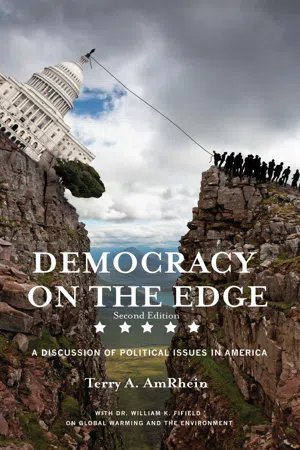
Democracy On The Edge
A Discussion Of Political Issues In America
This book is available to read until 23rd December, 2025
- English
- ePUB (mobile friendly)
- Available on iOS & Android
eBook - ePub
Available until 23 Dec |Learn more
About this book
If you are interested in American Political Issues, you are going to love reading this book!
Trying to make sense of political issues in the United States can be challenging, especially with the "spin" placed on so many issues by media and politicians. If you are fed up with the lies and half-truths and want real answers, look no further!
Democracy on the Edge discusses these important issues:
- The Supreme Court's decision on "Citizen's United"
- How gun ownership is a right but has limitations
- The effects of global warming (by W.K. Fifield, MD)
- How health care issues affect all Americans
- The influence of big business on American lives
- Causes of the "Financial Crisis, " and what Congress has done
- The Tea Party and their conflicting views
- America's deep debt and plans to dig out of it
While based on verifiable facts, Democracy on the Edge is also filled with Terry's flare for personal anecdotes and humorous quips that make the book delightful to read.
Frequently asked questions
Yes, you can cancel anytime from the Subscription tab in your account settings on the Perlego website. Your subscription will stay active until the end of your current billing period. Learn how to cancel your subscription.
No, books cannot be downloaded as external files, such as PDFs, for use outside of Perlego. However, you can download books within the Perlego app for offline reading on mobile or tablet. Learn more here.
Perlego offers two plans: Essential and Complete
- Essential is ideal for learners and professionals who enjoy exploring a wide range of subjects. Access the Essential Library with 800,000+ trusted titles and best-sellers across business, personal growth, and the humanities. Includes unlimited reading time and Standard Read Aloud voice.
- Complete: Perfect for advanced learners and researchers needing full, unrestricted access. Unlock 1.4M+ books across hundreds of subjects, including academic and specialized titles. The Complete Plan also includes advanced features like Premium Read Aloud and Research Assistant.
We are an online textbook subscription service, where you can get access to an entire online library for less than the price of a single book per month. With over 1 million books across 1000+ topics, we’ve got you covered! Learn more here.
Look out for the read-aloud symbol on your next book to see if you can listen to it. The read-aloud tool reads text aloud for you, highlighting the text as it is being read. You can pause it, speed it up and slow it down. Learn more here.
Yes! You can use the Perlego app on both iOS or Android devices to read anytime, anywhere — even offline. Perfect for commutes or when you’re on the go.
Please note we cannot support devices running on iOS 13 and Android 7 or earlier. Learn more about using the app.
Please note we cannot support devices running on iOS 13 and Android 7 or earlier. Learn more about using the app.
Yes, you can access Democracy On The Edge by Terry A AmRhein in PDF and/or ePUB format, as well as other popular books in Politics & International Relations & Democracy. We have over one million books available in our catalogue for you to explore.
Information
Chapter 1
Citizens United, Super PACS And Nonprofits
The First Amendment to the Constitution of the United States of America states:
“Congress shall make no law respecting an establishment of religion, or prohibiting the free exercise thereof; or abridging the freedom of speech, or of the press; or the right of the people peaceably to assemble, and to petition the government for a redress of grievances.”
In 2010, the Supreme Court’s ruling in the case Citizens United v. Federal Election Commission allows corporations, unions and associations to have the same freedom of speech rights as individuals and therefore permits them to spend literally unlimited funds on political campaign advertising. Corporations, unions and associations (like the National Automobile Dealers Association) henceforth are allowed to spend millions of dollars to expound on the superior qualities and virtues of their candidate and why he or she is uniquely fit to be elected to the office of president or senator or congressman. Or corporations, unions and associations can likewise spend millions of dollars telling the voting public why a particular candidate is a lying, deceitful good- for-nothing who has fabricated and falsified all of his or her so-called achievements throughout his or her entire life and in fact is not even an American citizen.
To understand how this situation developed, we must look back into history. As far back as 1907, under a law called the Tillman Act, corporations were prevented from contributing money directly to candidates’ political campaigns. Following in kind, in 1947 Congress enacted theTaft-Hartley Act that, among other things, prohibited labor unions from contributing directly to a candidate’s campaign. Although these laws prohibited corporations and unions from contributing directly to campaigns, nothing prohibited them from acting as a fundraiser for a candidate.The Congress of Industrial Organizations, a federation of labor unions that would later merge with the American Federation of Labor to become the AFL-CIO, formed the first political action committee (PAC) to help raise funds for candidates favorable to their view. In response, corporations began their own fundraising efforts and established their own PACs. The PACs then contributed money to their candidates’ campaigns. So what we had were laws forbidding corporations and unions from donating directly into a candidate’s campaign fund, but they were allowed to donate to a PAC and then the PAC could make donations directly to the candidate’s campaign. These shenanigans proceeded for quite a while, with corporations contributing through PACs to candidate’s campaigns to help assure the candidate’s election and subsequent favorable votes on legislation. Union members, likewise, contributed to their candidates in an attempt to influence votes.This practice was followed by both parties, Democrat and Republican. No one was immune to the candidate contribution fever. As elections progressed, Democratic contributions competed against Republican contributions, in true capitalistic fashion, and election campaigns became more and more costly. PACs for unions and corporations remained unregulated and influential in political campaigns until the 1970s. In 1971 Congress passed the Federal Election Campaign Act and in 1974 created the Federal Election Commission (FEC). As a result of the FEC’s creation, rules were finally established to regulate how PACs were funded and how PACs could spend their money. The rules required, among other things, that:
- Corporations and unions cannot contribute directly to candidates or parties, (because of the Tillman and Taft Hartley acts). However, PACs are allowed to contribute directly to candidates and political parties. Labor unions and corporations were allowed to contribute to PACs although the amounts of the donations were limited (initially to $5000 per candidate per election).
- The names of most donors and the expenditures of the PAC must be disclosed in monthly or quarterly reports to the FEC.
So this is how political action committees function. These rules still apply to PACs today (the donation amounts are periodically adjusted for inflation).
From the 1970s to the beginning of the 21st century, the costs of elections continued to grow, and the influence of corporations and unions helped fund this growth. In 2002, Congress, concerned about the growth in election finances and the influence of corporations, unions and wealthy individuals, passed the Bipartisan Campaign Reform Act, better known as the McCain-Feingold Act, na...
Table of contents
- Dedication
- Acknowledgements
- Introduction
- Chapter 1
- Chapter 2
- Chapter 3
- Chapter 4
- Chapter 5
- Chapter 6
- Chapter 7
- Chapter 8
- Bibliography