eBook - ePub
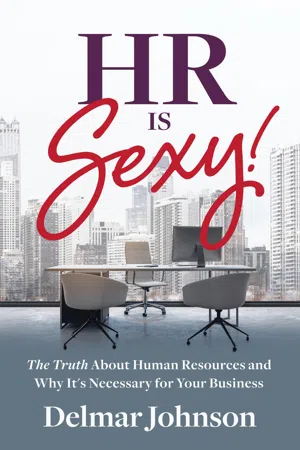
HR Is Sexy!
The Truth About Human Resources and Why It's Necessary for Your Business
- English
- ePUB (mobile friendly)
- Available on iOS & Android
eBook - ePub
Information
PART I
THE TRUTH ABOUT HUMAN RESOURCES
Chapter 1

Defining HR for Entrepreneurs
What is human resources?
In my twenty-five years of experience, most people I’ve encountered often define human resources as the “gatekeepers” of any company. I get it when people call us the gatekeepers; however, human resources is so much more than the “bad guy” in any organization.
I’ll tell you a little story about how my twenty-five-year journey began. Picture this: Memphis, 1984. It was my senior year in high school, and, as with all seniors, I was embarking upon a decision about which path I would take in college and in life. My hometown always held a college event called College-a-Rama, where all the tristate area schools would convene to share information about their respective schools with all the seniors who were attending. During my visit, I talked with several representatives, and I landed on a school called MTSU and their business degree program in office management with an emphasis on human resources. I was intrigued and eventually hooked. So, when one of my senior year teachers asked me what I wanted to do when I graduated, my seventeen-year-old self said with unknowing conviction, “I’m going into human resources.” At the time I didn’t know what human resources really was, but my understanding, and the thing that attracted me, was that it had something to do with helping people. That was the extent of my knowledge. Although that wasn’t far off the mark, it didn’t encompass all of what human resources is.
With all that said, allow me to formally define human resources, a.k.a. HR, a.k.a. human capital management, to set the stage for what you will read in this book. One of the most common questions is, what exactly is human resources? In layman’s terms, human resources are first and foremost the people that make up the workforce within your company or business sector. They are often referred to as human capital, although that relates more to the skillset and knowledge an individual has, as well as their economic growth. Other terms you probably have heard of describing human resources are people, talent, and manpower, just to name a few. A couple more modern terms would be calling your workforce either team members or associates. And, for all of us who have been in corporate America before, we think of human resources as a division in terms of its functions, like recruiting, hiring, firing, benefits, and training.
Human resources has been through its own evolution. The precursor to today’s HR used the word personnel for the functions they performed, which were described mostly as paying employees and managing the benefits they received. However, the evolution of human resources identified people as being the greatest asset and resource of a company, and now, instead of a company only paying and providing benefits to their workers, employees are hired, motivated, developed, and retained. HR is no longer like the days of old; it now has a seat at the table and is considered a strategic partner to decision makers.
Why is HR necessary for small businesses?
Many small business leaders wonder why human resources is even necessary. In my professional experience, I have often discovered that their view of human resources is a little too narrow. On many occasions when I’ve been asked what I do for a living and I share a little about my background, he or she always summarizes it as hiring, firing, and payroll. Trust me, it’s so much more than that, as the above formal definition provided a glimpse of. Providing a little more insight into what HR does encompass helps to increase a small business owner’s viewpoint, and as a result heightens their understanding in how it can and will play a part in their ability to grow and expand over time.
Why should small businesses care?
A savvy small business leader takes risks every day. It’s just the cost of doing business. However, that cost can be much greater when there is no infrastructure in place, such as processes and systems to create a semblance of efficiency. Well, that describes in short why small businesses should care about human resources and all that establishes it. HR has a huge effect on the culture and environment in your workplace, setting the tone for how employees communicate with each other, settle disputes, and work with each other.
Some small businesses prefer to outsource various components of human resources, but there is no getting around it completely. Human resources management plays an integral part in how to appropriately direct people and develop a workplace culture and environment. When effectively implemented, your company’s overall direction, goal, and objectives become increasingly clearer.
The elements of human resources don’t just establish structure inside small businesses so that you are able to scale up; just as important is how it aids in the development of business culture. At the root of every successful business is a culture that was established from its beginning; this is why it’s important to go a little deeper into what business culture looks like and how it’s implemented, whether you are brand new or considered a more established business.
If you’ve ever wondered what it takes to transition from an entrepreneur to a small business CEO mindset, HR Is Sexy! is the book for you. I cannot tell you the initial panic I felt trying to overcome my fear around building a team and systems that will be sustainable. Delmar’s passion for the success of small businesses, for them to be competitively positioned in the marketplace, is evident. From the cold hard facts of the power of human resources to the implementation of its strategies, this passion shines through and through. As an up-and-coming entrepreneur, this book provided me with practical step-by-step guidance on developing more CEO-like characteristics while implementing employer best practices that contributed to my profitable business success. This book will be a game changer for you, too!
Dr. April J. Lisbon, CEO
Running Your Race Enterprises, LLC
www.advocacycoaching.com
Chapter 2
Determine Your Company Culture Early
What is business culture?
Business culture, your company personality, is the starting point every entrepreneur should build as their foundation. The culture you develop as a leader becomes the driving force behind how you operate your business long-term. Many times, entrepreneurs consider culture as something that is to be established after they have a team in place or after they are making a certain amount of profits, which is not true. It doesn’t matter how long you’ve been in business, because culture is unique to every business. Whether your business is an offline or online operation, the core values you implement and how they communicate your culture are equally important.
You may ask, what is this talk about culture all about, and why is so much importance placed on it? That’s simple; ask yourself, how do you want your business to be perceived amongst your team and in the marketplace? Also consider this: in a company with no definitive cultural values demonstrated through the efficiency of their operations, the way their team is treated, or the things customers say about the level of service received, the company’s reputation can and will suffer. Your reputation could potentially make or break what you’re building.
When businesses shy away from investing either time or money in their culture, the consequences can be detrimental to their ability to grow. To help make the concept of culture a little clearer, let’s look at five ways you can begin to incorporate or tweak a culture that will attract the kinds of customers and team that you need and will create a work environment that thrives.
1. Be clear on your values. Companies have different values that they embrace and different ways to express them; these can include:
• Vision: This is a short description of what a company forecasts they will achieve or accomplish in the mid-term or long-term future. It’s intended to be a compass for the actions the company will take now and in the future. Example: Nike’s vision is “to bring inspiration and innovation to every athlete in the world.” The company includes everybody in this statement; according to Nike founder Bill Bowerman, “If you have a body, you are an athlete.” (panmore.com/nike-inc-vision-statement-mission-statement)
• Mission: This is a short, written statement of your business goals and philosophies. It should describe your company’s key functions, the markets you operate in, and your competitive advantages. A mission defines what a company is and why it exists. A mission statement has three main components—the company’s mission and vision, core values that drive workplace behaviors, and key goals and objectives. Example: Facebook’s mission is to “give people the power to build community and bring the world closer together.” (www.facebook.com/pg/facebook/about)
• Core Values: Core values are simply the beliefs of an individual or an organization. These principles are vital in creating a work environment that your employees want to be in and where they can thrive; they help us to clearly see the difference between what’s right and wrong. Core values also help a company to determine if they are headed in the right direction to meet their short-term and long-term goals and objectives. Example: Core values can be defined by words such as dependability, reliability, loyalty, commitment, open-mindedness, consistency, honesty, efficiency, innovativeness, and creativity.
• Purpose: The statement of purpose for your small business defines your company’s core goals and purpose. Example: Whole Foods declares that “Our purpose is to nourish people and the p...
Table of contents
- Title page
- Table of Contents
- Introduction
- PART I
- Chapter 1
- Chapter 2
- PART II
- Chapter 3
- Chapter 4
- PART III
- Chapter 5
- Chapter 6
- Chapter 7
- PART IV
- Chapter 8
- Chapter 9
- Chapter 10
- Final Thoughts
- Connect with Delmar
- About the Author
Trusted by 375,005 students
Access to over 1.5 million titles for a fair monthly price.
Study more efficiently using our study tools.
Frequently asked questions
Yes, you can cancel anytime from the Subscription tab in your account settings on the Perlego website. Your subscription will stay active until the end of your current billing period. Learn how to cancel your subscription
No, books cannot be downloaded as external files, such as PDFs, for use outside of Perlego. However, you can download books within the Perlego app for offline reading on mobile or tablet. Learn how to download books offline
Perlego offers two plans: Essential and Complete
- Essential is ideal for learners and professionals who enjoy exploring a wide range of subjects. Access the Essential Library with 800,000+ trusted titles and best-sellers across business, personal growth, and the humanities. Includes unlimited reading time and Standard Read Aloud voice.
- Complete: Perfect for advanced learners and researchers needing full, unrestricted access. Unlock 1.5M+ books across hundreds of subjects, including academic and specialized titles. The Complete Plan also includes advanced features like Premium Read Aloud and Research Assistant.
We are an online textbook subscription service, where you can get access to an entire online library for less than the price of a single book per month. With over 1.5 million books across 990+ topics, we’ve got you covered! Learn about our mission
Look out for the read-aloud symbol on your next book to see if you can listen to it. The read-aloud tool reads text aloud for you, highlighting the text as it is being read. You can pause it, speed it up and slow it down. Learn more about Read Aloud
Yes! You can use the Perlego app on both iOS and Android devices to read anytime, anywhere — even offline. Perfect for commutes or when you’re on the go.
Please note we cannot support devices running on iOS 13 and Android 7 or earlier. Learn more about using the app
Please note we cannot support devices running on iOS 13 and Android 7 or earlier. Learn more about using the app
Yes, you can access HR Is Sexy! by Delmar Johnson in PDF and/or ePUB format, as well as other popular books in Business & Human Resource Management. We have over 1.5 million books available in our catalogue for you to explore.