"Rapid Transformation Therapy calls us to be present in our bodies now and to address our suffering in a powerful way. The moment I began this work, I knew that I would live."- Crystal Rose Porter (Gux Xex Kaag Waan Taan), daughter of Walter Porter of the Raven Clan, Moon House, Yakutat Tlingit Tribe"Based on my own experiences and those of a number of my patients, I have seen the resultant ability to access, bring forth and engage fundamental issues related to trauma, enabling impressively consistent transformation. The team of professionals at White Raven Center, led by Dr. Marianne Rolland, clearly have the whole package when it comes to treating trauma. " - Dr. Richard A. Newman Developer of the H.E.A.R.T. system of holistic chiropractic care
eBook - ePub
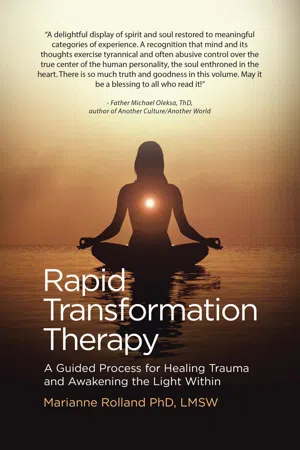
Rapid Transformation Therapy
A Guided Process for Healing Trauma and Awakening the Light Within
- English
- ePUB (mobile friendly)
- Available on iOS & Android
eBook - ePub
Rapid Transformation Therapy
A Guided Process for Healing Trauma and Awakening the Light Within
About this book
Information
Topic
Personal DevelopmentSubtopic
Self ImprovementChapter 1
The Genesis of Rapid Transformation Therapy
In 1977 I was twenty-four years old, a social worker living and working in rural Alaska Native villages. I lived alone in an isolated cabin with no running water. Outside temperatures sometimes dropped to 60 degrees below zero. My assignment was to provide comprehensive social services to eight villages and two larger communities, all linked by a regional hub road system.
My training provided me with the skills to be a good listener, to have compassion for others’ experiences and points of view without judgment, to reach out to others who were suffering, and to seek potential resources. To do all of that, I had to be willing to knock on the doors of total strangers in a culture foreign to my own life experience.
Soon, I realized I was a welcomed guest. My first friend was Elizabeth, an elder within the community. As we sat at her kitchen table sipping hot tea and nibbling on pilot bread crackers, she poured her heart out to me in her broken English. She told me horrific stories of human cruelty as she shared the hurts and suffering of her children, grandchildren, and great-grandchildren. “Drinking caused all of the bad things that people do to each other,” she told me.
Despite her emotional pain I also sensed her hope, her inner calm, and the belief that things would get better. As trust was nurtured between us and our hearts bonded, we became a team working together for the betterment and healing of the community.
I soon met more elders and became overwhelmed with the depth of their grief and suffering. I recognized their desperation and yet sensed the wisdom among these people. The elders repeatedly expressed gratitude for the opportunity to be heard and stressed that life in the villages had become imbalanced. They wanted the pain to end, and so did I.
I wasn’t aware then that the majority of the people in the villages were suffering from repressed trauma and post-traumatic stress disorder (PTSD). I also wasn’t aware that their stories were activating repressed feelings within my own psyche and body.
Nothing in my formal education had adequately prepared me to work with emotional trauma, so I returned to the University of Washington to earn master’s and doctorate degrees in social work. When it came time to complete my dissertation project, I was drawn again to the elders to gain a deeper understanding of their historical perspective on human traumas and traditional ways of healing. The elders, who are considered the wisdom-keepers for their tribes, repeatedly gave me the message that healing is only possible if you include the dimension of spirit. A middle-aged man trained in the traditional methods explained it this way:
“In the old days, everything was in balance. Everything was considered through a spiritual lens or realm. The medicine man, shaman, or sleep doctor was at the center of keeping things in balance. It was a whole and balanced system and it was highly spiritual. Each person learned how they were to be, to interact within that well-defined system.”
In traditional Native American communities, daily rituals and ceremonies were practiced to help maintain that balance. Everybody watched out for everyone else’s well-being. The elders also told me that “true healing comes from within.” I was intrigued by the concept of healing from within, and yet, I couldn’t find anyone to show me how to do it. I sensed that the elders knew, yet bringing long-forgotten traditional practices into the modern world was difficult. They all spoke in broken English, and they thought primarily in their Native language.
Despite the language barrier, I witnessed my elder friends releasing intense emotional pain. Even though they were isolated and blocked from using their traditional practices to ease suffering in the larger community, they allowed for the flow of great emotional energy in themselves, with me as their witness. They taught me the value of being present, and the power of having human witness to our pain and deepest suffering. I was honored and moved to the core of my being.
This experience planted a seed within me about what we all might need in order to heal our emotional pain. The concept of “balance” within the individual, the family, and the community became a guide for me as I gathered elements of what eventually became a very specific healing process.
Healing PTSD Is Possible
“I do not view post-traumatic stress disorder as pathology to be managed, suppressed, or adjusted to, but the result of a natural process gone awry. Healing trauma requires a direct experience of the living, feeling, knowing organism.”
—Peter A. Levine
Twenty years later, in 1997, my husband, Floyd—himself an Alaska Native—returned home after attending a workshop in Seattle with a national expert on healing the family. A Vietnam veteran and survivor of childhood neglect and sexual abuse, Floyd asked this expert, “Is there a cure for PTSD?”
Without hesitation, the expert said, “No, there is no cure. You just have to learn to live with it.”
Floyd looked at the man in shock. My husband had carried so much hope that one day, he would achieve peace within himself. Those words—“there is no cure”—devastated him.
When he came home and shared the story with me, I felt my body tighten and begin to shake. “He is dead wrong!” I blurted out angrily, “There is a cure for PTSD! I know there is!” Partially as a result of what I had experienced in the villages during my years of social work, my inner knowingness screamed that it couldn’t possibly be true that there was no cure. So I trusted that the cure did exist, and I set a clear intent to discover “the way.”
Two months later, I met a woman who was practicing a way of healing from the inside out. This teacher showed me that to heal trauma and restore balance to our beings, we must connect with the place inside of us where we most deeply suppress our pain.
We access those repressed core emotions through our breath. With focused practice, I came to understand that there was a way anyone could access deep emotions as I had watched the elders do so many years before. I became passionate about my discovery. I wanted to help the whole world heal.
I started with my immediate family, including myself. We had all experienced our share of trauma, and I finally began to see why the pain of the people I counseled as a social worker had activated so much of my own repressed inner pain. At last, a way to truly heal from within had been revealed, and I knew I would be working with this method for the rest of my life.
Fast-forward to 2014. Floyd, our dedicated team of facilitators, and I have witnessed hundreds of people transform their lives. We have spent the past eighteen years expanding the process of accessing core emotions through the breath into a comprehensive emotional healing process that we have come to call “Rapid Transformation Therapy” or “RTT.” In addition to this breath-work, RTT also draws upon wisdom from my elder teachers, including Grandmother Berniece Falling Leaves, Rita Blumenstein, and Martin High Bear, and methodologies from across a variety of disciplines including social work, regression therapy, energy medicine, traditional Western therapy, and both indigenous and Eastern practices.
With the aim of restoring balance, we have discovered repeatedly that unlocking emotional energy in the human body and allowing it to release will diminish PTSD symptoms and pain—both physical pain and emotional pain. This is as true for war veterans and those who have acute sympt...
Table of contents
- Rapid Transformation Therapy
- Copyright
- Disclaimer
- Contents
- Prologue: A White Raven Invitation
- Chapter 1: The Genesis of Rapid Transformation Therapy
- Chapter 2: Defining RTT as a Method of Recovery
- Chapter 3: Understanding Emotional Energy—A Journey to the Core of Your Being
- Chapter 4: Participatory Soul Retrieval
- Chapter 5: RTT for PTSD, Emotional Trauma, and Abuse
- Chapter 6: RTT for Addictions and Their Aftermath
- Chapter 7: Caretakers Discover the Benefits of RTT
- Chapter 8: Physical Symptoms Shift and Heal
- Chapter 9: Understanding and Clearing Energy Attachments
- Chapter 10: Maintaining a Transformed State of Inner Peace
- Chapter 11: Tips for Practitioners and Individuals Who Want to Try RTT
- Chapter 12: Healing Our Selves to Contribute to Healing the World
- Appendix A: RTT’s Connection to Other Treatment Modalities/Theories
- Appendix B: Floyd’s White Raven Story
- Appendix C: A Reflection From an RTT Participant
- Appendix D: White Raven Center Tool Kit
- Appendix E: Recommended Reading List
- Appendix F: Acknowledgements
- Endnotes
Trusted by 375,005 students
Access to over 1.5 million titles for a fair monthly price.
Study more efficiently using our study tools.
Frequently asked questions
Yes, you can cancel anytime from the Subscription tab in your account settings on the Perlego website. Your subscription will stay active until the end of your current billing period. Learn how to cancel your subscription
No, books cannot be downloaded as external files, such as PDFs, for use outside of Perlego. However, you can download books within the Perlego app for offline reading on mobile or tablet. Learn how to download books offline
Perlego offers two plans: Essential and Complete
- Essential is ideal for learners and professionals who enjoy exploring a wide range of subjects. Access the Essential Library with 800,000+ trusted titles and best-sellers across business, personal growth, and the humanities. Includes unlimited reading time and Standard Read Aloud voice.
- Complete: Perfect for advanced learners and researchers needing full, unrestricted access. Unlock 1.5M+ books across hundreds of subjects, including academic and specialized titles. The Complete Plan also includes advanced features like Premium Read Aloud and Research Assistant.
We are an online textbook subscription service, where you can get access to an entire online library for less than the price of a single book per month. With over 1.5 million books across 990+ topics, we’ve got you covered! Learn about our mission
Look out for the read-aloud symbol on your next book to see if you can listen to it. The read-aloud tool reads text aloud for you, highlighting the text as it is being read. You can pause it, speed it up and slow it down. Learn more about Read Aloud
Yes! You can use the Perlego app on both iOS and Android devices to read anytime, anywhere — even offline. Perfect for commutes or when you’re on the go.
Please note we cannot support devices running on iOS 13 and Android 7 or earlier. Learn more about using the app
Please note we cannot support devices running on iOS 13 and Android 7 or earlier. Learn more about using the app
Yes, you can access Rapid Transformation Therapy by Marianne Rolland in PDF and/or ePUB format, as well as other popular books in Personal Development & Self Improvement. We have over 1.5 million books available in our catalogue for you to explore.