- English
- ePUB (mobile friendly)
- Available on iOS & Android
eBook - ePub
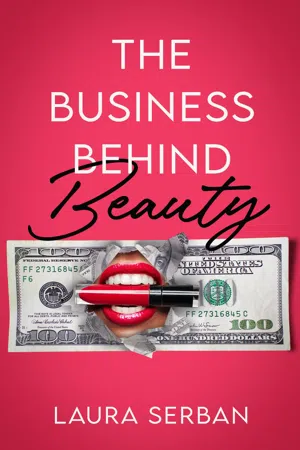
The Business Behind Beauty
Information
Part I
Laying the Foundation
Chapter 1
The Evolution of the Beauty Industry
One hundred sixty-nine billion.
That is the number of views that beauty-related content on YouTube generated in 2018 alone. Two years prior, when the boom of YouTube cosmetics videos began in earnest, the amount was fifty-nine billion. In 2010, it was a mere five billion.6
Before the 2010s, women who sought beauty products were typically constrained in both options and knowledge. Consumers were left to their own devices at drugstore retailers, or they depended on makeup counter employees at department stores to explain the function of products and the techniques needed to use them. Women were usually loyal to a small number of beauty companies, especially when they ventured into the luxury category.
With the invention of YouTube in 2005, beauty enthusiasts no longer had to rely on company employees, books, or magazines to learn how to paint their faces. YouTube ushered in an Information Age of the beauty industry, creating a beauty community that has become the bedrock of the beauty industry.
This community is spearheaded by beauty influencers who assume the role of a caring older sibling, best friend, or mentor. Early influencers like Michelle Phan, Marlena Stell, Jackie Aina, Patrick Starrr, Tati Westbrook, and NikkieTutorials created blueprints for teaching beauty techniques while simultaneously fostering a sense of friendship with their subscribers.
When influencers sit in front of their cameras and record videos for millions of young fans, they share not only product recommendations but also the private details of their lives. Their audiences, predominantly comprised of Generation Z and Millennials, become deeply devoted to hearing their perspectives, sharing their experiences, and vicariously living through their videos.
Certainly, the link between influencers and viewers is an example of a parasocial relationship, a one-sided relationship in which one person invests emotions while the other is unaware of the first’s existence.7 This kind of connection is typically associated with celebrities and their fans. However, influencers are unlike celebrities in one vital way: they routinely share intimate parts of their lives with their audiences. Their public personas are usually not polished and controlled by publicists, and as a result, viewers see their raw and unfiltered emotions.
Few other industries have had such extensive and influential communities built around them. In fact, the beauty community is omnipresent for many young people. The influencers we follow and support on these platforms permeate our daily lives. From sunup to sundown, their content is free and easily accessible. They cheer us up, share products with us, teach us makeup skills, and provide a haven from the world around us. They inspire us to be creative and confident. They amuse us with their publicized personal lives, which often provide the fodder for scandals that fascinate the internet. They remind us that we are not alone.
The creation of Instagram in 2010 further expanded this capacity to connect and share knowledge with millions of other beauty enthusiasts.
As YouTube influencer Jaclyn Hill declared in an interview with Refinery29, “In the past, we had the greats like Kevyn Aucoin. They wrote books, and you went to Barnes & Noble and you got the books and that was it—you had your fifty pages, and you’re done. Now you have these artists that are doing celebrities and runway and Fashion Week—the top people in the world—[and they’re] right there on Instagram.”8
Artists were not the only ones who took advantage of the platform. Led by an entrepreneurial spirit, indie companies that are independent of large conglomerates began to spring up and achieve cult followings on Instagram without spending money on traditional advertising. The platform provided a new sales channel, enabling companies to treat their feed like a virtual store in which they showcase each product and how to use it. Rather than invest in brick-and-mortar stores, indie companies embrace e-commerce and social media to directly connect with Generation Z and Millennials.
Now, the consumer is the expert and makes her own informed choices from a marketplace of seemingly endless options.
According to Tarang Amin, CEO of e.l.f. Beauty, “The internet has become the true equalizer.” His company was founded online in 2014 with the mission of offering affordable cosmetics that perform to the standard of professional grade products. Its success stems in part from consumers’ increased willingness to shop across segments. “They are just as likely to have a Chanel item as an e.l.f item,” Tarang asserted in The Wall Street Journal.9
Even brick-and-mortar retailers like Sephora and Ulta Beauty are taking advantage of this new age of consumers as the “experts.” They put out testers for each product, allowing customers to feel the consistency of the formula and to see the color applied on their skin. Employees are available to provide guidance, but many customers have already read or watched online reviews of the products that they are interested in. They enter the store knowing exactly what to buy. After all, influencers are continuously evaluating each product that is being released.
The opinions of YouTube influencers carry significant weight among young viewers. Negative reviews that target poor product quality, lack of shade inclusivity in complexion ranges, and questionable actions of CEOs have destroyed the reputation of many beauty companies. Some influencers have decided to boycott certain companies altogether, and their subscribers have followed along. Even companies owned by influencers-turned-CEOs are not safe from the “cancel culture” that ignites mass boycotting.
Cancel culture is also spurred by “drama channels,” or YouTube channels dedicated to reporting on scandals among influencers or between influencers and companies. Their investigative pieces influence public opinion and provide a platform for disgruntled consumers to voice their concerns. Many drama channels, much like influencers, serve as a sort of lever of accountability in the industry.
One instance of cancel culture was comically named Dramageddon, which is a reference to the Bible’s Armageddon, the last battle between the forces of good and evil. Dramageddon began in 2018 as a squabble within a friend group of prominent influencers, but it deteriorated into depravity when Twitter users discovered old, racist tweets from some of the influencers. Laura Lee received the brunt of the “cancelling” when she posted an apology video that was incoherent and appeared disingenuous. She immediately lost more than half a million subscribers, and cosmetic companies that were working with her ended the relationship. Laura’s YouTube channel, which was acquiring well over one hundred thousand new subscribers monthly before Dramageddon, has barely gained any since.10
On the other hand, the beauty community has a tremendous power to uplift people. One such example appears in the form of supporting companies founded by a person from a marginalized group. YouTuber Jackie Aina has created makeup tutorials in which she challenges herself to use only products from women-owned companies, black-owned companies, and Muslim-owned companies. Videos containing only products from Latina-owned companies are also popular. Posts similar to these exist across all platforms, and they serve as a means of spotlighting founders who are underrepresented in business.
When I interviewed Kiarie Mumbi, a biology major and pre-medicine student at Georgetown University, he shared the influence that this kind of advocacy has had on his own purchasing decisions: “I began to use hair products from a company named Jamaican Mango and Lime after seeing Instagram posts urging people to support black-owned businesses. I think that it is important to uplift founders who are creating wonderful products but who do not get the exposure that they deserve.”
This is the atmosphere of beauty today.
The advent of social media has made it possible to directly access millions of consumers who are ready to...
Table of contents
- Introduction
- Part I. Laying the Foundation
- Part II. Examining the Visionaries
- Part III. Anticipating the Future
- Conclusion
- References
- Acknowledgements
Trusted by 375,005 students
Access to over 1.5 million titles for a fair monthly price.
Study more efficiently using our study tools.
Frequently asked questions
Yes, you can cancel anytime from the Subscription tab in your account settings on the Perlego website. Your subscription will stay active until the end of your current billing period. Learn how to cancel your subscription
No, books cannot be downloaded as external files, such as PDFs, for use outside of Perlego. However, you can download books within the Perlego app for offline reading on mobile or tablet. Learn how to download books offline
Perlego offers two plans: Essential and Complete
- Essential is ideal for learners and professionals who enjoy exploring a wide range of subjects. Access the Essential Library with 800,000+ trusted titles and best-sellers across business, personal growth, and the humanities. Includes unlimited reading time and Standard Read Aloud voice.
- Complete: Perfect for advanced learners and researchers needing full, unrestricted access. Unlock 1.5M+ books across hundreds of subjects, including academic and specialized titles. The Complete Plan also includes advanced features like Premium Read Aloud and Research Assistant.
We are an online textbook subscription service, where you can get access to an entire online library for less than the price of a single book per month. With over 1.5 million books across 990+ topics, we’ve got you covered! Learn about our mission
Look out for the read-aloud symbol on your next book to see if you can listen to it. The read-aloud tool reads text aloud for you, highlighting the text as it is being read. You can pause it, speed it up and slow it down. Learn more about Read Aloud
Yes! You can use the Perlego app on both iOS and Android devices to read anytime, anywhere — even offline. Perfect for commutes or when you’re on the go.
Please note we cannot support devices running on iOS 13 and Android 7 or earlier. Learn more about using the app
Please note we cannot support devices running on iOS 13 and Android 7 or earlier. Learn more about using the app
Yes, you can access The Business Behind Beauty by Laura Serban in PDF and/or ePUB format, as well as other popular books in Business & Consumer Behaviour. We have over 1.5 million books available in our catalogue for you to explore.