eBook - ePub
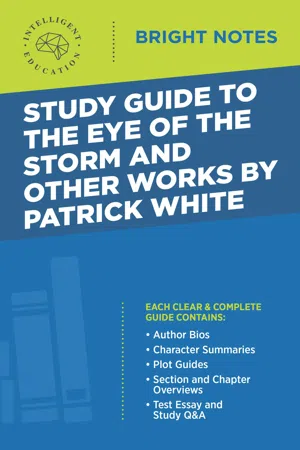
Study Guide to The Eye of the Storm and Other Works by Patrick White
- English
- ePUB (mobile friendly)
- Available on iOS & Android
eBook - ePub
Study Guide to The Eye of the Storm and Other Works by Patrick White
Trusted by 375,005 students
Access to over 1.5 million titles for a fair monthly price.
Study more efficiently using our study tools.
Information
Topic
Study AidsSubtopic
Study Guides
INTRODUCTION TO PATRICK WHITE
NOTE TO THE STUDENT
In this Critical Commentary, Professor Herbert Reaske aims to enhance your appreciation of the fiction of the great Australian writer, Patrick White. But Professor Reaske’s discussion will make little sense to you unless you are already familiar with White’s novels. Throughout his discussion, Professor Reaske assumes that it will prompt you to refer back continually to the original texts. In the United States, these are available in hardcover from Viking Press and in paperback from Avon Books.
------The Editors
PATRICK WHITE
Patrick White was awarded the Nobel Prize for Literature in 1973. His latest novel, The Eye of the Storm, had recently been published. Because of the high quality of the author’s earlier books, it was widely and fully reviewed. There was much to praise but sometimes there were qualifications, particularly in Australia and America. The English were more enthusiastic. Even so The Eye of the Storm did not reach the best-seller lists until after the announcement. Suddenly the public wanted to know more about the author. Many had read perhaps one of his earlier books. What were the others? The second-hand book dealers were soon cleaned out. Who was Patrick White?
THE MAN
Many years ago White’s grandfather had migrated to Australia. The family had become successful ranchers and property owners. They had money. When his father and mother were on a trip back to England in 1912, Patrick was born. He was still a baby when they returned to their native land. Patrick’s childhood was spent there until he was thirteen when he was sent to England to be “ironed out.” He has since said that the four years in the public school where he was enrolled were the most miserable of his life. In late adolescence he returned to Australia and became a “jackaroo” or ranch hand among the soft rolling hills behind the populated sea coast. At twenty he was a restless young man and made another trip to England. He read history at Cambridge and became expert in French and German. Afterwards he spent some time in London. He lived with literary people, painters, and actors. He wrote reviews and published a slim volume of poetry. By 1941 two novels had come out and were heralded as “promising.”
World War II intervened. He became an intelligence officer assigned to the Middle East. The war left Europe, it seemed to him, physically and intellectually barren. Even London which was trying to make a comeback as a center for the arts was uninspiring. He travelled much on the continent, particularly in Germany. Once he went so far as to make a trip across the United States. Back in London he wrote The Aunt’s Story, a novel that begins in Australia, climaxes in Europe, and ends in the United States. It was published in England, Canada, and the United States, but not in Australia until many years later. At about this time White decided if he was to continue to develop as a novelist he must return to Australia. He was determined to write an all-Australian novel.
White went back to Sydney and has stayed there ever since except for brief trips abroad. With a friend he first bought a house some miles out of the city. They did some farming, raised dogs, and sold flowers. Meanwhile White continued to write and Sydney to expand until his homestead was fronted by a busy, traffic-grinding thoroughfare. Patrick White then packed his books and his paintings, many of his own and more that he had acquired in his effort to sponsor modern art in Australia. He moved back into town in a large Edwardian house, such as those for which Sydney is still famous. He likes the neighborhood and stays pretty much at home.
THE MAN’S ACHIEVEMENT
Because of his many novels there has become what is known as White’s canon. In music a canon is a motif often repeated with variations; White has such a motif running through all his work. To simplify dangerously, it may be stated as the loneliness of all men in their attempts to communicate completely with others. In every man there is always something withheld or unrecognizable. Each of White’s books contains at least one lonely person. In each book the variations are more important. Each protagonist appears in a different setting at different times. Sometimes we have a man, sometimes a woman, yet each is revealed in his relationship with others. It was because of this that the Nobel Prize Committee spoke of White’s “epic psychological art.”
White’s first novel written entirely in an Australian setting and written by him in Australia, The Tree of Man, misfired with his compatriots. Insofar as it dealt with the opening up of the land, it was in the tradition of current or even earlier Australian fiction. A seemingly ordinary young couple move out of a town and settle, with much hard work, on a home of their own. But they turn out not to be so ordinary. On the other hand their children grow up to be quite ordinary and far from exemplary. Australians were not pleased with White’s picture of themselves.
The novels that seemed to satisfy them were usually of a journalistic type of realism stressing the virile pioneer, sometimes an ex-convict sent out from England, who struggled with the bush and the aboriginal bushmen. For all their realism, both whites and blacks were romanticized. The books were frequently historical in the Sir Walter Scott sense. The past was to shed light on the present.
White’s perspective on modern life differs in several fundamental elements from that of most contemporary novelists. He is conscious of changes in culture that are submerged by affluence and its fantasies. The confidence of society in itself, brought about by science and industrialization, is with White secondary to the lack of confidence, mainly self-confidence, to be found in individual men. Man’s limitations cannot be avoided when a writer examines man’s wholeness. White follows the lead that German psychologists presented as Gestalt theory. The French anthropologists more recently called it “total entity.”
White writes about people most novelists pass by. His characters only seem to be ordinary folk. Actually, they have a lively feeling about the mystery and complexity of life that is extraordinary. As we shall see when we examine the leading figures of his books, his characters are not developed; they are revealed.
Today Australians are being made to face a complex world for which their way of life and literature ill prepared them. This partially explains their hesitancy to accept Patrick White. Confused themselves, Australians have often found White’s characters confusing and unflattering. In novel after novel, White has extended the limits of accepted literary content. In particular, The Eye of the Storm is an enlarging and sometimes shocking experience. Remembering that Australia was once a subcontinent freed from a mainland, White borrows from the Rig Veda story the idea of the “freeing of the waters.” He sees Australia as “tomorrow land.”
INTRODUCTION TO THE EYE OF THE STORM
THEMES
The chief theme is the quest for the meaning of love, but not in the simple sense of “boy meets girl.” Instead love is revealed as a progression or becoming. It moves and grows from one universal aspect to another. There are four stages, each stage becoming a section of this twelve-chapter book. In using twelve chapters with four divisions, White shows his familiarity with the traditional literary structure of the quaternary. He had used it with success in earlier novels. In this one, the division into four is more subtle, one section flowing into the next in easy transition. It would seem, however, that each three-chapter block has a dominant symbol around which other lesser symbols are arranged. The lesser symbols often repeat in all of the sections. Each section may also be said to have a prevailing color. The minor colors are repeated in all sections because in a sense each character has an identifying color, regardless of varying degrees of tonal value. At the same time it must be remembered that Patrick White is not above inverting his symbols. He enjoys playing tricks on his readers in the same way that his characters sometimes subconsciously play tricks on themselves. In this way their characteristics emerge.
Among the novel’s many secondary themes, four stand out. All of these are aspects of the traditional motif of “sight.” The first of these deals with the struggle between honesty and dishonesty - how one sees oneself - how honest one is - how honest others are - the number of times the same person is honest compared with the times dishonest. The next concerns the method of sight. Mrs. Hunter is nearly blind. Her half-sight puts her in the category of the legendary. “Among the blind the one-eyed is king.” Here the queen dominates those with 20/20 vision. The third theme deals with the thin wavering line between reality and illusion. When is the illusory most real? This is the question begun by White in his early novel, The Aunt’s Story and explored by him ever since. White seems to be saying what the mind can see is real. The last quarter takes up the “Tiresias” theme. In Greek mythology Tiresias was blinded by Athene because he saw her in the bath. Later the goddess partially forgave him by bestowing upon him the power of “second sight,” the gift of prophecy. Unfortunately this ability has its dark side. It may be a curse. Accordingly, the theme widens into the concept that without evil there can be no good. It is necessary to be able to “see” evil. It must also be remembered that in one version of the Tiresias myth the soothsayer was first transformed into a woman then back into a man. Thus the Tiresias good-and-evil motif is tied into the main theme of love and love is always blind.
Other lesser themes include the Phoenix myth, the Vernal Equinox, fertility, the renewal in Passover and Easter, the Promethean myth of man against God, the story of Adam who carried Eve within his rib, the story of the Grail, and many other ancient themes in modern dress. White’s use of the tried and true archetypes is not stale because he often inverts or parodies them imaginatively. Through them we can absorb more and more of what this novel can teach us.
SYMBOLS
Words are symbols. Just as in mathematical games, we “let x” stand for something, usually an unknown quantity, words stand for something - things, or functions, animate, or inanimate - in many categories themselves all named and symbolic. It is a great game and Patrick White is a professional game player. All in fun we take games seriously. White frequently uses x to express y - which is metaphor the use of one word to express another. Words are not used for words’ sake but to brighten intelligibility. Words don’t dress up thought but are co-efficients of thought. This multi-functional mode of expression transmits experience economically. A secondary layer of language penetrates the reader’s consciousness.
Like any artist, trying to create a structure, and he conceives the novel as a structure, White is both a problem solver and a presenter of new problems which demand solution. He is among those who react to the problems of our times in an entirely personal way. In speaking through the mouths of his characters he is able to avoid making judgments. He condemns no one, not even those he satirizes as the living dead - the unaware. His sense of humor is never far from the surface. Sometimes we feel he plays a version of Blindman’s Bluff. He follows Wittgenstein in making a distinction between “spiel,” playing, and “ernst,” playing a game. Playing a game involves rules which in turn suggest the possibility of cheating. As White’s words break many grammatical rules, so his characters can be caught cheating. Perhaps this is what makes them human. But let it be said that though White plays with words, he never cheats his readers. We can trust him to “tell it like it is,” humorously but not sentimentally.
THE EYE OF THE STORM
TEXTUAL ANALYSIS
CHAPTER ONE
PROGRESSION OF STORY
The prevailing symbol of Chapter One is the mirror. Those of us who remember Nathaniel Hawthorne’s Scarlet Letter know that the mirror symbol is not new. Yet how different is the great sun of a mirror that White centers in the rosewood headboard of Mrs. Hunter’s great bed. She knew how it and the room’s many other mirrors annoyed the visitors to her sick room. And let us not forget the partly covered bed pan with the glare shining on its immaculate surface.
REFLECTIONS
The glimpses that we get by way of introduction to the novel’s leading characters are passing but revealing reflections. They appear with what the portrait painter, Van Gogh, called “terrifying lucidity.” When the night nurse tilts the looking glass for Elizabeth to have a look at herself, she is glad her patient has dim eyes. In this one bit of opening action, we learn several things with immediacy; Mrs. Hunter is vain, she deceives herself, knows she does upon reflection, and that the nurse, Marie de Santis is sympathetic. A few pages later when the nurse descends in the lower caverns of the house to get some fresh water (itself a symbol), she passes a great gilded mirror. To get away from what she sees she steps into the drawing room where the family portraits hang - an artist’s reflection of an earlier time. Here we see a youthful, beautiful Mrs. Hunter in evening dress with diamonds on her shoulders and wrists. In an almost unbelievably short time White has merged the past with the present. We learn not only more about the sick old woman upstairs but something of her two children with whom she was painted. We see these two as “then” before we see them as “now.” The little girl, whom the nurse was soon to meet as the Pr...
Table of contents
- Front Cover
- Title Page
- Copyright Page
- Contents
- 1) Introduction to Patrick White
- 2) Introductionto The Eye of the Storm
- 3) Textual Analysis
- 4) Introduction to Voss
- 5) Textual Analysis
- 6) The Aunt’s Story
- 7) The Tree of Man
- 8) Riders in the Chariot
- 9) The Solid Mandala
- 10) The Vivisector
- 11) Questions and Answers in Outline Form
- 12) Bibliography
Frequently asked questions
Yes, you can cancel anytime from the Subscription tab in your account settings on the Perlego website. Your subscription will stay active until the end of your current billing period. Learn how to cancel your subscription
No, books cannot be downloaded as external files, such as PDFs, for use outside of Perlego. However, you can download books within the Perlego app for offline reading on mobile or tablet. Learn how to download books offline
Perlego offers two plans: Essential and Complete
- Essential is ideal for learners and professionals who enjoy exploring a wide range of subjects. Access the Essential Library with 800,000+ trusted titles and best-sellers across business, personal growth, and the humanities. Includes unlimited reading time and Standard Read Aloud voice.
- Complete: Perfect for advanced learners and researchers needing full, unrestricted access. Unlock 1.5M+ books across hundreds of subjects, including academic and specialized titles. The Complete Plan also includes advanced features like Premium Read Aloud and Research Assistant.
We are an online textbook subscription service, where you can get access to an entire online library for less than the price of a single book per month. With over 1.5 million books across 990+ topics, we’ve got you covered! Learn about our mission
Look out for the read-aloud symbol on your next book to see if you can listen to it. The read-aloud tool reads text aloud for you, highlighting the text as it is being read. You can pause it, speed it up and slow it down. Learn more about Read Aloud
Yes! You can use the Perlego app on both iOS and Android devices to read anytime, anywhere — even offline. Perfect for commutes or when you’re on the go.
Please note we cannot support devices running on iOS 13 and Android 7 or earlier. Learn more about using the app
Please note we cannot support devices running on iOS 13 and Android 7 or earlier. Learn more about using the app
Yes, you can access Study Guide to The Eye of the Storm and Other Works by Patrick White by Intelligent Education in PDF and/or ePUB format, as well as other popular books in Study Aids & Study Guides. We have over 1.5 million books available in our catalogue for you to explore.