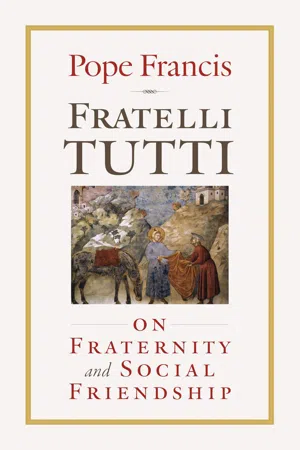
- English
- ePUB (mobile friendly)
- Available on iOS & Android
eBook - ePub
Information
Topic
Teología y religiónSubtopic
Religión1. “Fratelli tutti”.1 With these words, Saint Francis of Assisi addressed his brothers and sisters and proposed to them a way of life marked by the flavour of the Gospel. Of the counsels Francis offered, I would like to select the one in which he calls for a love that transcends the barriers of geography and distance, and declares blessed all those who love their brother “as much when he is far away from him as when he is with him”.2 In his simple and direct way, Saint Francis expressed the essence of a fraternal openness that allows us to acknowledge, appreciate and love each person, regardless of physical proximity, regardless of where he or she was born or lives.
2. This saint of fraternal love, simplicity and joy, who inspired me to write the Encyclical Laudato Si’, prompts me once more to devote this new Encyclical to fraternity and social friendship. Francis felt himself a brother to the sun, the sea and the wind, yet he knew that he was even closer to those of his own flesh. Wherever he went, he sowed seeds of peace and walked alongside the poor, the abandoned, the infirm and the outcast, the least of his brothers and sisters.
Without Borders
3. There is an episode in the life of Saint Francis that shows his openness of heart, which knew no bounds and transcended differences of origin, nationality, colour or religion. It was his visit to Sultan Malik-el-Kamil, in Egypt, which entailed considerable hardship, given Francis’ poverty, his scarce resources, the great distances to be traveled and their differences of language, culture and religion. That journey, undertaken at the time of the Crusades, further demonstrated the breadth and grandeur of his love, which sought to embrace everyone. Francis’ fidelity to his Lord was commensurate with his love for his brothers and sisters. Unconcerned for the hardships and dangers involved, Francis went to meet the Sultan with the same attitude that he instilled in his disciples: if they found themselves “among the Saracens and other nonbelievers”, without renouncing their own identity they were not to “engage in arguments or disputes, but to be subject to every human creature for God’s sake”.3 In the context of the times, this was an extraordinary recommendation. We are impressed that some eight hundred years ago Saint Francis urged that all forms of hostility or conflict be avoided and that a humble and fraternal “subjection” be shown to those who did not share his faith.
4. Francis did not wage a war of words aimed at imposing doctrines; he simply spread the love of God. He understood that “God is love and those who abide in love abide in God” (1 Jn 4:16). In this way, he became a father to all and inspired the vision of a fraternal society. Indeed, “only the man who approaches others, not to draw them into his own life, but to help them become ever more fully themselves, can truly be called a father”.4 In the world of that time, bristling with watchtowers and defensive walls, cities were a theatre of brutal wars between powerful families, even as poverty was spreading through the countryside. Yet there Francis was able to welcome true peace into his heart and free himself of the desire to wield power over others. He became one of the poor and sought to live in harmony with all. Francis has inspired these pages.
5. Issues of human fraternity and social friendship have always been a concern of mine. In recent years, I have spoken of them repeatedly and in different settings. In this Encyclical, I have sought to bring together many of those statements and to situate them in a broader context of reflection. In the preparation of Laudato Si’, I had a source of inspiration in my brother Bartholomew, the Orthodox Patriarch, who has spoken forcefully of our need to care for creation. In this case, I have felt particularly encouraged by the Grand Imam Ahmad Al-Tayyeb, with whom I met in Abu Dhabi, where we declared that “God has created all human beings equal in rights, duties and dignity, and has called them to live together as brothers and sisters”.5 This was no mere diplomatic gesture, but a reflection born of dialogue and common commitment. The present Encyclical takes up and develops some of the great themes raised in the Document that we both signed. I have also incorporated, along with my own thoughts, a number of letters, documents and considerations that I have received from many individuals and groups throughout the world.
6. The following pages do not claim to offer a complete teaching on fraternal love, but rather to consider its universal scope, its openness to every man and woman. I offer this social Encyclical as a modest contribution to continued reflection, in the hope that in the face of present-day attempts to eliminate or ignore others, we may prove capable of responding with a new vision of fraternity and social friendship that will not remain at the level of words. Although I have written it from the Christian convictions that inspire and sustain me, I have sought to make this reflection an invitation to dialogue among all people of good will.
7. As I was writing this letter, the Covid-19 pandemic unexpectedly erupted, exposing our false securities. Aside from the different ways that various countries responded to the crisis, their inability to work together became quite evident. For all our hyper-connectivity, we witnessed a fragmentation that made it more difficult to resolve problems that affect us all. Anyone who thinks that the only lesson to be learned was the need to improve what we were already doing, or to refine existing systems and regulations, is denying reality.
8. It is my desire that, in this our time, by acknowledging the dignity of each human person, we can contribute to the rebirth of a universal aspiration to fraternity. Brotherhood between all men and women. “Here we have a splendid secret that shows us how to dream and to turn our life into a wonderful adventure. No one can face life in isolation…We need a community that supports and helps us, in which we can help one another to keep looking ahead. How important it is to dream together… By ourselves, we risk seeing mirages, things that are not there. Dreams, on the other hand, are built together”.6 Let us dream, then, as a single human family, as fellow travelers sharing the same flesh, as children of the same earth which is our common home, each of us bringing the richness of his or her beliefs and convictions, each of us with his or her own voice, brothers and sisters all.
1. Admonitions, 6,1. English translation in Francis of Assisi: Early Documents, vol 1., New York, London, Manila (1999), 131.
2. Ibid., 25: op. cit., 136.
3. Saint Francis of Assisi, Earlier Rule of the Friars Minor (Regula non bullata), 16: 3.6: op. cit. 74.
4. Eloi Leclerc, O.F.M., Exil et tendresse, Éd. Franciscaines, Paris, 1962, 205.
5. Document on Human Fraternity for World Peace and Living Together, Abu Dhabi (4 February 2019): L’Osservatore Romano, 4-5 February 2019, p.6.
6. Address at the Ecumenical and Interreligious Meeting with Young People, Skopje, North Macedonia (7 May 2019): L’Osservatore Romano, 9 May 2019, p. 9.
Chapter One
Dark clouds over a closed world
9. Without claiming to carry out an exhaustive analysis or to study every aspect of our present-day experience, I intend simply to consider certain trends in our world that hinder the development of universal fraternity.
SHATTERED DREAMS
10. For decades, it seemed that the world had learned a lesson from its many wars and disasters, and was slowly moving towards various forms of integration. For example, there was the dream of a united Europe, capable of acknowledging its shared roots and rejoicing in its rich diversity. We think of “the firm conviction of the founders of the European Union, who envisioned a future based on the capacity to work together in bridging divisions and in fostering peace and fellowship between all the peoples of this continent”.7 There was also a growing desire for integration in Latin America, and several steps were taken in this direction. In some countries and regions, attempts at reconciliation and rapprochement proved fruitful, while others showed great promise.
11. Our own days, however, seem to be showing signs of a certain regression. Ancient conflicts thought long buried are breaking out anew, while instances of a myopic, extremist, resentful and aggressive nationalism are on the rise. In some countries, a concept of popular and national unity influenced by various ideologies is creating new forms of selfishness and a loss of the social sense under the guise of defending national interests. Once more we are being reminded that “each new generation must take up the struggles and attainments of past generations, while setting its sights even higher. This is the path. Goodness, together with love, justice and solidarity, are not achieved once and for all; they have to be realized each day. It is not possible to settle for what was achieved in the past and complacently enjoy it, as if we could somehow disregard the fact that many of our brothers and sisters still endure situations that cry out for our attention”.8
12. “Opening up to the world” is an expression that has been co-opted by the economic and financial sector and is now used exclusively of openness to foreign interests or to the freedom of economic powers to invest without obstacles or complications in all countries. Local conflicts and disregard for the common good are exploited by the global economy in order to impose a single cultural model. This culture unifies the world, but divides persons and nations, for “as society becomes ever more globalized, it makes us neighbours, but does not make us brothers”.9 We are more alone than ever in an increasingly massified world that promotes individual int...
Table of contents
- Fratelli tutti [1–2]
- Chapter One: Dark clouds over a closed world [9–55]
- Chapter Two: A stranger on the road [56–86]
- Chapter Three: Envisaging and engendering an open world [87–127]
- Chapter Four: A heart open to the whole world [128–153]
- Chapter Five: A better kind of politics [154–197]
- Chapter Six: Dialogue and friendship in society [198–224]
- Chapter Seven: Paths of renewed encounter [225–270]
- Chapter Eight: Religions at the service of fraternity in our world [271–287]
- A Prayer to the Creator
- An Ecumenical Christian Prayer
- Copyright
Trusted by 375,005 students
Access to over 1.5 million titles for a fair monthly price.
Study more efficiently using our study tools.
Frequently asked questions
Yes, you can cancel anytime from the Subscription tab in your account settings on the Perlego website. Your subscription will stay active until the end of your current billing period. Learn how to cancel your subscription
No, books cannot be downloaded as external files, such as PDFs, for use outside of Perlego. However, you can download books within the Perlego app for offline reading on mobile or tablet. Learn how to download books offline
Perlego offers two plans: Essential and Complete
- Essential is ideal for learners and professionals who enjoy exploring a wide range of subjects. Access the Essential Library with 800,000+ trusted titles and best-sellers across business, personal growth, and the humanities. Includes unlimited reading time and Standard Read Aloud voice.
- Complete: Perfect for advanced learners and researchers needing full, unrestricted access. Unlock 1.5M+ books across hundreds of subjects, including academic and specialized titles. The Complete Plan also includes advanced features like Premium Read Aloud and Research Assistant.
We are an online textbook subscription service, where you can get access to an entire online library for less than the price of a single book per month. With over 1.5 million books across 990+ topics, we’ve got you covered! Learn about our mission
Look out for the read-aloud symbol on your next book to see if you can listen to it. The read-aloud tool reads text aloud for you, highlighting the text as it is being read. You can pause it, speed it up and slow it down. Learn more about Read Aloud
Yes! You can use the Perlego app on both iOS and Android devices to read anytime, anywhere — even offline. Perfect for commutes or when you’re on the go.
Please note we cannot support devices running on iOS 13 and Android 7 or earlier. Learn more about using the app
Please note we cannot support devices running on iOS 13 and Android 7 or earlier. Learn more about using the app
Yes, you can access Fratelli Tutti by Pope Francis in PDF and/or ePUB format, as well as other popular books in Teología y religión & Religión. We have over 1.5 million books available in our catalogue for you to explore.