Though engineering design can tackle the world's most pressing challenges, engineering-related courses and experiences are often alienating, especially to people from minoritized groups. Literacies of Design: Studies of Equity and Imagination in Engineering and Making covers the latest pedagogical theories—as well as case studies and practical tips—to support diverse people in identifying problems and designing solutions through engineering and making.
Engineers tackle a range of problems, big and small, from climate change to viral transmission to improved handrails for persons with disabilities. Inclusion and equity efforts include not only preparing the next generation of engineers and makers, but also creating and fostering spaces where youth can express their ideas and bring forth their whole selves. This book offers theories and real-life examples for educators and practitioners at every level, from K–12 through higher education and beyond.
Multiliteracies and Design Practices in First-Grade Engineering
SALEM R. METZGER,1 ALISON K. MERCIER,2 AND HEIDI B. CARLONE3
1 University of North Carolina at Greensboro, 2 University of Wyoming, 3 Vanderbilt University
INTRODUCTION
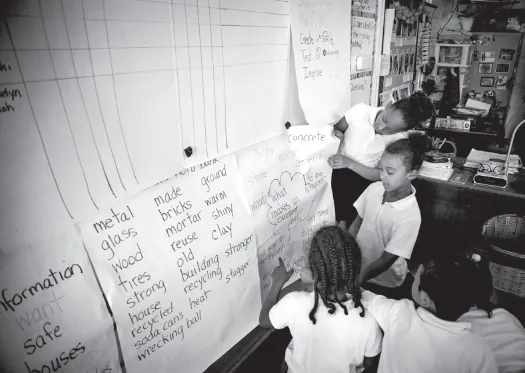
Imagine first graders clustered together, working on the rug, their desks, and tables. Students are engaged in conversation and sketching methods to build walls. Kayla stops sketching and inquires, “What did Mrs. Wallingdale call it?” Bibiana looks up from her design and reads from a sticky note, “The staggering method” (see Figure 1.1). Kayla responds, “I’m going to label my stuff, because if you label it, that’s a good idea and then we know our ideas!” Student-driven discussions occur across the classroom.
Students’ days and the content they learn are often compartmentalized by discipline and activity. Therefore, what “part” of the day are these children experiencing? The answer is both straightforward and fuzzy. In this classroom, students are in the “engineering design” portion of their day. However, these students and their teacher do not see sections of their schedule as disciplinary silos, with disciplines and skills taught in isolation. Elementary schools serving underprivileged youth allocate little time to teach science and almost no time to teach engineering because high-stakes testing focuses on mathematics and literacy (Jones et al., 2003).
FIGURE1.1 First graders engaged in multiliteracies pedagogies and the engineering design process. Credit: Tigermoth Creative.
This missed opportunity is unfortunate, as science and engineering design are content areas that bolster literacy achievement and learning, especially for students in class-rooms highly impacted by poverty (Feldman & Flores Malagon, 2017). We also view this gap in the elementary curriculum in high-needs schools as a form of injustice. We recognize that sociohistorical legacies of high-needs schools reproduce student subject positions celebrating compliance, decontextualized skills, and achievement on low-level, intellectually uninteresting tasks (Carlone et al., 2014; Haberman, 1991; Taylor, 2016). In such cases, students lack opportunities to engage in knowledge-building work in their classrooms (Miller et al., 2018). This is especially true of K – 1 students, who are often framed as deficit in skills, knowledge, preparation, and prior experience (Varelas et al., 2011). Dotson (2014) calls this a form of epistemic injustice, or patterns of exclusion, that hinder youths’ opportunities to shape knowledge production in the learning setting. Over time, epistemic injustice can affect students’ long-term perceptions of themselves as capable knowers and knowledge producers (Fricker, 2007; Miller et al., 2018). In this classroom, science and/or engineering were taught daily, with robust integration of literacy, mathematics, and social studies, eschewing the prototypical silo-based approach.
Engineering design instruction provides unique learning opportunities, nudging students out of comfortable, teacher-led strategies that emphasize one right answer to-ward instruction that privileges student talk, knowledge production, and collaboration. Engineering design can be integrated with science, mathematics, literacy, and social studies through providing many ways to creatively weave it into the school day and teaching students novel skills, such as experiencing productive failure (Lottero-Perdue & Parry, 2014), balancing risks and rewards, defining problems and solutions through design thinking, and collaboratively discussing and making decisions (Dym et al., 2005).
This study explored the presence of engineering design instruction and multiliteracies pedagogies in a first-grade classroom highly impacted by poverty. We examined the multiliteracies pedagogies and their power to reshape literacy, science, and engineering design curricula. Multiliteracies pedagogies, defined as the active meaning-making through multiple representations (Cope & Kalantzis, 2009), reshape traditional literacy instruction by expanding skills-based instruction to include students’ experiences and perspectives. Engineering design practices broaden the traditional elementary curriculum to emphasize collaboration, creativity, and inquiry. Therefore, finding multiliteracies pedagogies within engineering design practices, and also engineering design practices within multiliteracies pedagogies, begs the question: What do multiliteracies pedagogies in a first-grade classroom look like when integrated with engineering instruction? In this work, we drew on observations and interviews to investigate the convergence of multiliteracies pedagogies and engineering design practices as enacted and experienced by Mrs. Wallingdale and her first-grade students.
The Case for Engineering Design in Elementary Classrooms
The National Research Council’s (NRC) reviews of research (2000, 2007) showed disciplinary experience is important to integrating, since it integrates multiple types of interactions and disciplines. Process and content learning must proceed hand in hand. Limiting instruction to fact memorization can impede learning; over time, students need to develop a rich knowledge structure that approaches the knowledge structure of an expert. Such a knowledge structure is accomplished through engagement with complex ideas in discussion, reflection, investigation, and experimentation (NRC, 2000, 2007).
To solve engineering design problems, students think critically and creatively while testing materials, making plans, designing models, and testing solutions. Incorporating engineering design in the elementary curriculum provides students with ways of connecting, applying, and reinforcing knowledge in math, science, and literacy (Lachapelle & Cunningham, 2014).
Engineering design in elementary grades is multifaceted. It opens children’s minds to diversity and pervasiveness of technology and design and encourages attitudes and habits of mind that can lead students to think critically (Lachapelle & Cunningham, 2014). Children engaging in real-world engineering experiences have opportunities to make connections and practice skills across content areas. Engineering design can potentially transform the culture of traditional classrooms (Carlone et al., 2011). In some cases, students solve real-world problems, learn to collaborate with peers, engage in productive argumentation, work through failure, use data to inform design decisions, deepen science knowledge, and feel a genuine sense of accomplishment when their designs are successful (Cunningham & Carlsen, 2014).
Design Principles From an Engineering Mindset
Engineering design incorporates design thinking and practices. However, definitions of design abound. What does “design” mean in engineering and, even more importantly, in engineering practices in an elementary classroom? For this research, we used Dym and colleagues’ (2005) definition of engineering design: “Engineering design is a systematic, intelligent process in which designers generate, evaluate, and specify concepts for devices, systems, or processes whose form and function achieve clients’ objectives or users’ needs while satisfying a specified set of constraints” (p. 104). Here, engineering design is conceptualized as a thoughtful process, with many iterations of a design concept, making it a complex cognitive process for students.
There are many ways to characterize engineering design principles in an educational context. Table 1.1 summarizes engineering design principles highlighted in engineering education literature (Dym et al., 2005; Cunningham, 2018).
Multiliteracies
Multiliteracies, defined by the New London Group (1996), focus on representational modes more expansive than simply language. Multiliteracies focus on increasing local diversity and global connectedness, as effective citizenship and productive work require interactions using multiple languages and communication patterns. In a multiliteracies pedagogy, all forms of representation, including language and communication, are dynamic processes of transformation (Gee, 2000, 2012). Cope and Kalantzis (2000) asserted that all students, regardless of economic and racial status, have the right to multiliteracies pedagogies. In 2006, the New London Group reformulated the multiliteracies pedagogies to address related knowledge processes: experiencing, conceptualizing, analyzing, and applying (see Table 1.2). These four aspects of multiliteracies pedagogy are explained below.
TABLE1.1. Design Principles in Engineering Instruction
DESIGN PRINCIPLE
EXPLANATION
Tolerating ambiguity
There is more than one answer to questions and more than one possible solution to problems
Divergent–convergent thinking
Building up deeper reasoning by asking and thinking about simpler comprehension questions and ideas
Systems thinking
Thinking that incorporates reasoning through the uncertainty of a model or idea
Collaborative, team environment
Design and engineering work is recognized, celebrated, and taught as a team process with multiple social dimensions
Multiple languages of design and engineering
Different “languages” (verbal or textual statements, graphical representations, numbers, and functional features) are used to represent and communicate meaning
Open-ended problems
Design challenges and questions are open-ended, with more than one “correct” answer, and failure is valued for what it teaches
Scaffolded student work
Modeling and making explicit the practices of design thinking and engineering while assuming no previous expertise with materials, tasks, or language
We highlight ways multiliteracies pedagogies were used as tools in first-grade engineering to contest the sociohistorical legacy of skills-based instruction for culturally and economically diverse students.
Research Question
Frequently, in elementary classrooms, content instruction is relegated to book work, memorization, and recitation of facts. As such, we asked: What do multiliteracies pedagogies in a first-grade classroom look like when integrated with engineering instruction?
TABLE 1.2. Components of Multiliteracies Pedagogies
ULTILITERACIES PEDAGOGY
EXPLANATION
Experiencing known and the new
Experiencing the known includes reflecting on current knowledge, while experiencing the new includes immersion in new ideas
Conceptualizing
naming and with theory
Conceptualizing by naming includes comparing and categorizing information; conceptualizing with theory involves making generalizations and grouping information in interpretive frameworks
Analyzing
functionally and critically
Analyzingfunctionally involves reasoning, drawing conclusions, and establishing relationships; analyzing critically entails evaluations of perspectives and motives
Applying
appropriately and creatively
Applying appropriately involves the application of knowledge to real-world situations; applying creatively includes contributing fresh, innovative ideas
RESEARCH CONTEXT
Nestled within a low-income, urban neighborhood in a large, Southeastern city, Wexford Elementary School, “Home of the Vikings,” is comprised of diverse (29% Latinx and 59% Black) students, with 99.1% receiving free or reduced-priced lunch. We focused on Mrs. Wallingdale’s first-grade classroom. This class, reflective of the school demographics, included 15 students: three boys, 12 girls, nine African...
Table of contents
Cover Page
Copyright
Title Page
Contents
Introduction: Literacies and Design for Equity
1 “It’s Like a Rock Puzzle in a Wall”: Multiliteracies and Design Practices in First-Grade Engineering
2 Elementary Students’ Communicative Practices in the Engineering Design Process Across Materials and Modes
3 Amplifying a Student’s Voice: An Engineering Design Unit About Communication
4 Engineering Design in a Dual-Language Classroom
5 The Face-to-Face Language of Engineering Design Teams in Urban Elementary Classrooms
6 Answerability in Making Democratic Worlds: An Exploration of One Fifth-Grade Teacher’s Engineering Communication in Service of Dialogic Citizenship
7 Action Civics, Literacies, and Design: Transforming Community Spaces Through Engineering and Civic Action
8 Twinning Critical Community and Technical Literacies: Exploring Design Literacies Toward Equitable and Consequential Making and Engineering With Historically Marginalized Youth
9 “It Will Be a Symphony of Children”: Learning STEM Literacies Through Technologies of the Heart in Making Spaces
10 Make Some Noise: Teens Respond to Sound Pollution in a Community Problem-Solving Project
11 Designing for Justice in a School-Based Makerspace
12 Contortion and Contextual Literacy: How Low-Income, First-Gen Engineering Students Manage Relationships Among People, Texts, and Objects
13 Critical Literacies in Practice: Deconstructing Engineering Through an Engineering Social Justice Course
About the Contributors
Index
Trusted by 375,005 students
Access to over 1.5 million titles for a fair monthly price.
Study more efficiently using our study tools.
Frequently asked questions
Yes, you can cancel anytime from the Subscription tab in your account settings on the Perlego website. Your subscription will stay active until the end of your current billing period. Learn how to cancel your subscription
No, books cannot be downloaded as external files, such as PDFs, for use outside of Perlego. However, you can download books within the Perlego app for offline reading on mobile or tablet. Learn how to download books offline
Perlego offers two plans: Essential and Complete
Essential is ideal for learners and professionals who enjoy exploring a wide range of subjects. Access the Essential Library with 800,000+ trusted titles and best-sellers across business, personal growth, and the humanities. Includes unlimited reading time and Standard Read Aloud voice.
Complete: Perfect for advanced learners and researchers needing full, unrestricted access. Unlock 1.5M+ books across hundreds of subjects, including academic and specialized titles. The Complete Plan also includes advanced features like Premium Read Aloud and Research Assistant.
Both plans are available with monthly, semester, or annual billing cycles.
We are an online textbook subscription service, where you can get access to an entire online library for less than the price of a single book per month. With over 1.5 million books across 990+ topics, we’ve got you covered! Learn about our mission
Look out for the read-aloud symbol on your next book to see if you can listen to it. The read-aloud tool reads text aloud for you, highlighting the text as it is being read. You can pause it, speed it up and slow it down. Learn more about Read Aloud
Yes! You can use the Perlego app on both iOS and Android devices to read anytime, anywhere — even offline. Perfect for commutes or when you’re on the go. Please note we cannot support devices running on iOS 13 and Android 7 or earlier. Learn more about using the app
Yes, you can access Literacies of Design by Amy Wilson-Lopez,Eli Tucker-Raymond,Alberto Esquinca,Joel Alejandro Mejia in PDF and/or ePUB format, as well as other popular books in Éducation & Éducation multiculturelle. We have over 1.5 million books available in our catalogue for you to explore.