Illegitimate Freedom: Informality in Modernist Literature, 1900 - 1940 is the first study of informality in modernist literature. Differentiating informality from intimacy in its introduction, the book discusses the informal in relation with sensory experience, aesthetic presentation, ethical deliberation or action, and social attitudes within modernist works. It examines these works for particular nuances of the word "informality" in each of its chapters in the following thematic sequence: informality that offers humour, interpretive freedom, and promiscuity as counters to self-absorption in works by Virginia Woolf; rebuttals to male priorities in liberalism through "feminine informality" in several short stories by Katherine Mansfield; contempt for colloquialism and intimacy, tinged with class-anxieties and crises of attitude, in T. S. Eliot's poetry; resistance to disgust in James Joyce's novels; and the fusion of irreverence, protest, and praise in W. H. Auden's writings before 1940. The book's conclusion considers the risks of informality through a discussion of what it calls "inverted dignity." The theoretical aspects of the book offer insights into Lockean liberalism, the ethical dimensions of what Hélène Cixous termed "feminine writing," relations of sublimity and domesticity, Sigmund Freud's arguments on humour and melancholia, and recent affect theory's—as well as Immanuel Kant's and Friedrich Nietzsche's—views on disgust, linking these with modernism. This wide range of engagement makes this study relevant for those interested in literary studies, critical theory, and philosophy.
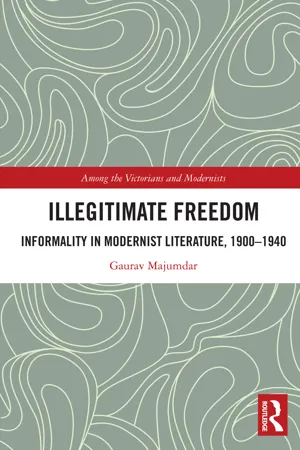
- 170 pages
- English
- ePUB (mobile friendly)
- Available on iOS & Android
eBook - ePub
About this book
Information
1 “Intoxicated Sense”
Humour and Promiscuity in To the Lighthouse and Orlando
DOI: 10.4324/9781003009894-1
In one of the many interruptions of her reverie, the narrator of Woolf’s “The Mark on the Wall” thinks, “And yet that mark on the wall is not a hole at all” (84). Who in the text has said that it was? No one identifies the mark as a hole, earlier in the text. In the face of that missing information, the narrative structure around this moment and the inferences that it invites violate linearity—this moment is responding to (and insinuating) a thought that the text transmits as fore-written, avant la lettre. To be legible within Woolf’s narrative, it requires an interpretive freedom and a freedom of engagement with the text, a kind of interpretive promiscuity: an analytical freedom of association.
Nevertheless, given its narrator’s specifically stated or clearly implied arguments, the text suspects whimsical free-association, at the same time. The mark on the wall interrupts fancy, as when it curtails the narrator’s projections of red knights and a red flag on a castle tower (83). In other words, within such a moment, the narrator’s shifting views of the mark produce flexible—but not indiscriminate—elaborations of the stated or clear arguments in the essayistic story. This flexibility produces and ironically depends upon incongruity, a sense of disjointedness that Woolf provides as a way out of moments of ethical impasse, emotional confusion, or interpretive frustration, taking “the mould of [a] queer conglomeration of incongruous things,” as Woolf puts it in “The Narrow Bridge of Art” (19–20). The staging of this solution provides a formal argument—an argument through form—in “The Mark on the Wall” that anticipates the subtle collaboration of incongruity with informality in To the Lighthouse and Orlando.
Promiscuities
Combining the informal with the incongruous in Woolf’s novels, promiscuity is a main resource for the “illegitimate freedom” that Woolf evokes in “The Mark on the Wall.” To the Lighthouse and Orlando echo such combination to assert arguments on various topics: a persistence of the past in later or current actions; incongruity as sign and resource for temporal, spatial, and psychological relations; informality as an engine of freedom; and the informal self as various iterations of the influences and actions of the past—as forms of difference that suggest the latter novel’s cosmopolitanism.
The Oxford English Dictionary offers the following definitions for the word “promiscuous”:
-
-
- Done or applied with no regard for method, order, etc.; random, indiscriminate, unsystematic.
- Of an agent or agency: making no distinctions; undiscriminating.
- spec. Of a person or animal: undiscriminating in sexual relations. Also (of sexual intercourse, relationships, etc.): casual, characterized by frequent changes of sexual partner.
- Consisting of assorted parts or elements grouped or massed together without order; mixed and disorderly in composition or character; (with plural noun) of various kinds mixed together. Now arch. and rare.
- Chiefly Grammar. Of common gender; of either sex, of both sexes. Cf. epicene adj. 1. rare. [Example:] 1878 L. Villari tr. P. Villari Life & Times Machiavelli (1898) I. iii. vii. 130[: “]There were three sexes, male, female and promiscuous.[”]
- Chiefly slang (depreciative). That forms part of a mixed or undifferentiated company.
Obs. - colloq. Casual, careless (cf. sense B. 2). Obs.
-
- adv. 1. = promiscuously adv. 1; indiscriminately; at random. Now rare (colloq. in later use).
- colloq. = promiscuously adv. 2; without ceremony; casually. Now rare.
The third sense given above is obviously germane to a discussion of gender and sexuality in Orlando—I will gesture to it, later. Here, instead, I will emphasize my ensuing complication of the fifth nuance of the word: I will argue that Woolf’s novels do indeed employ promiscuous effects, but often as the deliberate effects of a deceptive, ostensible casualness, rather than as unconsidered or negligent textual choices. These choices reflect Woolf’s critical ambivalence with casualness to signal her disagreements with hierarchization and formality. To discuss promiscuity in Woolf’s deployment of informality, I will mainly employ the senses of the word “promiscuous” in definitions A.I.c and 2 from the OED; the first, sexual: “Of a person or animal: undiscriminating in sexual relations. Also (of sexual intercourse, relationships, etc.): casual, characterized by frequent changes of sexual partner”; and the second, to do with composition and form: “Consisting of assorted parts or elements grouped or massed together without order; mixed and disorderly in composition or character; (with plural noun) of various kinds mixed together.”
Humour and Liberated Affective Expenditure in To the Lighthouse
The latter sense is evident in the third part of To the Lighthouse, when the artist Lily Briscoe’s sudden praise for Mr. Ramsay’s boots relieves their interaction of the oppressive, but unspoken, gambits for attention that the widower Ramsay directs towards Lily (153–4). Seeing Ramsay “bearing down on her” for attention and emotional succour, Lily wonders:
Surely, she could imitate … the self-surrender, she had seen on so many women’s faces[,] when on some occasion like this they blazed up—she could remember the look on Mrs. Ramsay’s face—into a rapture of sympathy[,] which, though the reason of it escaped her, evidently conferred on them the most supreme bliss.(150)
Soon after that thought, however, the narrative hints at her internalization of normative gendered expectations, as it presents her shame and panic through free indirect discourse:
A woman, she had provoked this horror; a woman, she should have known how to deal with it. It was immensely to her discredit, sexually, to stand there dumb. One said—what did one say?—Oh, Mr. Ramsay! Dear Mr. Ramsay! That was what that kind old lady who sketched, Mrs. Beckwith, would have said instantly, and rightly. But, no. They stood there, isolated from the rest of the world. His immense self-pity, his demand for sympathy poured and spread itself in pools at her feet, and all she did, miserable sinner that she was, was to draw her skirts a little closer round her ankles, lest she should get wet.(152)
Experiencing her reluctance as a sin here, Lily initially seeks an appropriately gendered response to Ramsay (“what did one say?”), but she casts off the burden. Instead of giving Ramsay the gushing concern that he desires, she offers him a banal compliment about a part of his clothing: “What beautiful boots!” (153). Marked by an almost-involuntary informality through a diversion of this psychic pressure, Lily’s blurted praise lays bare and transforms Ramsay’s emotional parasitism. She expects “complete annihilation” from “one of his sudden roars of ill-temper,” but Ramsay smiles, instead (153). Her praise for Ramsay’s boots jolts him out of the intense, self-pitying, but unspoken, calls for sympathy into gently ironic, humorous interaction with Lily. The informality implicitly compacted into this pivotal moment offers Lily relief from the pious emotional charity that Ramsay, in his invocation of such piety, initially expects as a feminine duty from her. The small, absurd, informal moment is an upheaval: It is the point where discursive pressure for propriety collapses.
This moment expands and refines analyses of the superego role as liberatory observer at humorous moments, as advanced in Sigmund Freud’s writings on humour, as well as Simon Critchley’s commentary on the economic structure of humour in Infinitely Demanding. In Jokes and Their Relation to the Unconscious (1905), Freud describes the relief that humour provides from “the cost of an economy of the feelings of piety” (286). Humour is, thus, a release of freed emotions or, in Freud’s phrase, “liberated expenditure” (Jokes, 292). According to Freud, it performs another important function: It is “a means of obtaining pleasure in spite of the distressing affects that interfere with it; it acts as a substitute for the generation of these affects, it puts itself in their place” (284). Lily’s reference to Ramsay’s boots deflates the demands on her to provide appropriately feminine substitutes for the sympathy that he formerly received from his wife. She eludes Ramsay’s call for the proper or normative response through a further substitution: Exchanging an expected, nourishing response for a banal compliment about Ramsay’s shoes, Lily’s focus on the shoes lightens the pious pressures of sorrow that Ramsay exerts in his call for care and, implicitly but liberatingly, profanes the almost-sacralized memory of Mrs. Ramsay that Ramsay evokes in service of his current need. This profanation is not voluntary: Lily does not plan to divert Ramsay jocularly, but she does make an incongruous substitution as per Freud’s mapping of the humorous process. While Lily does not intend humour in her perplexed search for a proper reply to Ramsay, the apparent absurdity of her response produces a humorous effect. The novel, rather than Lily, clearly recognizes an aspect of the production of humour that, in his recent book on humour, Terry Eagleton appreciatively locates in the following line from Mark Akenside’s “The Pleasures of the Imagination”: “Some stubborn dissonance of things combin’d” (68, my italics). Humour recognizes the persistence of the unwanted, but substitutes it with a dissonant response. Lily’s substitution of hyperbolic affirmation with a manifestly incongruous response relieves her of the emotional toll that the expected affirmation would take.
Freud suggests that the substitution in such situations is a gift of the super-ego. In his short essay “Humour” (1927), he observes that, in humour, the humorist withdraws “the psychical accent” or larger psychological attachment from the ego and transposes it onto the super-ego, giving the super-ego expanded psychological control (430–1). Consequently, to “the super-ego, thus inflated, the ego can appear tiny and all its interests trivial,” so that “it may become an easy matter for the super-ego to suppress the ego’s possibilities of reacting” (431). Once “the subject suddenly hypercathects his super-ego and then, proceeding from it, alters the reactions of the ego[,]” the super-ego can perform its production of pleasure, despite circumstantial strains on the subject (432). As Freud explains it, this is as if the super-ego comforts the intimidated ego by saying, “Look! here is the world, which seems so dangerous! It is nothing but a game for children—just worth making a jest about!” (432–3). Humour, then, is the super-ego’s explanatory dismissal of vitiating facts. Pointing to humour’s antidotal capacities in Infinitely Demanding, Simon Critchley contends:
Humour has the same formal structure as depression, but it is an anti-depressant that works by the ego finding itself ridiculous. The subject looks at itself like an abject object and instead of weeping bitter tears, it laughs at itself and finds consolation therein.(81)
Critchley establishes this claim by pointing to the crucial argument in Freud’s “On Humour” on humour’s self-critical function, a product of super-ego’s view of the ego’s anxieties as trivial: “[I]n humour I find myself ridiculous and I acknowledge this in laughter or simply in a smile. Humour is essentially self-mocking ridicule” (Infinitely Demanding, 79). In the scene of “the blessed boots,” Lily Briscoe’s implicit self-mockery in her comment about the boots suggests both an appeal to, and defiance of, Mr. Ramsay’s demand. Lily’s self-ridiculing, nonsensical reply suggests her helpless confusion, but also, within it, her volition to disobey or even refuse Ramsay’s imposition of desire and power. As Freud admiringly warns in his essay, “Humour is not resigned; it is rebellious. It signifies not only the triumph of the ego but also of the pleasure principle” (429). The scene replies richly to Critchley’s question: “[M]ight there not be other ways of sublimating ethical experience than tragedy?” (78). Producing such sublimation after Ramsay turns to her for his emotional sustenance, Lily generously does not mention his need.
Freud clarifies the interpretive mechanics of joke-making when he says, “A joke is a playful judgment” (Jokes, 7). I mention this here to highlight that Woolf’s jokes and informal play in To the Lighthouse and Orlando assert judgments, often acerbic ones. However, in the humorous, apparently absurd exchange between Lily and Mr. Ramsay, these judgments are kind, and the kindness not reserved for one character. Lily’s choice prevents her own false and agonized deference to Ramsay, even as it keeps Ramsay from another’s dishonest affirmation.
The scene encapsulates Adam Phillips’s arguments in Going Sane, which imply that sanity is a form of kindness that prevents the humiliation of the self and the other.1
The “Random Moment”: Ecstasy, Informality, and Interpretive Freedom
Evoking the sacred ironically through the word “blessed,” Lily Briscoe’s phrase “blessed island of good boots” could be read, further, as a lighthearted outlet for her relief in the form of an ironic, ambiguous curse: a milder version of “damn,” “bloody,” or “fucking” as adjectives, if you will. This underscores not only the already-ample gender politics in the scene, but other political tensions that it constellates in its improprieties. As Caroline Levine writes, drawing on Jacques Rancière’s theories of aesthetic politics, “Political struggles include ongoing contests over the proper places for bodies, goods, and capacities” (3). Of course, within classical narrative conventions, these “proper places” have also have a temporal dimension: “bodies, goods, and capacities” must appear in persuasive, sound sequence. Gesturing to the temporal in The Edges of Fiction, Rancière himself identifies classical philosophy’s “major principle of fiction” to be the Aristotelian peripeteia “that inverts the expected effects of the causal chain” (115). This is because, for Rancière, the peripeteia cancels all prior events for the sake of a resolution and, in this sense, the “model driving it is that of construction bound for destruction” (115). He contends that modern fiction, in contrast, can be “most succinctly defined by the abolition of the peripeteia” (115). Borrowing a formulation from Erich Auerbach’s Mimesis to specify an instance of such abolition, Rancière declares the “random occurrence” or “random moment” to be “the principle of Virginia Woolf’s fiction” (115). The random occurrence, in Rancière’s reading, “dilates endlessly, and includes, virtually, every other time and place,” thus forming “a time of coexistence, overcome by the liberalness of space” (115). Randomness suggests thoughtless construction: The first definition of “informality” that I quote above from the OED is “Done or applied with no regard for method, order, etc.; random, indiscriminate, unsystematic.” However, in Woolf’s hands, it is the effect of randomness or informality in her portrayal of a moment that “dilates endlessly.” It is a complex mesh of sensation, memory, emotion, and time that produces a sense of the permeability or even collapse of formal or normative temporal boundaries at such moments.2 As Rancière helpfully adds:
The random moment, in reality, is not random. Most certainly it can be produced at any instant for any insignificant occasion. But it is also the decisive moment, the moment of turning that stands on the exact boundary between the nothing and the all.(136)
A clarification of this dense insight: Woolf includes a poignant instance of such a moment in the “Time Passes” section of To the Lighthouse when, describing the silent scene in the Ramsays’ empty living room, she writes:
light turned on the wall its shape clearly there seemed to drop into this silence, this indifference, this integrity, the thud of something falling.[A shell exploded. Twenty or thirty young men were blown up in France, among them Andrew Ramsay, whose death, mercifully, was instantaneous.](133)
The thud described before the bracketed narration has a sympathetic resonance: It echoes in the Ramsays’ home the sound of the bomb on the French warfront that kills Andrew, but Woolf does not specify its provenance or trajectory. The thud in the Ramsays’ house could mark the sound of something banal, such as a household object falling in the uninhabited space; the sound of every projectile falling in the history of global violence; merely a synaesthetic sonic effect, mingling with the light; or—given the uncertainty evoked by the qualifying word “seemed”—no sound at all. The sound gains its complex semiotic scope, precisely because, in Ranc...
Table of contents
- Cover
- Half-Title
- Series
- Title
- Copyright
- Dedication
- Contents
- Acknowledgments
- Introduction: Informality as Illegitimate Freedom
- 1 “Intoxicated Sense”: Humour and Promiscuity in To the Lighthouse and Orlando
- 2 Marking Absence: Mansfield’s Feminine Informality vs. Lockean Liberalism
- 3 Eliotic Contempt
- 4 Joyce’s Challenges to Disgust
- 5 “Inverted Hypocrisy”: Auden’s Informal Pedagogy
- Conclusion: Openness to Misreading: The Risks of Informality
- Works Cited
- Index
Trusted by 375,005 students
Access to over 1.5 million titles for a fair monthly price.
Study more efficiently using our study tools.
Frequently asked questions
Yes, you can cancel anytime from the Subscription tab in your account settings on the Perlego website. Your subscription will stay active until the end of your current billing period. Learn how to cancel your subscription
No, books cannot be downloaded as external files, such as PDFs, for use outside of Perlego. However, you can download books within the Perlego app for offline reading on mobile or tablet. Learn how to download books offline
Perlego offers two plans: Essential and Complete
- Essential is ideal for learners and professionals who enjoy exploring a wide range of subjects. Access the Essential Library with 800,000+ trusted titles and best-sellers across business, personal growth, and the humanities. Includes unlimited reading time and Standard Read Aloud voice.
- Complete: Perfect for advanced learners and researchers needing full, unrestricted access. Unlock 1.5M+ books across hundreds of subjects, including academic and specialized titles. The Complete Plan also includes advanced features like Premium Read Aloud and Research Assistant.
We are an online textbook subscription service, where you can get access to an entire online library for less than the price of a single book per month. With over 1.5 million books across 990+ topics, we’ve got you covered! Learn about our mission
Look out for the read-aloud symbol on your next book to see if you can listen to it. The read-aloud tool reads text aloud for you, highlighting the text as it is being read. You can pause it, speed it up and slow it down. Learn more about Read Aloud
Yes! You can use the Perlego app on both iOS and Android devices to read anytime, anywhere — even offline. Perfect for commutes or when you’re on the go.
Please note we cannot support devices running on iOS 13 and Android 7 or earlier. Learn more about using the app
Please note we cannot support devices running on iOS 13 and Android 7 or earlier. Learn more about using the app
Yes, you can access Illegitimate Freedom by Gaurav Majumdar in PDF and/or ePUB format, as well as other popular books in Letteratura & Critica letteraria. We have over 1.5 million books available in our catalogue for you to explore.