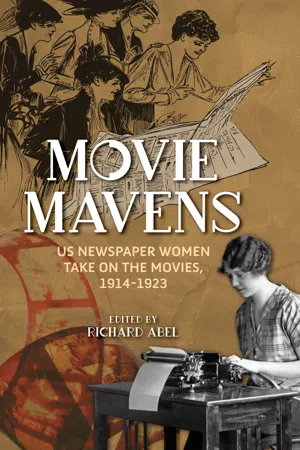
An invaluable collection of rare archival sources, Movie Mavens reveals women's essential contribution to the creation of American film culture.
- English
- ePUB (mobile friendly)
- Available on iOS & Android
eBook - ePub
About this book
During the early era of cinema, moviegoers turned to women editors and writers for the latest on everyone's favorite stars, films, and filmmakers. Richard Abel returns these women to film history with an anthology of reviews, articles, and other works. Drawn from newspapers of the time, the selections show how columnists like Kitty Kelly, Mae Tinee, Louella Parsons, and Genevieve Harris wrote directly to female readers. They also profiled women working in jobs like scenario writer and film editor and noted the industry's willingness to hire women. Sharp wit and frank opinions entertained and informed a wide readership hungry for news about the movies but also about women on both sides of the camera. Abel supplements the texts with hard-to-find biographical information and provides context on the newspapers and silent-era movie industry as well as on the professionals and films highlighted by these writers.
Information
Publisher
University of Illinois PressYear
2021Print ISBN
9780252086045
9780252043970
eBook ISBN
9780252052903
Subtopic
Film History & Criticism

Women Writers Lead the Way, 1914–1916
Before 1914 at least two women were among an equal number of men who signed newspaper columns devoted to the movies.1 For a brief time, between December 1911 and January 1912, Ona Otto wrote a page bannered “In the Land of the Photoplays and Players” in the San Francisco Bulletin.2 But she was a kind of flaneuse, contributing columns on everything from window shopping and gardens to automobiles and real estate for several months thereafter. The more important figure was Gertrude Price, who, from October 1912 to April 1914, wrote a frequent column, first called “The Movies,” for the Scripps-McRae newspaper chain, syndicated through the United Press.3 Promoted as a “moving picture expert,” she specialized in “personality sketches,” primarily of movie stars and especially young, single, independent women, some of them playing leading roles in westerns. Among those sketches, however, were interviews with filmmakers Alice Guy Blaché and Lois Weber, as well as scriptwriter Nell Shipman (who later would produce and direct her own films); and one of Price’s last columns encouraged readers to see “the movies as [a] great new field for women folk.”4 During the year and a half that her syndicated column appeared, Price likely was the signed newspaper writer most read by movie fans.
The period from 1914 through 1916 was marked by an explosion of pages and columns devoted to the movies across the country. Newspapers, from metropolitan areas to small towns, either assigned or hired at least a dozen male reporters to cover what had now become a major mass entertainment. Most of them served as editors or columnists of industry stories, star gossip, or fictional sketches: Gardner Mack of the Washington Times, Gene Morgan of the Chicago Herald, Britt Craig of the Atlanta Constitution, R. E. Pritchard of the New Orleans Item, George W. Stark of the Detroit News-Tribune, and N. D. Tevis of the La Crosse (WI) Tribune. Having relatively short tenures were James Warren Currie of the Chicago Examiner and Arthur C. Stolte of the Waterloo (IA) Reporter. Archie Bell and John DeKoven, one after the other, edited a special weekly supplement, the “Motion Picture Leader,” in Cleveland. In the Black press, Lester A. Walton had been contributing a movie column to the weekly New York Age since 1909, and Juli Jones urged other African Americans to “join the ranks of the moving picture business” in a rare 1915 article in the Chicago Defender.5 Four men, however, were known for their film reviews, including W. K. Hollander of the Chicago News, Richard F. Lussier of the Birmingham Age-Herald, and Philip H. Welch of the Minneapolis Tribune. The most important of all, however, was “Wid” Gunning of the New York Evening Mail, who left the newspaper in August 1915, eventually to edit Wid’s Daily, which soon turned into Film Daily.6
Strikingly, as if propelled by Price’s column on career opportunities for women, newspapers assigned or hired just as many female reporters and columnists to cover the movies. For a few exhausting months, Ruth Vinson wrote short reviews of as many pictures as she could “personally see” for the Cleveland Plain Dealer. Mary B. Leffler, the “circulation bragger” of the Fort Worth Star-Telegram’s “Sunday Sandwich,” edited a weekly Sunday page bannered “In the Photoplay World,” along with her daily “Flashes of Filmdom” column. Daisy Dean followed Price’s model in concocting a syndicated column of personality sketches, which the Central Press Association distributed in the Midwest. The most influential of these undoubtedly was Mae Tinee, who in early March 1914 began editing a weekly Sunday page titled “Right Off the Reel” in the Chicago Tribune. Much imitated, this page had a centered feature, “In the Frame of Public Favor,” with an exceptionally large publicity halftone (in a gilded frame) and profile of a current movie star supposedly chosen each week by readers. During this period, Mae Tinée served essentially as an editor and gossip columnist (and a recognized asset to the paper).7 She began writing a film review column for the Tribune in late 1916.8
Nine other women writers were important enough that selections of their work are reprinted in the pages that follow. Strikingly, only three of those appeared in newspapers outside the Midwest. One was Grace Kingsley, best known perhaps as a drama critic and interviewer for the Los Angeles Times. Another was the Film Girl, who penned a daily film review column for the Syracuse Herald. A third was Los Angeles publisher Charlotta Bass, who wrote and/or edited unsigned columns in the California Eagle, the leading Black newspaper on the West Coast. No fewer than four women besides Mae Tinée served as editors and columnists in three different Chicago newspapers, arguably making the city the initial center of newspaper film reviewing. Beginning in July 1914, Kitty Kelly, a major recent discovery, wrote trenchant daily film reviews and compiled rare censorship records for the Chicago Tribune, which promoted her in a large advertisement in April 1916. By early 1915 Louella O. Parsons was competing with Kelly with daily reviews, along with interviews, for the Chicago Record-Herald. At the same time, Mildred Joclyn began editing a movie page and writing columns for the Chicago Post; in late 1915 Oma Moody Lawrence replaced her as both editor and columnist. The last of these women was Dorothy Day, who, also in late 1915, was editing movie pages and writing review and gossip columns for the Des Moines Tribune.9 One other not included here, however, was Anita Maris Boggs, a social reformer who in 1914 promoted films as an innovative form of visual education in Pedagogical Seminary, a specialist scientific journal.10
The short introductions that precede the selections of each writer’s columns include more information.
Grace Kingsley (1873–1962)
Kingsley initially served as a secretary to superintendents in the Los Angeles school system, writing drama reviews and features on the side for the Los Angeles Herald. Hired by the Los Angeles Times in 1910, she became its motion picture editor in 1914. For the most part she contributed feature stories on the industry and conducted interviews with personnel at all levels. Her feature on Universal City in the summer of 1914 probably is the earliest description of the new studio facilities in a newspaper prior to its opening to tourists in the spring of the following year. Her column on the Los Angeles filmmaking scene in early 1915 is a rare survey of other major companies such as Famous Players–Lasky, Selig Polyscope Company, Bosworth Film, and Thomas H. Ince Film, as well as independents like D. W. Griffith of Reliance-Majestic Studios. Kingsley also wrote film reviews, such as the exemplary one on Lois Weber’s Shoes, in which she showed some ignorance of the conditions ensnaring the film’s shop girl heroine.11
“Where the Movies Are Hatched,” Los Angeles Times, August 23, 1914, 3.1, 3.
“Biggest Thrill Factory in the World”
“Universal’s New Picture Ranch”
“Zoo Where Animal Actors Stay”
A stock company of 2000 actors, the largest stock company in the world with a stage of 457 acres!
Universal City, the oddest city in the world, an Alice-in-Wonderland city, “where all the creatures do behave so queerly!”12
A vast stage is the new Universal City, nestling in the foothills edging San Fernando Valley, out there beyond Cahuenga Pass. The site is much larger than the old ranch studio at Oak Crest, and its ruler, political boss, Magician Merlin and General Pooh-Bah is Isadore Bernstein, manager of the Pacific Ocean studios of the Universal Film Company.13 Mr. Bernstein avers the city will be “finished by December 1.”
The army of 2000 employees and actors in the fifteen companies which work out there under the Universal management contains every sort of performer from the “artists,” real hand-painted ladies and gentlemen, to the cook and fire department. Anyone who has a job at Universal City must be willing to drop into the phantom photos at a moment’s notice. Wild mountain peaks, rushing streams, dark canyons, the whole city and the animal zoo—even the corner drug store—make up scenery and “props.”
For this seemingly Rackety-Packety Town is just one big canned laboratory for the movies. Everything in it, from actors to architecture, is capable of being transformed in the twinkling of an eye into a performer or a background and setting for the silent drama. Even the big bridge to be flung across the stream will be only a foundation bridge, which can be hastily transformed into a Roman bridge or an S.P. crossing, as occasion demands.
CITY OF PARADOXES A city of paradoxes is Universal City. Though not yet finished, it has the traditions of 1000 years. Its architectural façade of big buildings, facing on Lankershim boulevard, is an impressive and correct blending of mission and classic styles, yet scattered along its lovely boulevard are the ruins of an ancient city, and little bits of Spain, and, cheek-by-jowl with the cowboys’ tents is a Greek temple, and there is the queer street composed entirely of front exteriors!
It has its own efficient lighting system, telephones, telegraph, post office; yet weird messages are carried long distances by naked runners and hurrying horsemen.
It is the most law-abiding city in the world. It has its own efficient police force, and noble deeds are as common as fly specks in July; yet beauteous maidens are imprisoned in tall towers and dark deeds are committed every day. It has a fire department, yet a whole tenement district in New York burns in “The Trye of Hearts,” and nobody puts it out.
It will be an incorporated city as soon as all the buildings are complete, and its Mayor will probably be a cowboy or an expert (stage) safecracker, and its Chief of Police is Laura Oakley, sworn in last week.14 Its society is the most democratic in the world. As we rode along the boulevard toward the gulley where the cowboys and girls were riding we viewed a hairy hermit drinking soda-pop under a tree in company with a lot of cow-punchers; a Roman senator was getting his shoes shined in front of the restaurant, and a smutty-faced slavey was borrowing a cigarette from a dolled-up duchess in an automobile!
BEAUTIFUL SETTING No more beautiful spot was ever dreamed of than this Universal City ranch, with its wooded foothills, green canyons, its tiny springs under the chaparral, the willow-fringed river and the wonderful terrace of foothills and mountains viewed across the valley.
There under the giant eucalyptus trees, facing the Lankershim boulevard, beyond the ivy-covered arched entrance the big white buildings are to be placed. Already the hollow-tile framework of two of the buildings is erected, ready for the metal-lath and cement finish, and fronting them Japanese gardens, and a tiny artificial lake will soften the somewhat severe lines of the façade.
The administration building occupies the center. This contains Mr. Bernstein’s office, offices of the directors, reception hall, telegraph and telephone booths, bank, business offices, library rooms for scenario writers and reader; while up above a lookout tower gives the manager a private retreat and also a place from which he may view nearly every spot on the ranch.
Fifty feet to the left is the huge factory, a laboratory for the building of every movie accessory imaginable, also containing three projecting rooms for showing the pictures to the assembled directors, developing-rooms, camera-rooms, etc.
WHERE THEY EAT On the right of the administration building the restaurant will be erected, the foundation being already in. This will contain an open-air dining-room on a luxurious veranda, an inside dining-room, and a great cafeteria, a candy booth and immense soda fountain; also there will be a roof tea garde...
Table of contents
- Cover
- Title
- Copyright
- Contents
- Acknowledgments
- Introduction: Surveying a New Field for Newspaper Women
- Chapter 1. Women Writers Lead the Way, 1914–1916
- Chapter 2. Women Writers during the Great War, 1917–1918
- Chapter 3. A Peak Period for Women Writers, 1919–1921
- Chapter 4. Women Writers Carry On, 1922–1923
- Afterword
- Appendix: Newspaper References
- Index
- Back Cover
Trusted by 375,005 students
Access to over 1.5 million titles for a fair monthly price.
Study more efficiently using our study tools.
Frequently asked questions
Yes, you can cancel anytime from the Subscription tab in your account settings on the Perlego website. Your subscription will stay active until the end of your current billing period. Learn how to cancel your subscription
No, books cannot be downloaded as external files, such as PDFs, for use outside of Perlego. However, you can download books within the Perlego app for offline reading on mobile or tablet. Learn how to download books offline
Perlego offers two plans: Essential and Complete
- Essential is ideal for learners and professionals who enjoy exploring a wide range of subjects. Access the Essential Library with 800,000+ trusted titles and best-sellers across business, personal growth, and the humanities. Includes unlimited reading time and Standard Read Aloud voice.
- Complete: Perfect for advanced learners and researchers needing full, unrestricted access. Unlock 1.5M+ books across hundreds of subjects, including academic and specialized titles. The Complete Plan also includes advanced features like Premium Read Aloud and Research Assistant.
We are an online textbook subscription service, where you can get access to an entire online library for less than the price of a single book per month. With over 1.5 million books across 990+ topics, we’ve got you covered! Learn about our mission
Look out for the read-aloud symbol on your next book to see if you can listen to it. The read-aloud tool reads text aloud for you, highlighting the text as it is being read. You can pause it, speed it up and slow it down. Learn more about Read Aloud
Yes! You can use the Perlego app on both iOS and Android devices to read anytime, anywhere — even offline. Perfect for commutes or when you’re on the go.
Please note we cannot support devices running on iOS 13 and Android 7 or earlier. Learn more about using the app
Please note we cannot support devices running on iOS 13 and Android 7 or earlier. Learn more about using the app
Yes, you can access Movie Mavens by Richard Abel in PDF and/or ePUB format, as well as other popular books in Media & Performing Arts & Film History & Criticism. We have over 1.5 million books available in our catalogue for you to explore.