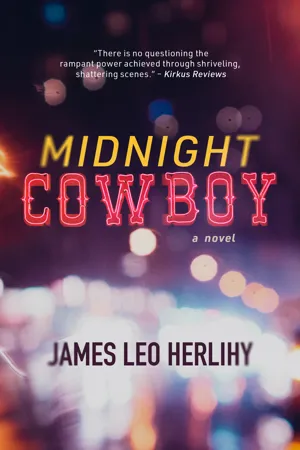
The basis for the Oscar–winning buddy film. "There is no questioning the rampant power achieved through shriveling, shattering scenes" (
Kirkus Reviews).
Midnight Cowboy is considered by many to be one of the best American novels published since World War II. The main story centers around Joe Buck, a naive but eager and ambitious young Texan, who decides to leave his dead-end job in search of a grand and glamorous life he believes he will find in New York City. But the city turns out to be a much more difficult place to negotiate than Joe could ever have imagined. He soon finds himself and his dreams compromised. Buck's fall from innocence and his relationship with the crippled street hustler Ratso Rizzo form the novel's emotional nucleus. This unlikely pairing of Ratso and Joe Buck is perhaps one of the most complex portraits of friendship in contemporary literature.
The focus on male friendship follows a strong path cut by Twain's Huck and Jim, Melville's Ishmael and Queequeg, Fitzgerald's Nick Carraway and Jay Gatsby, and Kerouac's Sal Paradise and Dean Moriarty.
Midnight Cowboy takes a well-deserved place among a group of distinguished American novels that write—often with unnerving candor—about those who live on the fringe of society.
"Leaves the world of innocence that is muddied by sex for a world that is innocent in the midst of sex, with a protagonist who is a sexual entrepreneur." —
The New York Review of Books
- 256 pages
- English
- ePUB (mobile friendly)
- Available on iOS & Android
eBook - ePub
About this book
Information
1
In his new boots, Joe Buck was six-foot-one and life was different. As he walked out of that store in Houston something snapped in the whole bottom half of him: A kind of power he never even knew was there had been released in his pelvis and he was able to feel the world through it. Brand-new muscles came into play in his buttocks and in his legs, and he was aware of a totally new attitude toward the sidewalk. The world was down there, and he was way up here, on top of it, and the space between him and it was now commanded by a beautiful strange animal, himself, Joe Buck. He was strong. He was exultant. He was ready.
“I’m ready,” he said to himself, and he wondered what he meant by that.
Joe knew he was no great shakes as a thinker and he knew that what thinking he did was best done looking in a mirror, and so his eyes cast about for something that would show him a reflection of himself. Just ahead was a store window. Ta-click ta-click ta-click ta-click, his boots said to the concrete, meaning power power power power, as he approached the window head on, and there was this new and yet familiar person coming at him, broad-shouldered, swaggering, cool and handsome. Lord, I’m glad I’m you, he said to his image—but not out loud—and then, Hey, what’s all this ready crap? What you ready for?
And then he remembered.
***
When he arrived at the H tel, a hotel that not only had no name but had lost its O as well, he felt the absurdity of anyone so rich and hard and juicy as himself ever staying in such a nameless, no-account place. He ran up the stairs two at a time, went to the second floor rear and hurried into the closet, emerging seconds later with a large package. He removed the brown paper and placed on the bed a black-and-white horsehide suitcase.
He folded his arms, stood back and looked at it, shaking his head in awe. The beauty of it never failed to move him. The black was so black and the white so white and the whole thing so lifelike and soft, it was like owning a miracle. He checked his hands for dirt, then brushed at the hide as if it were soiled. But of course it wasn’t, he was merely brushing away the possibility of future dirt.
Joe set about removing from their hiding place other treasures purchased in recent months: six brand-new Western-cut shirts, new slacks (black gabardines and black cottons), new underwear, socks (a half dozen pair, still in their cellophanes), two silk handkerchiefs to be worn at his neck, a silver ring from Juarez, an eight-transistor portable radio that brought in Mexico City without a murmur of static, a new electric razor, four packs of Camels and several of Juicy Fruit chewing gum, toilet articles, a stack of old letters, etc.
Then he took a shower and returned to the room to groom himself for the trip. He shaved with his new electric razor, cleaning it carefully before placing it in the suitcase, splashed his face and armpits and crotch with Florida Water, combed a nickel-sized glob of Brylcream into his brown hair, making it appear almost black, sweetened his mouth with a fresh stick of Juicy Fruit and spat it out, applied some special leather lotion to his new boots, put on a fresh, seven-dollar shirt (black, decorated with white piping, a shirt that fit his lean, broad-shouldered frame almost as close and neat as his own skin), tied a blue handkerchief at his throat, arranged the cuffs of his tight-thighed whipcord trousers in such a way that, with a kind of stylish untidiness, they were half in and half out of those richly gleaming black boots so you could still see the yellow sunbursts at the ankles, and finally he put on a cream-colored leather sport coat so soft and supple it seemed to be alive.
Now Joe would appraise the finished product. During the grooming process, he seldom looked at his total image. He would allow himself to focus only upon that patch of face being covered by the razor at a given moment, or at the portion of the head through which the comb was traveling, and so on. For he didn’t want to wear out his ability to perceive himself as a whole. He was in some ways like a mother preparing her child to meet some important personage whose judgment will decide the child’s fate, and so when all was ready and the time had come to assess the total effect, Joe Buck would actually turn his back on the mirror and walk away from it, roll his shoulders to get the kinks out, take a few deep belly breaths and a couple of quick knee bends, and crack his knuckles. Then he would slouch in a way that he thought attractive and that was his habitual stance anyway—most of his weight on one foot—get hold of a certain image in his mind, probably of some pretty, wide-eyed adoring girl, smile at it with a kind of crooked, indulgent wisdom, light a Camel and stick it into his mouth, and hook one thumb into his low-riding garrison belt. And now, ready for that fresh look at himself, he would swing his eyes back onto the mirror as if some hidden interloper beyond the glass had suddenly called his name: Joe Buck!
On this day of the trip, Joe liked especially what he saw: liked the sweet, dark, dangerous devil he surprised in the dirty mirror of that H tel room. Beyond his own reflection he could see the splendid suitcase lying on the bed, and in his hip pocket he could feel the flat-folded money, two hundred and twenty-four dollars, more than he’d ever at any one time owned before. And he felt most of all the possession of himself, inside his own skin, standing in his own boots, motivator of his own muscles and faculties, possessor of all that beauty and hardness and juice and youngness, box-seat ticket holder to the brilliant big top of his own future, and it was nearly overwhelming to him. Formerly, and not so long ago, there had confronted him always in mirrors a brooding and frightened and lonesome person who was not at all pleased with himself, but he was gone now, put out of the way entirely, while Joe beheld the new. He could not have borne one more scrap of splendor without buckling under the wonder of it, for even as it was he felt that if he savored for one more instant the incredible good fortune of being himself in this time and place and on the move through it, he might easily wreck it all by weeping.
And so he gathered up his possessions and left that H tel for good.
***
Over the door of the Sunshine Cafeteria was a big yellow sunburst with a clock (twenty to seven) set in it, and on the face of the clock it said TIME TO EAT.
As Joe approached this place he saw enacted in his mind the following scene:
He goes into the Sunshine. His employer, a pink man in a soiled gray suit, is just inside the door holding his pocket watch in his right hand and shaking the forefinger of his left at Joe. “You’re due here at four o’clock, four to midnight, understand?” he shouts. Customers stop eating and look up. Joe Buck takes the pink man by the ear and leads him past the astonished diners and into the scullery. A number of cooks and counter girls and dishwashers pause in their work to watch as Joe shoves the pink manager against the dishwashing machine. Joe takes his time lighting a cigarette, lifts a brilliantly booted foot and rests it on a dish crate. Then, exhaling a puff of smoke, he says, “They’s something about that dishwashing machine been bothering me. Been bothering me a long long time. Yes it has. What I been wondering is whether or not that dishwashing machine would fit up your ass. Now bend over.” “What? What? Bend over? Are you crazy?” the pink man protests. Joe remains dangerously still, looks out from under dark eyebrows: “Did you call me crazy?” “No, no, no, I only meant—” “Bend over,” says Joe. The man bends over and Joe sees a billfold sticking out of his hip pocket. “Believe I’ll take my pay,” he says, removing the money, “plus help m’self to a little bonus.” He stuffs a great wad of money into his jockstrap and walks out of the place, all eyes upon him, wide open and profoundly impressed. But no one dares follow or in any way impede his exit. In fact just to play it safe, the pink man himself remains bent over for several days after Joe has gone.
That was the way Joe imagined it. This is what actually took place:
He clicked across the street, pushed through the revolving door and into the Sunshine Cafeteria, swung his new body past the tables and toward a door that said EMPLOYEES ONLY on it. This door marked the end of the air conditioning; inside it was hot and steamy. He passed through another doorway that led into the scullery. A colored man of middle age was filling a tray with dirty dishes. Joe watched as the man filled the tray and placed it on a conveyor belt that would carry it through the dishwashing machine. Then he smiled up at Joe and nodded toward a mountain of dish-filled wire baskets stacked on the floor. “Looka that shit, will you?” he said.
Joe stood next to the man. “Listen, uh, it looks like I’m headin’ East.” He lit a cigarette.
The man looked at Joe’s suitcase. “You ain’t coming to work?”
“Naw, I don’t guess. I just come to say goodbye, tell you I’m headin’ East.”
“East?”
“Yeah. Oh, hell yeah. Thought I say g’bye, take a look around the place.”
A door opened and a fat woman with a splotchy face stood there shouting “Cups!” at the top of her voice. Then she closed the door and was gone.
The colored man put his hand forward. “Well. Goodbye.” They shook hands and for a moment Joe felt reluctant to release the other man’s grip. Inexplicably, he felt like putting on an apron and starting to work, but that was out of the question. “What the hell am I hanging around here for, right?”
“That’s right,” the man said, looking down at his own hand, still caught in Joe’s. “What you going to do back there, East?”
“Women,” Joe said. “Eastern women. They got Eastern women back there, and they going to pay for it, too.”
“Pay for what?” The man finally got his hand free.
“The men back there,” said Joe, “is just faggots mostly, and so the women got to buy what they want. They glad to pay for it’ cause it’s just about the only way they can get it.”
The colored man shook his head. “That must be some mess back there.” He took another empty tray and began filling it with cups.
“Yeah, it’s a mess. And I’m going to cash in on some of it. Isn’t that right?”
“I don’t know. I don’t know nothing about it.”
“What do you mean? I just told you.”
“Yeah, I know, but I don’t know.”
“Well, they’s no use hanging around here. I got places to go. Right?”
Joe Buck, all dressed up like a cowboy, suddenly knew he was not a cowboy at all. He stood there with his mouth slack, his big, slightly bucked teeth showing white, his blue eyes caught on the older man’s face. “Papa,” his eyes said, “I am going now to seek my fortune and have come to ask your blessing.” But of course the poor colored man was not his father. Nor was Joe the son of anyone in particular. And so he walked out of that scullery. The place owed him a day’s pay, but he had no stomach for an interview with the pink man who was manager of the Sunshine. Besides, he knew he would never actually tell the man to put the dishwashing machine up his ass.
He walked through the cafeteria and out onto the sidewalk, where it was evening and pleasant and clearly springtime, and pretty soon, with the clicking of his own heels to nourish his heart as he walked toward the bus station, he felt fine and his thoughts were thousands of miles away: walking down Park Avenue in New York City. Rich ladies looking out their windows swooned to see a cowboy there. A butler tapped him on the shoulder, an elevator whirred him up to a penthouse, a golden door opened to admit him to a large apartment carpeted from wall to wall with soft brown fur. Madame was wearing scanties covered by a sheer black negligee. At sight of Joe Buck, breathing became a labor: She was overwhelmed. Quivering with desire, she threw herself at once onto the soft floor. The juices of her womanliness had already risen to meet him. There was no time for undressing. He took her immediately. The butler handed him a check, signed in a florid hand, on which the amount had been left for him to fill in as he chose.
***
There was a juke box in the depot at Houston. As Joe climbed aboard the bus he heard the voice of some fine, big Western woman singing about a wheel of fortune turning turning turning, and it seemed to him that what this woman was getting at, she was sending all the studs East to clean up. Joe smiled his crooked and gleaming white smile all the way down the aisle, knowing and savoring something he had no words for about destiny: that there is a certain way of climbing inside of time that gives a man ownership of the world and everything in it, and when this takes place there is a kind of click, and from then on when you hear a juke box, for instance, it plays only what you need to hear, and everything, even Greyhound buses, operates for your convenience—you walk into the station and you say, “What time’s a bus to New York City?” and the man says, “Right away,” and you just step on the thing and that’s all there is to it. The world is music and yours is the rhythm that owns it. You don’t even have to snap your fingers, the beat is you, and when you think about those Eastern women, the big broad on the juke box sings the finish of the thought for you, yearning yearning yearning, that’s what they’re doing in the East. (Okay, here it is, lady, it’s just climbed on the bus, it’s on the way!) And there’s a seat for you, two of them in fact, one for your butt and one for your feet, and you don’t need a reservation, the whole world is reserved, and the minute you sling your horsehide suitcase onto the overhead rack, the driver shifts into gear and begins to back out on schedule. Maybe not on schedule from the Greyhound’s point of view, but from yours. Because you are the schedule, and that bus moves.
2
Now at this time in which Joe Buck was coming out of the West on that Greyhound bus to seek his fortune in the East, he was already twenty-seven years old. But he had behind him as little experience of life as a boy of eighteen, and in some ways even less.
He had been raised by various blondes. The first three, who brought him up to the age of seven, were young and pretty.
There was a great deal of coming and go...
Table of contents
- Cover
- Title Page
- Copyright
- Contents
- Dedication
- eForeword
- Part One
- Part Two
- Part Three
Trusted by 375,005 students
Access to over 1.5 million titles for a fair monthly price.
Study more efficiently using our study tools.
Frequently asked questions
Yes, you can cancel anytime from the Subscription tab in your account settings on the Perlego website. Your subscription will stay active until the end of your current billing period. Learn how to cancel your subscription
No, books cannot be downloaded as external files, such as PDFs, for use outside of Perlego. However, you can download books within the Perlego app for offline reading on mobile or tablet. Learn how to download books offline
Perlego offers two plans: Essential and Complete
- Essential is ideal for learners and professionals who enjoy exploring a wide range of subjects. Access the Essential Library with 800,000+ trusted titles and best-sellers across business, personal growth, and the humanities. Includes unlimited reading time and Standard Read Aloud voice.
- Complete: Perfect for advanced learners and researchers needing full, unrestricted access. Unlock 1.5M+ books across hundreds of subjects, including academic and specialized titles. The Complete Plan also includes advanced features like Premium Read Aloud and Research Assistant.
We are an online textbook subscription service, where you can get access to an entire online library for less than the price of a single book per month. With over 1.5 million books across 990+ topics, we’ve got you covered! Learn about our mission
Look out for the read-aloud symbol on your next book to see if you can listen to it. The read-aloud tool reads text aloud for you, highlighting the text as it is being read. You can pause it, speed it up and slow it down. Learn more about Read Aloud
Yes! You can use the Perlego app on both iOS and Android devices to read anytime, anywhere — even offline. Perfect for commutes or when you’re on the go.
Please note we cannot support devices running on iOS 13 and Android 7 or earlier. Learn more about using the app
Please note we cannot support devices running on iOS 13 and Android 7 or earlier. Learn more about using the app
Yes, you can access Midnight Cowboy by James Leo Herlihy in PDF and/or ePUB format, as well as other popular books in Literature & Classics. We have over 1.5 million books available in our catalogue for you to explore.