eBook - ePub
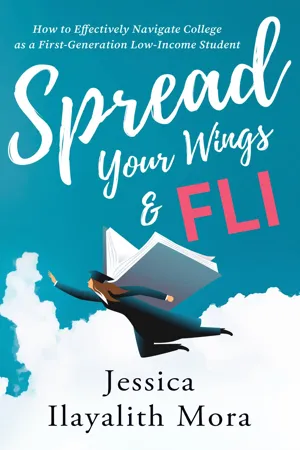
Spread Your Wings and FLI
How to Effectively Navigate College as a First-Generation, Low-Income Student
- English
- ePUB (mobile friendly)
- Available on iOS & Android
eBook - ePub
Spread Your Wings and FLI
How to Effectively Navigate College as a First-Generation, Low-Income Student
Information
Topic
EducationSubtopic
Education AdministrationCHAPTER 1
You Are Not Alone
“No matter where you come from or how much money your family has, I want you to know that you can succeed in college, and get your degree, and then go on to build an incredible life for yourself.”
—Michelle Obama5
As I began to unpack and settle in to my college dorm on move-in day, I felt like I was touching history. Walking around campus was like taking a walk back in time—a time where the cobblestone sidewalks and the gargoyles didn’t seem out of place. As I walked, I passed the law school where Barack Obama had taught and the dorm where Bernie Sanders had stayed when he was an undergrad. History felt so tangible to me in that moment. I felt invincible.
I don’t quite remember where I was or when it happened, but at some point during my walk of history I was bestowed a title. I was a FLI student. I was unclear as to what that meant. The word “FLI” seemed like a word other FLI students seemed really proud of and excited to talk more about. I would later learn that FLI stood for first-generation, low-income, and it represented students whose parents did not attend two- or four-year colleges and who were Pell Grant eligible.6
While the definition fit me like a glove, I was a bit taken aback by my new label of “low-income.” Growing up, I never felt like my family was “poor.” We lived in a nice apartment on the North Side of Chicago. I had my own bedroom and even got to go on vacation with my family every few years. Certainly these were not the characteristics of a “low-income” family. Little did I know, my perception of income would soon change.
Before I dive any deeper, I should disclose that while I did experience many challenges of being a FLI student in college, experiencing culture shock or navigating a predominantly white space were things I was familiar with before arriving at UChicago. In his research, Professor Anthony Jack reveals the existence of two types of low-income students: the privileged poor and the doubly disadvantaged. He describes privileged poor students to be those “who went to private high school, usually well resourced.”7 On the other hand, doubly disadvantaged students are those who went to a public and usually under-resourced high school.
Yet even with having gone to a predominantly white and wealthy high school with many advanced classes, I still struggled in college. One of the biggest moments of uncertainty and doubt for me was when I took a chemistry class the summer before freshman year.
The Game of Catch Up
Chemistry… it’s never been my strong suit. Any science, really. Something about the chemical structures, the math—it just doesn’t stick with me. In the summer of 2016, however, I decided to give it a second chance. If I was going to be a computer science major when I started college in the fall, I needed to get as much of a head start as possible.
I remember heading into class that first day, excited. How hard could it be, really? This was college—my new beginning. The professor’s introduction was brief. Name, pronouns, research interests. Right away, he dove into the formulas, balancing equations, and protons and neutrons. It was a hurricane of information coming at me faster than I could make sense of it all. There were brief flashbacks to material I learned during my high school chemistry class. It was like seeing a distant relative after years of not seeing them. I could recognize their face, but barely remembered anything about them.
I wrote down notes as fast as I could, but by the end of the class my page was flooded with question marks. As class wrapped up, I noticed many of my peers smile. They looked at each other, sharing in their happiness that this class would only be a recap of the AP Chemistry course they had taken the previous year.
I couldn’t believe it. How was it that they were so prepared to be successful in this class, yet I was not? How did they even learn college level chemistry in high school, and how in the world was I supposed to catch up to them? It seemed impossible.
UChicago was meant for the smartest of the smart; maybe it was not meant for students like me. How was I supposed to get through four years at UChicago if the first class already felt like a game of catch up? Could I go to the professor for help? Would he think I was stupid for not being familiar with the material already? How could I go into office hours and ask for help on everything? The thoughts continued to race through my mind at speeds impossible for me to understand.
I decided then that my best option would be to go to a peer for help—one of those “I took AP Chemistry in high school” students—and hope for the best.
“Hey, want to study for Chemistry together?”
It seemed like a simple enough ask. He said yes. We scheduled a study session for the next day—more than enough time before our next problem set was due. The next day, we met in a library next to the dorms.
“This shouldn’t take long,” he assured me. What he didn’t know was that the homework assignment was already burning a hole through my backpack. I hadn’t been able to get a single problem done the night before.
We opened the textbook, heavy with problems that drew a deep line between my peer’s knowledge and my own. Problem one: We wrote the equation in our notebooks. I stopped, staring at the jumble of numbers and letters on my sheet. He continued, jotting down notes and looking up the periodic table on his computer. Then he stopped, placing the pen in his mouth, deep in thought.
“What do you think?” he asked.
I gave up. I couldn’t keep pretending like I knew what was going on. It was time to come clean. As I explained my limited background in chemistry and my recent frustrations in the classroom with him, I could feel the tears in my eyes. I needed so much help that I didn’t even know where to start. When I was done, he closed his textbook and rapidly began typing something. I couldn’t quite make out what he was typing, but within a few seconds a periodic table and a step-by-step process on how to balance an equation popped up on his screen.
“Let’s work through this one together,” he said encouragingly. He jotted each step down in his notebook and began explaining, stopping periodically to make sure I was following along.
After practicing a few of the same types of questions over and over again—many more times than I dare admit—I finally understood. I could practically scream from the excitement. I couldn’t believe it! My mind felt like it h...
Table of contents
- Contents
- Introduction
- CHAPTER 1 You Are Not Alone
- CHAPTER 2 Who Are We Leaving Behind?
- CHAPTER 3 The FLI Student Experience
- CHAPTER 4 No Blueprint? No Problem
- CHAPTER 5 Rocking the First Day of Class
- CHAPTER 6 Finding the “YOU” in Comm-YOU-nity
- CHAPTER 7 How to Develop Personal Relationships
- CHAPTER 8 Striking a Balance
- CHAPTER 9 Networking and How to Start
- CHAPTER 10 Using the Power of Social Media
- CHAPTER 11 Budgeting and Personal Finance
- CHAPTER 12 From FLI Student to FLI Professional
- CHAPTER 13 Becoming a FLI Graduate Student
- CHAPTER 14 Spread Your Wings and FLI
- Acknowledgments
- Appendix
Trusted by 375,005 students
Access to over 1.5 million titles for a fair monthly price.
Study more efficiently using our study tools.
Frequently asked questions
Yes, you can cancel anytime from the Subscription tab in your account settings on the Perlego website. Your subscription will stay active until the end of your current billing period. Learn how to cancel your subscription
No, books cannot be downloaded as external files, such as PDFs, for use outside of Perlego. However, you can download books within the Perlego app for offline reading on mobile or tablet. Learn how to download books offline
Perlego offers two plans: Essential and Complete
- Essential is ideal for learners and professionals who enjoy exploring a wide range of subjects. Access the Essential Library with 800,000+ trusted titles and best-sellers across business, personal growth, and the humanities. Includes unlimited reading time and Standard Read Aloud voice.
- Complete: Perfect for advanced learners and researchers needing full, unrestricted access. Unlock 1.5M+ books across hundreds of subjects, including academic and specialized titles. The Complete Plan also includes advanced features like Premium Read Aloud and Research Assistant.
We are an online textbook subscription service, where you can get access to an entire online library for less than the price of a single book per month. With over 1.5 million books across 990+ topics, we’ve got you covered! Learn about our mission
Look out for the read-aloud symbol on your next book to see if you can listen to it. The read-aloud tool reads text aloud for you, highlighting the text as it is being read. You can pause it, speed it up and slow it down. Learn more about Read Aloud
Yes! You can use the Perlego app on both iOS and Android devices to read anytime, anywhere — even offline. Perfect for commutes or when you’re on the go.
Please note we cannot support devices running on iOS 13 and Android 7 or earlier. Learn more about using the app
Please note we cannot support devices running on iOS 13 and Android 7 or earlier. Learn more about using the app
Yes, you can access Spread Your Wings and FLI by Jessica Ilayalith Mora in PDF and/or ePUB format, as well as other popular books in Education & Education Administration. We have over 1.5 million books available in our catalogue for you to explore.