- English
- ePUB (mobile friendly)
- Available on iOS & Android
eBook - ePub
Information
Topic
SozialwissenschaftenSubtopic
PolitikPart I
Promises, Promises
All political candidates make promises on the campaign trail. However well-intentioned they may be, keeping those promises can be tough. Circumstances change: unexpected events happen, priorities shift. Political opponents on either side are always ready to score points when a promised outcome doesn’t happen (or doesn’t happen soon enough). But they’re also just as ready to ignore or minimize the context. The reality is that change takes time. Rome (and DC) wasn’t built in a day.
President Biden is familiar with this reality, to say the least. He was a moderate Democratic senator from Delaware—a state known for its friendliness to corporations. On many occasions, he’s had to be the “negotiator in chief” while dealing with multiple competing interests. Finding acceptable compromises never endeared him to partisans on either side, but Biden does have a long history of patiently leading by diplomacy.
Many of Biden’s promises—and the focus of his first one hundred days—are responses to the turmoil of the Trump presidency. Independents and moderate voters of both parties wanted someone who would turn down the heat, restore a sense of normalcy, and above all, work for policies that benefit ordinary citizens. Biden is doing just that, and it’s working better than blaming others for our troubles. His job approval rating is an average net positive of 12.1 percent as I write this,1 indicating that many people agree, especially on mainstream issues that affect all of us.
The Bipartisan Riddle
In general elections throughout history, most politicians have declared they will “work across the aisle” and seek bipartisan support for policies that benefit all Americans. Even when they’re sincere, elected officials soon learn that bipartisan legislation is a lot harder than they thought—especially in today’s divisive times.
Joe Biden knew that going in, but he’s working to give new meaning to the word “bipartisan.” In a 2020 speech in Milwaukee, he said, “We’re going to bring the Republicans and Democrats together and deliver economic relief for working families, and schools, and businesses; I promise you.” He added, “I’m not going to shut down the economy. I’m going to shut down the virus.”2
Following Biden’s inauguration, his actions make one thing clear: by “Republicans and Democrats,” he did not mean only politicians. He is clearly speaking of all voters—many of whom voted for Trump in 2016. They include disenfranchised citizens in rural districts and swing states who care about issues that affect them personally. In other words, Biden is betting that voters of either party or independents—in 2022 and beyond—will care more about how he resolves these issues than about the politician who shouts the loudest.
With that in mind, imagine how a typical voter might feel about (and how their current representative or senator might respond to) some of Biden’s promises:
- On getting COVID-19 under control: “I’m never going to raise the white flag and surrender. We’re going to beat this virus. We’re going to get it under control.”
- On the increasingly popular (even among Republicans3) Affordable Care Act (ACA): “I’ll not only rebuild Obamacare, I’ll improve on it.”
- On resolving the crises of policing and justice reform: “I promise you there will be a national commission on policing out of the White House where I’ll bring everyone to the table, including police chiefs, including civil rights activists, including the NAACP, including the African, the Latino community. We’re going to sit down there and we’re going to work it out.”
- On solving the growing climate crisis: “I will make massive, urgent investments at home that puts the United States on track to have a clean energy economy with net-zero emissions by 2050.”
Great progress has been made with the $1.9 trillion COVID-19 relief package that passed in March. Schools are opening. Vaccine distribution has been successful. To address a host of COVID-19–related issues, the president has issued substantive executive orders (enforceable written policies that implement federal laws4). In addition to supporting and signing the desperately needed COVID-19 relief bill, which a majority of Americans support, the administration is also preparing to send Congress a landmark, largely popular infrastructure package—one that includes tax breaks!
President Biden has also been busy on other fronts, issuing executive orders and taking other executive action on issues such as climate change, foreign relations, gun safety, immigration, the rights of voters, inequality, and more. At this point, however, the road gets much more difficult. Infrastructure, voting rights, and major gun legislation must pass through the legislative gantlet of undying Republican opposition. Some popular measures, including infrastructure, may pass via budget reconciliation (which only requires a simple majority vote), but certainly not all.
One hundred days is too short a time to know if Biden’s “new bipartisanship” plan will work—or if he will have to address filibuster reform and other measures to keep his campaign promises to help our country.
I hope Biden succeeds, for the sake of those who desperately need the economy to get back on its feet. We need greater opportunity for everyone, regardless of race, sex, political affiliation, or wealth so we can all pursue the blessings of liberty. I still believe that Americans want good things to be possible for every citizen. I even believe it’s possible for our elected representatives to act accordingly.
How to Use This Book
The rest of this book is divided into two sections: an overview of specific policies and an abbreviated record of President Biden’s actions during his first one hundred days. As you will see, almost all government policies are interrelated, so you’ll see several times where they affect each other.
Please use this book as a convenient guide to gauge how well the administration is faring, and, of course, feel free to disagree with me. Like the president, and all presidents who preceded him, I am only human. I am passionate about these issues, however, and I hope this brief account stirs the same passion in you for the future happiness of our great country and beyond and lets your voice be heard.
Part II
Overview by Policy Area
Recovering from the COVID-19 Pandemic
Since the first reported US case in January 2020, well over half million Americans have died from COVID-19.1 On Inauguration Day, that number was 412,730 and rising.2 Thankfully, since then, the disease has slowed in this country, although as I write this, the pandemic is not yet over.
The devastating impact of this disease on American families, jobs, and businesses cannot be overestimated, and my thoughts are with all those who lost loved ones during the pandemic. It revealed massive gaps in our infrastructure, our education system, and in the public and private “safety net” that helps Americans in times of crisis. Clearly, it was a decisive issue in the 2020 election.
Promises
During the campaign, Biden and Harris focused on COVID-19, its health and economic impact, and a proposed timeline to address the crisis.3 He called attention to the health emergency infrastructure and response mechanisms put in place by President Bush and expanded under President Obama that were minimized or eliminated during the previous administration.
Both during the campaign and afterward, Biden’s proposed science-based approach to the pandemic was in stark contrast to that of President Trump. Worries about the stock market frequently resulted in Trump’s minimizing the warnings of his own scientific and medical advisors, and he routinely allocated responsibility to state governments. In contrast, Biden stressed the importance of a federally coordinated response—backed by scientific and financial resources that states simply did not have.
Biden’s promises on COVID-19 response were twofold. On the medical side, a streamlined vaccine distribution plan was considered top priority. While he praised the speed of vaccine development, he said that was not enough. Wearing masks and, most important, getting vaccines into arms was imperative. Shortly after the election, he declared it a goal to vaccinate 100 million Americans during the first hundred days of his administration.4
On the economic side, Biden proposed a massive relief effort for individuals, businesses, and state and local governments severely impacted by the pandemic. Although many have labeled these promises as an economic stimulus, the campaign—and the Biden administration—clearly intend them as emergency economic relief, just as the government provides in any other natural disaster.
Accomplishments
On day one, Biden issued a flurry of executive actions designed to lead a recovery from the pandemic, including reengaging with the World Health Organization (WHO), extending President Trump’s moratorium on evictions and foreclosures,5 and a number of other COVID-19–related measures.6 Besides establishing a clear chain of command and making scientific data once again transparent, he authorized the purchase of more vaccines7 and invoked the Defense Production Act, requiring manufacturers to ramp up COVID-19 vaccine supplies during a national emergency.8 This enabled more Americans to get vaccinated, to the point where the nationwide adult eligibility date for COVID-19 vaccines was moved up to April 19, two weeks earlier than expected.9
Greater transparency has also been the hallmark of the new administration; press briefings have again become common. Medical briefings and public data access from the CDC and Health and Human Services have opened up. Even more significantly, medical research reports are no longer subject to change by political appointees.
The COVID-19 relief package in particular addressed a number of non-vaccine-related issues. This included financial assistance for families, small businesses, and local communities affected by the shutdown, as well as aid to schools and improvement of safety conditions for health care workers. Apart from the relief package, Biden also continued the Trump administration’s moratorium on student debt repayment and the moratorium on evictions and foreclosures caused by the pandemic. He has also proposed changes and implemented simplified SBA procedures for the Paycheck Protection Program (PPP) to benefit small businesses (sole proprietors, independent contractors, and the self-employed) that may have previously missed out on accessing loans.10
Although the vaccine rollout has had its hitches, Biden has fulfilled and even surpassed his “one hundred vaccines in one hundred days” pledge. With vaccine eligibility open to all Americans sixteen years of age and older, the potential now exists for our country to achieve herd immunity to the coronavirus by the time we celebrate the Fourth of July (some have even predicted herd immunity by April or May.11)
What’s Next
Polls indicate that more than 70 percent of Americans indicated a comfort level with taking the COVID-19 vaccine.12 The main problem will be President Trump’s inordinate success in spreading disinformation to his loyal followers. In one survey, only 56 percent of Republicans seemed willing to be vaccinated versus more than 85 percent of Democrats.13
Although Trump and his top advisors did get the vaccine (as well as advanced therapeutic treatments) for themselves, they were reluctant to share that fact with their supporters. This has fueled the existing anti-vaccination movement. The puzzling reluctance of some Americans to believe in science is not new, but it does endanger the people we love.
The same problem exists when it comes to wearing masks or other science-based health practices. These should never have been politicized, but they were. For much of 2020, Trump and his adherents either panned the use of masks outright or downplayed their importance in fighting the pandemic. Contrast that with the current administration’s persuasion campaign—backed in many cases by celebrities of all political persuasions.
There will be similar pushback on any notion of mandatory vaccine “passports” or other ways to verify vaccination. Even though the Biden administration has announced it will not require vaccine passports,14 it is still a puzzling opposition talking point. In fact, such a requirement is more likely to come from travel-related companies, small businesses, and foreign countries,15 not our government.
This pushback on basic facts is bad for all of us. When I appear on conservative shows, I’m concerned whenever I hear guests make unscientific claims—that masks don’t work, that children don’t get COVID-19, or that people could die from the vaccine (it’s a fact that people could die after receiving a vaccine—just as they could die after taking a walk. That doesn’t mean the vaccine—or the walk—was the cause of death). Masks and vaccines work. Whenever I hear claims to the contrary, I get concerned for the loved ones of the very people who disagree with me politically on TV.
Everyone has a right to privacy and free expression, but people don’t have a right to harm others. As Justice Oliver Wendell Holmes once said, “My right to swing my fist ends where your nose begins.”
It’s also important to remember that businesses have a right to protect their customers, their employees, and their own business practices and reputations. So any business could potentially say, “You cannot enter my establishment unless you wear a mask” or have proof of vaccination, and so on. The same argument could apply to a business that requires wearing a tie or refuses service if a customer doesn’t wear shoes. It especially applies if they choose not to serve someone who is threatening violence against another customer or a staff member. Government mandates are not the issue. Freedom, private enterprise, and common sense are.
The COVID-19 relief act has yet to be fully implemented, but the Biden administration has not been shy about declaring its benefits. The simple fact is that the law is supported by a large majority of Americans, including 41 percent of Republicans.16 Even though it passed without a single Republican vote, some Republican legislators are even claiming credit for the parts they like, suc...
Table of contents
- Prologue
- Introduction
- PART I. Promises, Promises
- PART II: Overview by Policy Area
- Conclusion
- Addendum: Executive Chronology
- Acknowledgments
- About the Author
- Notes
Trusted by 375,005 students
Access to over 1.5 million titles for a fair monthly price.
Study more efficiently using our study tools.
Frequently asked questions
Yes, you can cancel anytime from the Subscription tab in your account settings on the Perlego website. Your subscription will stay active until the end of your current billing period. Learn how to cancel your subscription
No, books cannot be downloaded as external files, such as PDFs, for use outside of Perlego. However, you can download books within the Perlego app for offline reading on mobile or tablet. Learn how to download books offline
Perlego offers two plans: Essential and Complete
- Essential is ideal for learners and professionals who enjoy exploring a wide range of subjects. Access the Essential Library with 800,000+ trusted titles and best-sellers across business, personal growth, and the humanities. Includes unlimited reading time and Standard Read Aloud voice.
- Complete: Perfect for advanced learners and researchers needing full, unrestricted access. Unlock 1.5M+ books across hundreds of subjects, including academic and specialized titles. The Complete Plan also includes advanced features like Premium Read Aloud and Research Assistant.
We are an online textbook subscription service, where you can get access to an entire online library for less than the price of a single book per month. With over 1.5 million books across 990+ topics, we’ve got you covered! Learn about our mission
Look out for the read-aloud symbol on your next book to see if you can listen to it. The read-aloud tool reads text aloud for you, highlighting the text as it is being read. You can pause it, speed it up and slow it down. Learn more about Read Aloud
Yes! You can use the Perlego app on both iOS and Android devices to read anytime, anywhere — even offline. Perfect for commutes or when you’re on the go.
Please note we cannot support devices running on iOS 13 and Android 7 or earlier. Learn more about using the app
Please note we cannot support devices running on iOS 13 and Android 7 or earlier. Learn more about using the app
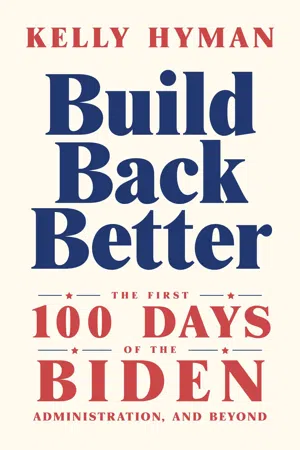
Yes, you can access Build Back Better by Kelly Hyman in PDF and/or ePUB format, as well as other popular books in Sozialwissenschaften & Politik. We have over 1.5 million books available in our catalogue for you to explore.