![]()
Section 1
General
![]()
Chapter 1 Disease Risk Analysis in Wildlife Health Field Studies
Although risk may be defined many ways, it always denotes the possibility of loss or injury. In mathematical terms, a risk is calculated as the probability of an outcome multiplied by the impact if the outcome occurs. We calculate risks in all aspects of our lives. There are risks in walking across a highway (e.g., risk of being hit by a car) or putting money in the stock market (e.g., risk of losing money). With each of these actions, there is an uncertain possibility of injury or loss because the outcome cannot be known beforehand. Rather, we may have a subjective impression (qualitative) or use a calculated probability (quantitative) as an indicator of the risks associated with the action.
As zoological and wildlife veterinarians, we perform risk analyses daily. With each of our decisions, whether working with captive or free-living animals, we weigh the benefits versus risks (a form of risk analysis) for every diagnostic and therapeutic option. We do this knowing that no medical action is risk-free. For example, there are risks when we anesthetize an animal to perform diagnostics. However, there are also risks if we do not anesthetize the animal because we may not be able to collect the biomaterials necessary for making a sound diagnosis leading to proper treatment. Veterinarians are aware of these risks and must often defend their medical decisions to curators, park managers, and politicians based on the risks associated with each of their informed medical actions.
To calculate and manage risks better, the use of disease risk analysis has become an important tool in many areas of the veterinary sciences.21 Disease issues are often complex and predictive models, using a disease risk analysis format, may be highly effective in dealing with these disease-related challenges. Within wildlife veterinary medicine, risk analysis has also become a highly valued tool.1,2,20 Many wildlife health field studies are now directed at understanding the following: (1) diseases in wildlife populations; (2) links among wildlife, domestic animal, and human health; and (3) links between the health of captive and free-living wildlife species. Illustrative examples for each of these three areas of study include an understanding of the following: (1) the conservation implications of Batrachochytrium dendrobatidis in amphibian species; (2) tuberculosis in African wildlife and people; and (3) herpesviruses in captive and free-living elephants. Additionally, we often must make medical management decisions based on findings from wildlife health studies. For example, is vaccination a viable medical decision, or does one let nature take its course during a disease epidemic in a wild canid population? These risk management decisions may best be answered using disease risk analysis.
The growth in awareness, interests, and efforts directed at wildlife health field studies may be viewed as positive for biodiversity conservation; however, this growth is most likely the result of a significant increase in disease-related conservation challenges.8 These field studies provide a scientific process that may better direct wildlife conservation initiatives. With the current extinction crisis, limited funds for wildlife health and conservation field projects, and the zoonotic connection of diseases found in many species of conservation concern, disease risk analyses should be used to direct and perform wildlife health field studies more effectively.
Disease Risk Analysis
Risk analysis is a formal procedure for estimating the likelihood and consequences of adverse effects occurring in a specific population, taking into consideration exposure to potential hazards and the nature of their effects.23 Disciplines as diverse as economics, engineering, business, environmental science, and health all commonly apply this technique. In the health sciences, a disease risk analysis is defined as a multidisciplinary process used to evaluate existing knowledge to prioritize risks associated with the spread or occurrence of diseases.
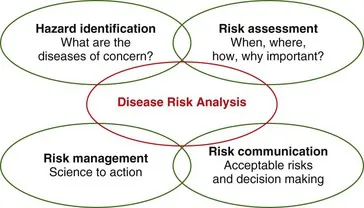
A risk analysis consists of four interconnected phases: (1) hazard identification; (2) risk assessment; (3) risk management; and (4) risk communication (Fig. 1-1). All the phases are interactive with the others—the process should not simply flow from phase 1 to phase 4 in chronologic order. A disease risk analysis is structured similar to that for other risk analyses.
Hazard identification is the identification of what may go wrong. We must identify what diseases have potential effects harmful enough to warrant inclusion in the risk analysis. Some criteria used for ranking infectious disease hazards include prevalence and incidence data, infectivity, pathogenicity (e.g., morbidity, mortality, fitness costs, reproductive costs), transmissibility (e.g., routes, rates, competent vectors), susceptibility (e.g., species, humans), and economic impacts associated with wildlife species, domestic animals, humans, and the ecosystem. Ranking of noninfectious diseases may include species susceptibility to injuries, physiologic stress, and genetic defects.
Risk assessment is the range of calculations required to estimate release, exposure, and consequence parameters for infectious diseases of concern. The process of assessing the risk will help understand the when, where, how, and why of a potential disease risk. With noninfectious diseases, it may involve calculations of the likelihood and consequences of the disease occurring (e.g., capture myopathy, toxicity) in a certain population or community. A subsequent estimate of the total risk may then be calculated based on the parameters for each of the identified hazards.
Risk management focuses on responses that may decrease the likelihood of an adverse outcome and reduce the consequences if such an outcome occurs. This element of risk analysis may best be viewed as the reason for performing the analysis so that science may move into action. Risk management may be the single most important component because it translates the identification of diseases and assessment of associated risks into management actions that may mitigate these risks.
Risk communication is a continuous process, necessitating respectful communication among the multiple stakeholders throughout the risk analysis.21 Risk communication should occur among field staff (those on the ground collecting data), modelers (those using data for a quantitative risk analysis), managers, laypersons, politicians, and all potentially affected parties to ensure that management policies and efforts are equitably based on the risk assessment outcome. To be of value, this requires a real-time communications network. All stakeholders must know about and understand the risks and options, with a clear statement of acceptable risk. Additionally, it must be clear as to who makes the risk management decisions. Different stakeholders often hold very different views on which risks are acceptable and who is in charge.
Hazard identification and risk assessment are sometimes grouped together because they are clearly interrelated. The criteria used to identify diseases of concern may also be used to assess the level of their associated risks. In many risk analyses, hazard identification and risk assessment are performed based solely on expert opinion or literature review. One of the most valuable products of disease risk analysis is the identification of missing data points that if obtained, would enhance a broader understanding of disease risks for a population or project. For a disease risk analysis to provide the highest quality outputs, hazard identification and risk assessments should be based on scientific data collected from the field and pertinent to the analysis in question. Providing these necessary data points for disease risk analysis are best performed by implementing standardized disease surveillance and monitoring systems.6,15,22
Performing a disease risk analy...