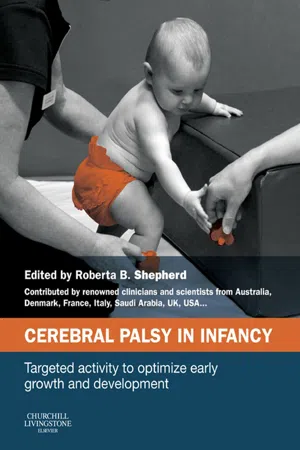
Cerebral Palsy in Infancy is a thought-provoking book which introduces a new way of thinking on the development and use of interventions. Relevant to current practice, it advocates early, targeted activity that is focused on increasing muscle activation, training basic actions and minimizing (or preventing) mal-adaptive changes to muscle morphology and function. The authors present recent scientific findings in brain science, movement sciences (developmental biomechanics, motor control mechanisms, motor learning, exercise science) and muscle biology. This knowledge provides the rationale for active intervention, underpinning the need for an early referral to appropriate services. The book features methods for promoting relatively intensive physical activity in young infants without placing a burden on parents which include assistive technologies such as robotics, electronic bilateral limb trainers and baby treadmills.Cerebral Palsy in Infancy begins by specifying the guidelines for training and exercise, outlining the rationale for such intervention. It goes on to cover the fundamentals of neuromotor plasticity and the development and negative effects of limited motor activity on brain organization and corticospinal tract development. Neuromuscular adaptations to impairments and inactivity are discussed along with the General Movement assessment that can provide early diagnosis and prognosis, facilitating very early referral from paediatric specialists to training programs. The book ends with a section featuring various methods of training with the emphasis on preventing/minimizing muscle contracture, stimulating biomechanically critical muscle activity and joint movement.An ideal clinical reference for those working to improve the lives of infants suffering from cerebral palsy.CONTRIBUTORS: Adel Abdullah Alhusaini (Saudi Arabia); David I. Anderson (USA); Nicolas Bayle (France); Roslyn Boyd (Australia); Giovanni Cioni (Italy); Diane L. Damiano (USA); Janet Eyre (UK); Linda Fetters (USA); Mary Galea (Australia); Andrew M Gordon (USA); Martin Gough (UK); Richard L Lieber (USA); Jens Bo Nielsen (Denmark); Micah Perez (Australia); Caroline Teulier (France).- conceived and edited by Roberta Shepherd with contributions from internationally renowned expert clinicians and researchers- discusses new research and new evidence-based treatment interventions- shows how to organize very early and intensive physical activity in young infants to stimulate motor development and growth- therapies include the specificity of training and exercise, with emphasis on promoting muscle activity and preventing contracture by active instead of passive stretching- methods include new interactive technologies in enhancing home-based training sessions carried out by the infant's family- extensive referencing in each chapter for further study- chapters feature "Annotations" which illustrate scientific findings
eBook - ePub
Cerebral Palsy in Infancy
targeted activity to optimize early growth and development
- 368 pages
- English
- ePUB (mobile friendly)
- Available on iOS & Android
eBook - ePub
Cerebral Palsy in Infancy
targeted activity to optimize early growth and development
About this book
Information
Table of contents
- Cover image
- Title page
- Table of Contents
- Copyright
- Preface
- Acknowledgements
- Contributors
- Part 1: Introduction
- Part 2: Neuromotor Plasticity and Development
- Part 3: Impairments and Neuromuscular Adaptations to Impairments and Inactivity
- Part 4: Early and Active Intervention to Optimize Growth, Development and Functional Motor Performance
- Part 5: Specific Methods of Motor Training for Infants
- Index
Trusted by 375,005 students
Access to over 1.5 million titles for a fair monthly price.
Study more efficiently using our study tools.
Frequently asked questions
Yes, you can cancel anytime from the Subscription tab in your account settings on the Perlego website. Your subscription will stay active until the end of your current billing period. Learn how to cancel your subscription
No, books cannot be downloaded as external files, such as PDFs, for use outside of Perlego. However, you can download books within the Perlego app for offline reading on mobile or tablet. Learn how to download books offline
Perlego offers two plans: Essential and Complete
- Essential is ideal for learners and professionals who enjoy exploring a wide range of subjects. Access the Essential Library with 800,000+ trusted titles and best-sellers across business, personal growth, and the humanities. Includes unlimited reading time and Standard Read Aloud voice.
- Complete: Perfect for advanced learners and researchers needing full, unrestricted access. Unlock 1.5M+ books across hundreds of subjects, including academic and specialized titles. The Complete Plan also includes advanced features like Premium Read Aloud and Research Assistant.
We are an online textbook subscription service, where you can get access to an entire online library for less than the price of a single book per month. With over 1.5 million books across 990+ topics, we’ve got you covered! Learn about our mission
Look out for the read-aloud symbol on your next book to see if you can listen to it. The read-aloud tool reads text aloud for you, highlighting the text as it is being read. You can pause it, speed it up and slow it down. Learn more about Read Aloud
Yes! You can use the Perlego app on both iOS and Android devices to read anytime, anywhere — even offline. Perfect for commutes or when you’re on the go.
Please note we cannot support devices running on iOS 13 and Android 7 or earlier. Learn more about using the app
Please note we cannot support devices running on iOS 13 and Android 7 or earlier. Learn more about using the app
Yes, you can access Cerebral Palsy in Infancy by Roberta B. Shepherd in PDF and/or ePUB format, as well as other popular books in Medicine & Physiotherapy, Physical Medicine & Rehabilitation. We have over 1.5 million books available in our catalogue for you to explore.