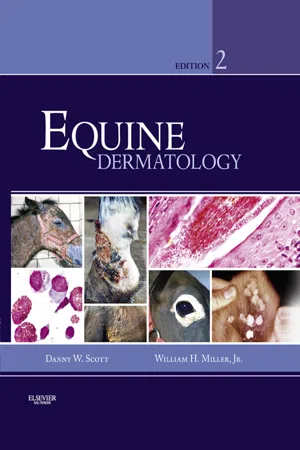
Diagnose, treat, and manage equine skin disorders with the most comprehensive reference available! With 900 full-color photos, Equine Dermatology covers skin diseases ranging from those that merely annoy the horse to others that interfere with the horse's ability to function in riding, working, or show. Thorough coverage includes essential basics and practical diagnostic methods, therapies, and specific abnormalities and defects. The book describes the structure and function of the skin, and discusses disorders including bacterial, fungal, parasitic, viral, protozoal, allergic, immune-mediated, endocrine, metabolic, and nutritional diseases. It also covers congenital and hereditary defects, pigmentation abnormalities, keratinization defects, environmental skin diseases, and skin tumors. Written by renowned equine dermatologists Danny Scott and Bill Miller, this all-inclusive resource covers the latest dermatologic topics and the newest therapies.- Current, comprehensive coverage includes every known equine dermatosis.- An emphasis on differential diagnosis includes key differentials and breed predilections for each disease, especially helpful when you have only a specimen and an incomplete history to work with.- A consistent format makes it easy to locate information on each skin disorder, including a clinical description, its cause and pathogenesis, clinical features, clinical management, diagnosis, treatment, and any zoonotic aspects.- Expert authors Danny W. Scott, DVM, and William H. Miller, Jr., VMD, offer years of knowledge, experience, and their vast image collections.- Diagnostic tables in each chapter provide a quick reference for identifying lesions and disorders.- An extensive list of references at the end of each chapter includes recommendations for further reading.- New coverage of dermatologic conditions includes the latest topics and emerging disorders such as chronic progressive lymphedema, herpesvirus-2-associated dermatitis, salmonella-associated dermatoses, and nodular auricular chondropathy.- Updated Diagnostic Methods chapter covers multiple methods of developing a differential diagnosis list based on breed, lesion type, patterns, and location.- A focus on common clinical problems highlights the conditions most likely to be seen in practice.- Almost 1, 000 full-color photos of skin disorders make it easy to distinguish clinical characteristics and variations of normal and abnormal for accurate diagnosis and therapy.
- 552 pages
- English
- ePUB (mobile friendly)
- Available on iOS & Android
eBook - ePub
Equine Dermatology - E-Book
About this book
Information
Topic
MedicinaSubtopic
Scienza veterinaria equinaCHAPTER 1 Structure and Function of the Skin
The skin is the largest and most visible organ of the body and the anatomic and physiologic barrier between animal and environment. It provides protection from physical, chemical, and microbiologic injury, and its sensory components perceive heat, cold, pain, pruritus, touch, and pressure. In addition, the skin is synergistic with internal organ systems and thus reflects pathologic processes that are either primary elsewhere or shared with other tissues. Not only is the skin an organ with its own reaction patterns, it reflects the milieu intérieur and, at the same time, the capricious world to which it is exposed.
General functions and properties of the skin
The general functions of animal skin are as follows:73,92
1. Enclosing barrier. The most important function of skin is to make possible an internal environment for all other organs by maintaining an effective barrier to the loss of water, electrolytes, and macromolecules.
2. Environmental protection. A corollary function is the exclusion of external injurious agents—chemical, physical, and microbiologic—from entrance into the internal environment.
3. Motion and shape. The flexibility, elasticity, and toughness of the skin allow motion and provide shape and form.
4. Adnexa production. Skin produces glands and keratinized structures such as hair, hoof, and the horny layer of the epidermis.
5. Temperature regulation. Skin plays a role in the regulation of body temperature through its support of the hair coat, regulation of cutaneous blood supply, and sweat gland function.
6. Storage. The skin is a reservoir of electrolytes, water, vitamins, fat, carbohydrates, proteins, and other materials.
7. Indicator. The skin may be an important indicator of general health, internal disease, and the effects of substances applied topically or taken internally. It contributes to physical and sexual identity.
8. Immunoregulation. Keratinocytes, Langerhans cells, lymphocytes, and dermal dendrocytes together provide the skin with an immunosurveillance capability that effectively protects against the development of cutaneous neoplasms and persistent infections.
9. Pigmentation. Processes in the skin (melanin formation, vascularity, and keratinization) help determine the color of the coat and skin. Pigmentation of the skin helps prevent damage from solar radiation.
10. Antimicrobial action. The skin surface has antibacterial and antifungal properties.
11. Sensory perception. Skin is a primary sensory organ for touch, pressure, pain, itch, heat, and cold.
12. Secretion. Skin is a secretory organ by virtue of its epitrichial sweat glands and sebaceous glands.
13. Excretion. The skin functions in a limited way as an excretory organ.
Ontogeny
Skin is a complex multicellular organ in which endoderm, neural crest, and ectoderm contribute to form a three-dimensional unit in a spatially and temporally defined manner. Skin morphogenesis involves the action of multiple genes in a coordinated fashion. Homeobox genes are a gene family that encode information critical for normal embryologic development and that likely play an important role in the development of skin adnexa, pigment system, and stratified epithelium during embryogenesis.
Epithelial-mesenchymal interactions regulate tissue homeostasis, the balanced regulation of proliferation and differentiation maintaining normal tissue architecture and function. Multiple circuits of reciprocal permissive and instructive effects exist between epithelial and mesenchymal cells and extracellular matrices.
To the authors’ knowledge, the ontogeny of equine skin has not been reported. The following discussion is an amalgamation of information from other domestic mammals and humans.34,36,89,91
Initially, the embryonic skin consists of a single layer of ectodermal cells and a dermis containing loosely arranged mesenchymal cells embedded in an interstitial ground substance. The ectodermal covering progressively develops into two layers (the basal cell layer, or stratum germinativum, and the outer periderm), three layers (the stratum intermedium forms between the other two layers), and then into an adultlike structure. Melanocytes (neural crest origin) and Langerhans cells (bone marrow origin) become identifiable during this period of ectodermal maturation.
Dermal development is characterized by an increase in the thickness and number of fibers, a decrease in ground substance, and the transition of mesenchymal cells to fibroblasts. This process of building a fiber-rich matrix has been referred to as a “ripening” of the dermis. Elastin fibers appear later than do collagen fibers. Histiocytes, Schwann cells, and dermal melanocytes also become recognizable. Fetal skin contains a large percentage of Type III collagen compared with the skin of an adult, which includes a large proportion of Type I collagen. Lipocytes (adipocytes, fat cells) begin to develop into the subcutis from spindle-shaped mesenchymal precursor cells (prelipoblasts) in the second half of gestation.
The embryonal stratum germinativum differentiates into hair germs (primary epithelial germs), which give rise to hair follicles, sebaceous glands, and epitrichial (apocrine) sweat glands. Hair germs initially consist of an area of crowding of deeply basophilic cells in the basal layer of the epidermis. Subsequently, the areas of crowding become buds that protrude into the dermis. Beneath each bud lies a group of mesenchymal cells, from which the dermal hair papilla is later formed.
As the hair peg lengthens and develops into a hair follicle and hair, three bulges appear. The lowest (deepest) of the bulges develops into the attachment for the arrector pili muscle; the middle bulge differentiates into the sebaceous gland; and the uppermost bulge evolves into the epitrichial sweat gland. In general, the first hairs to appear on the fetus are vibrissae and tactile or sinus hairs that develop on the chin, eyebrows, and upper lip as white, slightly raised dots on otherwise smooth, bare skin. The general body hair appears...
Table of contents
- Cover
- Title Page
- Front matter
- Copyright
- Preface
- Acknowledgments
- Preface and Acknowledgments from the First Edition
- Table of Contents
- Chapter 1: Structure and Function of the Skin
- Chapter 2: Diagnostic Methods
- Chapter 3: Dermatologic Therapy
- Chapter 4: Bacterial Skin Diseases
- Chapter 5: Fungal Skin Diseases
- Chapter 6: Parasitic Diseases
- Chapter 7: Viral and Protozoal Skin Diseases
- Chapter 8: Skin Immune System and Allergic Skin Diseases
- Chapter 9: Immune-Mediated Disorders
- Chapter 10: Endocrine, Nutritional, and Miscellaneous Hair Coat Disorders
- Chapter 11: Keratinization Defects
- Chapter 12: Pigmentary Abnormalities
- Chapter 13: Environmental Skin Diseases
- Chapter 14: Congenital and Hereditary Skin Diseases
- Chapter 15: Miscellaneous Skin Diseases
- Chapter 16: Neoplasms, Cysts, Hamartomas, and Keratoses
- Index
Trusted by 375,005 students
Access to over 1.5 million titles for a fair monthly price.
Study more efficiently using our study tools.
Frequently asked questions
Yes, you can cancel anytime from the Subscription tab in your account settings on the Perlego website. Your subscription will stay active until the end of your current billing period. Learn how to cancel your subscription
No, books cannot be downloaded as external files, such as PDFs, for use outside of Perlego. However, you can download books within the Perlego app for offline reading on mobile or tablet. Learn how to download books offline
We are an online textbook subscription service, where you can get access to an entire online library for less than the price of a single book per month. With over 1.5 million books across 990+ topics, we’ve got you covered! Learn about our mission
Look out for the read-aloud symbol on your next book to see if you can listen to it. The read-aloud tool reads text aloud for you, highlighting the text as it is being read. You can pause it, speed it up and slow it down. Learn more about Read Aloud
Yes! You can use the Perlego app on both iOS and Android devices to read anytime, anywhere — even offline. Perfect for commutes or when you’re on the go.
Please note we cannot support devices running on iOS 13 and Android 7 or earlier. Learn more about using the app
Please note we cannot support devices running on iOS 13 and Android 7 or earlier. Learn more about using the app
Yes, you can access Equine Dermatology - E-Book by Danny W. Scott,William H. Miller in PDF and/or ePUB format, as well as other popular books in Medicina & Scienza veterinaria equina. We have over 1.5 million books available in our catalogue for you to explore.