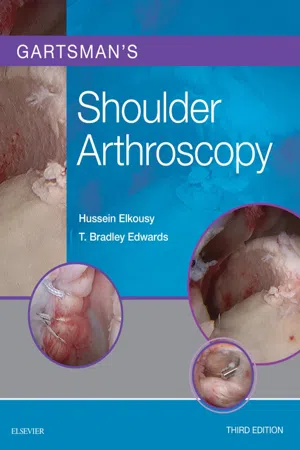
Covering the entire spectrum of operative shoulder arthroscopy, including both routine and complex shoulder procedures, Gartsman's Shoulder Arthroscopy, 3rd Edition, provides a straightforward, "classroom" approach that walks you through each step of these challenging surgeries. Two master surgeons in the field, Drs. Hussein Elkousy and T. Bradley Edwards, present clear explanations of the standard approach to each procedure, plus variations and complications that frequently arise. Focused, concise coverage includes review of anatomy, indications and contraindications, non-operative options, pre-operative assessment and imaging, and more.- Provides a uniform, consistent approach to all aspects of shoulder arthroscopy, including "pearls" from the expert author team of Hussein Elkousy and T. Bradley Edwards.- Includes new and revised content on bicep lesions and acromioclavicular joint pathology, arthroscopic diagnostic and management tools, rehabilitation and new non-metallic implants and knotless techniques.- Contains more videos, techniques and images on how to address rotator cuff and labral pathology.- Features superb intraoperative photographs and line drawings, as well as accompanying videos for dynamic clarification – all updated to offer the latest visual guidance in the field.- Expert Consult™ eBook version included with purchase. This enhanced eBook experience allows you to search all of the text, figures, and references from the book on a variety of devices.
- 392 pages
- English
- ePUB (mobile friendly)
- Available on iOS & Android
eBook - ePub
Gartsman's Shoulder Arthroscopy E-Book
About this book
Information
Topic
MedicineSubtopic
OrthopedicsSection Three
Subacromial Space Surgery
Chapter 10
Impingement Syndrome
Rotator cuff tendon lesions of the subacromial space include tendinosis (impingement syndrome), partial-thickness tears, and full-thickness tears. Full-thickness tears come in all patterns and sizes and can be further classified as being fully reparable, partially reparable, or irreparable, depending on several factors that will be reviewed in later chapters. Impingement syndrome refers to extrinsic compression of the rotator cuff tissue by the acromion or coracoid resulting in pain with or without damage to the rotator cuff. The impingement is due to contact of these structures with the underlying rotator cuff (static). Internal impingement is associated with glenohumeral pathology or dyskinesis of the rotator cuff and scapular stabilizers, and is not addressed in this chapter.
Diagnosis
Because impingement involves the rotator cuff, it presents similar to rotator cuff tears. The patient complains of subdeltoid pain with radiation down the lateral arm to the area of the deltoid insertion or down the front of the arm into the biceps muscle. Pain occurs as the arm passes through the arc of 70 to 100 degrees of abduction. Typical activities that are bothersome include reaching overhead (e.g., for items on a high shelf), behind the back (e.g., to fasten a brassiere or belt), or to the side (e.g., to insert an ATM card, use a seatbelt, or access an alarm clock). Patients with severe symptoms may complain of pain that interferes with sleep. The role of trauma is variable; some patients present with symptoms after major injury, but in many others, the pain occurs after repetitive activities without trauma or antecedent injury.
Physical examination normally demonstrates full passive range of motion. Small limitations in elevation and behind-the-back internal rotation are due to the patient's pain rather than true passive glenohumeral joint contracture. Active abduction and behind-the-back internal rotation are painful. The patient often reports pain while actively lowering the arm after the examiner raises it passively. The primary (Neer) and secondary (Hawkins) impingement signs are positive, and pain is relieved with a subacromial lidocaine injection (impingement test). The patient may have pain with palpation over the supraspinatus insertion.
Three special physical exam tests consistent with impingement have been described and are recorded as positive when subacromial pain is produced. The primary (Neer) sign occurs when the examiner places the shoulder in maximal elevation. To demonstrate the secondary (Hawkins) sign, the shoulder is elevated 80 degrees and then maximally internally rotated. The tertiary sign (painful arc) consists of subacromial pain with the shoulder in 90 degrees of abduction. The location of the pain should be carefully noted. A patient with soft tissue pain from rhomboid-trapezius spasm may have increased pain during each of these maneuvers, but the pain is not localized to the subacromial region.
After the physical examination, the surgeon may perform an impingement test. This test consists of injecting local anesthetic into the subacromial space and then attempting to elicit the impingement signs again. If the pain is eliminated or substantially reduced, the test is recorded as positive. The physician must be aware that a positive test result only confirms that the structures producing pain lie within the subacromial space; it is not, by itself, diagnostic of impingement syndrome. Our preferred technique for subacromial injection is posterior, but other surgeons are equally successful with lateral or anterior approaches. We use ultrasound guidance to confirm the location of the injection.
The diagnosis of impingement syndrome is clinical, and arthroscopy does not routinely play ...
Table of contents
- Cover image
- Title Page
- Table of Contents
- Copyright
- Dedication
- Preface
- Video Contents
- Section One The Basics
- Section Two Glenohumeral Joint Surgery
- Section Three Subacromial Space Surgery
- Index
Trusted by 375,005 students
Access to over 1.5 million titles for a fair monthly price.
Study more efficiently using our study tools.
Frequently asked questions
Yes, you can cancel anytime from the Subscription tab in your account settings on the Perlego website. Your subscription will stay active until the end of your current billing period. Learn how to cancel your subscription
No, books cannot be downloaded as external files, such as PDFs, for use outside of Perlego. However, you can download books within the Perlego app for offline reading on mobile or tablet. Learn how to download books offline
Perlego offers two plans: Essential and Complete
- Essential is ideal for learners and professionals who enjoy exploring a wide range of subjects. Access the Essential Library with 800,000+ trusted titles and best-sellers across business, personal growth, and the humanities. Includes unlimited reading time and Standard Read Aloud voice.
- Complete: Perfect for advanced learners and researchers needing full, unrestricted access. Unlock 1.5M+ books across hundreds of subjects, including academic and specialized titles. The Complete Plan also includes advanced features like Premium Read Aloud and Research Assistant.
We are an online textbook subscription service, where you can get access to an entire online library for less than the price of a single book per month. With over 1.5 million books across 990+ topics, we’ve got you covered! Learn about our mission
Look out for the read-aloud symbol on your next book to see if you can listen to it. The read-aloud tool reads text aloud for you, highlighting the text as it is being read. You can pause it, speed it up and slow it down. Learn more about Read Aloud
Yes! You can use the Perlego app on both iOS and Android devices to read anytime, anywhere — even offline. Perfect for commutes or when you’re on the go.
Please note we cannot support devices running on iOS 13 and Android 7 or earlier. Learn more about using the app
Please note we cannot support devices running on iOS 13 and Android 7 or earlier. Learn more about using the app
Yes, you can access Gartsman's Shoulder Arthroscopy E-Book by Hussein Elkousy,T. Bradley Edwards in PDF and/or ePUB format, as well as other popular books in Medicine & Orthopedics. We have over 1.5 million books available in our catalogue for you to explore.