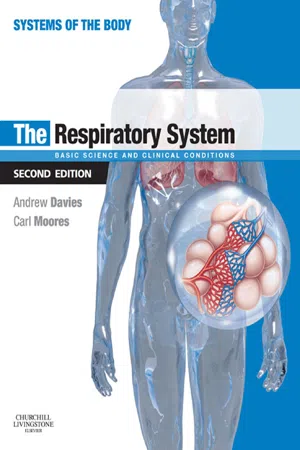
This is an integrated textbook on the respiratory system, covering the anatomy, physiology and biochemistry of the system, all presented in a clinically relevant context appropriate for the first two years of the medical student course.- One of the seven volumes in the Systems of the Body series.- Concise text covers the core anatomy, physiology and biochemistry in an integrated manner as required by system- and problem-based medical courses.- The basic science is presented in the clinical context in a way appropriate for the early part of the medical course.- There is a linked website providing self-assessment material ideal for examination preparation.
- 180 pages
- English
- ePUB (mobile friendly)
- Available on iOS & Android
eBook - ePub
About this book
Information
1
INTRODUCTION
Introduction
The aim of this book is to provide an understanding of the respiratory system: its structure, function, and the diseases and conditions that may affect it. In attempting to do this we are adopting the philosophy of the new curriculum in medicine, which involves bringing to bear on a particular topic all the sciences relevant to that topic. To include in one book all that a student should know about the anatomy, histology, physiology, pharmacology and medicine of the respiratory system would result in a gigantic and intimidating tome. Equally unsatisfactorily, all these subjects could be treated superficially. We have adopted the policy of basing an understanding of the respiratory system on a full description of its physiology and anatomy, with specific topics of particular clinical importance being expanded upon in terms of clinical sciences.
For students to learn effectively, the material they must master should be broken down into manageable portions with a coherent theme: these are the chapters of this book, with each theme being based on a particular function of the respiratory system.
Students must also know what is expected of them, and each chapter is preceded by a list of aims and objective – things you should be able to do when you have mastered the material of that chapter. To provide experience of that bane of student life, examinations, each chapter contains questions of the type you might be asked at an undergraduate level.
What is respiration?
That depends on the context in which you use the word. Biochemists use it to describe the energy-producing chemical processes that take place in tissues, cells or even parts of cells. In this book we will use the physiologist’s definition, which is ‘An interchange of gases between an organism and its environment’. To all intents and purposes, for human beings this means ‘breathing’ (Latin, spiro, ‘I breathe’). The movement of air into and out of the lungs, which most people call breathing, is called by physiologists ventilation. Breathing is brought about by specific structures of the body, including (but not exclusively) the lungs. A description of these structures at a macroscopic (anatomical) and microscopic (histological) level helps us to understand the processes of the respiratory system and the disruption of these processes and structures (pathology) that brings about disease.
The part of our environment involved in this ‘interchange of gases’ mentioned above is of course the air around us, and our need for air must have been obvious to even our most distant ancestors. This need is recorded in some very ancient writings. For example, Anaximenes of Miletus (c. 570 bc) observed that air or pneuma (Greek, ‘breath’) was essential to life.
What was not clear to the ancients was what the air was used for. Aristotle, drawing on theories dating from the 5th century bc which noted the rapid and repeated movements of the heart, relegated the function of the lungs to a sort of radiator, and stated with his usual authority:
…as the heart might easily be raised to too high a temperature by hurtful irritation (by its rapid movements) the genii placed the lungs in its neighbourhood, which adhere to it and fill the cavity of the thorax, in order that air vessels might moderate the great heat.
Galen (130–199 ad), probably more by an accident of metaphor rather than on any scientific evidence, came close to describing the true nature of respiration when he compared it to a lamp burning in a gourd:
When an animal inspires it is, I think, similar to a perforated gourd, but when respiration is prevented at the appropriate place on the trachea, you may compare it to a gourd unperforated and everywhere closed.
If Galen had had the benefit of modern gas analysing facilities he would have found even closer parallels between breathing and burning, with oxygen (O2) being consumed and carbon dioxide (CO2) being produced in both cases.
The ‘bottom line’ of an account of the complicated process of respiration begins with a flow of
OXYGEN IN and ends with a flow of CARBON DIOXIDE OUT.
These two flows are the first and final results of the complex metabolism of the body, and this book describes the respiratory system that facilitates these flows.
The need for respiration
One definition of the success of a species of organism, in evolutionary terms, is how well it can maintain constant the composition of the fluid surrounding its individual cells (its internal environment) despite changes in its external environment (surroundings getting dryer, colder, warmer etc.). This process is called homeostasis and requires energy. Most of the energy generated by our tissues is the result of oxidation of food substrates, and this is the reason we need a flow of OXYGEN IN. Neophytes in physiology often emphasize the role of the respiratory system in providing this oxygen, and certainly an uninterrupted supply is important, particularly for the nervous system, but of more immediate importance is the removal of CO2. The word oxygen means ‘acid producer’ (Greek, oxy; acid; gen, to produce), and the major product of our oxidative metabolism is the acid gas CO2. The accumulation of CO2 would result in acidification of the body fluids. The importance of removing this CO2 can be demonstrated by rebreathing from a plastic bag for a few minutes. The unpleasant sensation that forces you to stop this rather dangerous experiment is due to over stimulation of the reflex that controls breathing to get rid of this gas. You will see later (Chapter 8) that CO2 produces its acidic effect by reacting with water to form carbonic acid.
Ventilation of the lungs would not fulfil the needs of the cells of our bodies if the results of this ventilation did not diffuse into the blood, which is then carried close to the cells of the body by the circulation.
Diffusion in respir...
Table of contents
- Cover image
- Title page
- Table of Contents
- Copyright
- PREFACE
- ACKNOWLEDGEMENTS
- Chapter 1: INTRODUCTION
- Chapter 2: STRUCTURE OF THE RESPIRATORY SYSTEM, RELATED TO FUNCTION
- Chapter 3: ELASTIC PROPERTIES OF THE RESPIRATORY SYSTEM
- Chapter 4: AIRFLOW IN THE RESPIRATORY SYSTEM
- Chapter 5: VENTILATION OF THE RESPIRATORY SYSTEM: THE IMPORTANCE OF ITS LACK OF UNIFORMITY IN DISEASE
- Chapter 6: GAS EXCHANGE BETWEEN AIR AND BLOOD: DIFFUSION
- Chapter 7: THE PULMONARY CIRCULATION: BRINGING BLOOD AND GAS TOGETHER
- Chapter 8: CARRIAGE OF GASES BY THE BLOOD AND ACID/BASE BALANCE
- Chapter 9: CHEMICAL CONTROL OF BREATHING
- Chapter 10: NERVOUS CONTROL OF BREATHING
- Chapter 11: LUNG FUNCTION TESTS: MEASURING DISABILITY
- Appendix: some basic science
- Glossary
- Index
Trusted by 375,005 students
Access to over 1.5 million titles for a fair monthly price.
Study more efficiently using our study tools.
Frequently asked questions
Yes, you can cancel anytime from the Subscription tab in your account settings on the Perlego website. Your subscription will stay active until the end of your current billing period. Learn how to cancel your subscription
No, books cannot be downloaded as external files, such as PDFs, for use outside of Perlego. However, you can download books within the Perlego app for offline reading on mobile or tablet. Learn how to download books offline
Perlego offers two plans: Essential and Complete
- Essential is ideal for learners and professionals who enjoy exploring a wide range of subjects. Access the Essential Library with 800,000+ trusted titles and best-sellers across business, personal growth, and the humanities. Includes unlimited reading time and Standard Read Aloud voice.
- Complete: Perfect for advanced learners and researchers needing full, unrestricted access. Unlock 1.5M+ books across hundreds of subjects, including academic and specialized titles. The Complete Plan also includes advanced features like Premium Read Aloud and Research Assistant.
We are an online textbook subscription service, where you can get access to an entire online library for less than the price of a single book per month. With over 1.5 million books across 990+ topics, we’ve got you covered! Learn about our mission
Look out for the read-aloud symbol on your next book to see if you can listen to it. The read-aloud tool reads text aloud for you, highlighting the text as it is being read. You can pause it, speed it up and slow it down. Learn more about Read Aloud
Yes! You can use the Perlego app on both iOS and Android devices to read anytime, anywhere — even offline. Perfect for commutes or when you’re on the go.
Please note we cannot support devices running on iOS 13 and Android 7 or earlier. Learn more about using the app
Please note we cannot support devices running on iOS 13 and Android 7 or earlier. Learn more about using the app
Yes, you can access The Respiratory System by Andrew Davies,Carl Moores in PDF and/or ePUB format, as well as other popular books in Medicine & Medical Theory, Practice & Reference. We have over 1.5 million books available in our catalogue for you to explore.