Exercise Physiology in Special Populations covers the prevalent health conditions that are either linked to an inactive lifestyle or whose effects can be ameliorated by increasing physical activity and physical fitness. The book explores physiological aspects of obesity and diabetes before moving on to cardiac disease, lung disease, arthritis and back pain, ageing and older people, bone health, the female participant, neurological and neuromuscular disorders, and spinal chord injury. The author team includes many of the UK's leading researchers and exercise science and rehabilitation practitioners that specialise in each of the topic areas.·Structured in an easy accessible way for students and lecturers·Well referenced, including a further reading list with each chapter..·Written by a group of highly experienced experts.
This text on exercise physiology in special populations aims to cover a number of the prevalent health conditions that are linked to an inactive lifestyle or whose effects can be ameliorated by increasing physical activity and physical fitness. Throughout the text the terms physical activity, exercise and fitness will be used. It is therefore important at this point to first define the assumed meanings of these three terms. Following this, the concepts of physical activity behaviour and the various measurement parameters used by exercise professionals or healthcare practitioners to either monitor or prescribe exercise will be reviewed.
Physical activity is considered to be any muscular movement occurring above resting levels. It is an all-encompassing concept that includes any physical movements occurring within free daily living or planned leisure pursuits (exercise and sport). As will be mentioned in a number of chapters, the prevalence of some diseases is greater in those who expend less than 1500 kilocalories per week above their basal metabolic rate. The arguments highlighted in the Chief Medical Officer’s (CMO) report for England and Wales (Department of Health 2004) tend to suggest that declines in health which are related to inactivity (hypokinesis) and obesity are due more to the loss of physical activity in free daily living than to the debatable reduction in the population’s participation in organized exercise and sport (Cordain et al 1998, Eaton & Eaton 2003). One only has to look at the increased number of sports and fitness centres that have been built in the UK in the last decade to realize that there is certainly not a decline in those already engaged in organized sport and exercise. The reduction in energy expenditure in normal daily life, especially in non-sporty/exercise participants, has greatly increased in the last two decades (Department of Health 2004). This is a result of the increased preference for sedentary leisure pursuits and decreases in the physicality of daily domestic-occupational tasks and transportation.
The discussion thus far focuses on the correlation between inactivity and the increased prevalence of chronic diseases. However, a number of chapters within this text consider exercise in individuals with conditions acquired by poor nutrition or smoking, an accident, or an unfortunate health event, including pulmonary disease, osteoporosis, Parkinson’s disease, multiple sclerosis, arthritis or spinal injury. These conditions can lead to declines in physical activity that contribute to an inactive lifestyle, thus putting the sufferers at risk of chronic diseases such as coronary heart disease and diabetes. In these cases, exercise can be used as a means of combating the future potential ills of inactivity as well as a therapeutic intervention in helping the individual cope better in living with the physiological and psychosocial challenges that lie ahead.
Exercise is typically a planned and/or structured physical activity which has an aim. The aim is usually to satisfy either a physical, psychological or social need, or often a mixture of all three. Exercise was traditionally used as a means of preparing soldiers for battle but in the last 50 years has become prominent in enhancing sporting performance, physical health and personal ‘body image’. Sports performance targets provide a natural motivation for maintaining exercise training. One’s self-image, as promoted through the popular press, often relates to promoting shorter-term targets such as looking good in a holiday swimsuit or for a large social event such as a wedding or important party. The benefit of regular and sustained participation in health-promoting activity is less easy to quantify than athletic performance as the true health outcomes may only be observed after years of participation. Enhancing social and enjoyment aspects of participation in health-based exercise becomes a very important aspect of sustaining any regimen (Biddle & Mutrie 2001). More frequent bouts (
3 times per week) of more intense activity provide a training threshold at which physiological fitness adaptations occur (i.e. enhanced cardiorespiratory fitness, improved blood lipid profile, glucose control and reduced insulin resistance) (ACSM 1998).
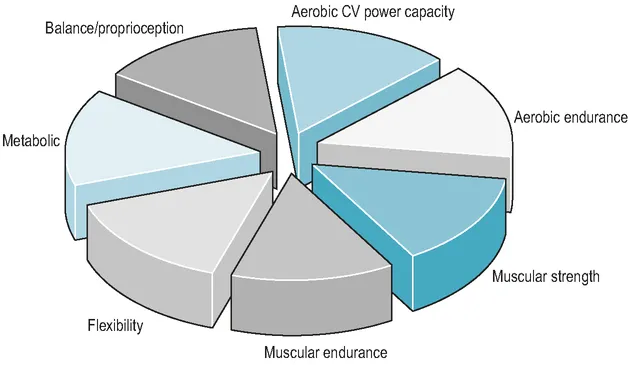
Physical fitness has seven components, which indicate the ability to perform a given task or physical activity. The benefits of improving fitness for health are twofold:
1. Being able to sustain an active life in order to contribute to one’s personal needs and/or roles within family, community and society.
2. Improved fitness is inversely linked with the incidence of morbidity of a variety of diseases and all-cause mortality.
Whether exercising for health or sport performance, the seven components of fitness are the same (summarized below and in Fig. 1.1), namely:
Figure 1.1 The components of physical fitness.
1. Aerobic (cardiorespiratory) power, typically described as
O2max. This is the maximal amount of oxygen the body can take in and utilize. It is influenced by three factors: the lungs’ ability to oxygenate the blood, the cardiovascular system’s ability to deliver the oxygenated blood to the exercising muscles and the muscles’ ability to extract and utilize the oxygen to produce energy for sustained contractions. Inactivity and/or disease impair one or a combination of these three systems and hence reduce an individual’s ability to function.
2. Aerobic (cardiorespiratory) endurance is the highest proportion of
O2max at which an individual can sustain >20 minutes’ activity. It is closely allied to the lactate thresholds described in standard exercise physiology texts, the point at which muscular fatigue begins to be hastened. Elite endurance athletes can sustain activity typically at greater than 80% of their aerobic power, whereas sedentary or diseased individuals may only be able to sustain activity at 40–50% of aerobic power. What this means is that the inactive or diseased person not only has a reduced capacity but also cannot utilize as much of whatever capacity they possess compared with the more active or fitter individual.
3. Metabolic function from a health perspective relates to the ability to control blood sugar levels better and from an exercise performance perspective the ability to deal with or buffer exercise-related changes in muscle and blood pH. The latter demonstrates that the more active individual is also able to tolerate and deal with higher levels of metabolites, prolonging the time before muscular fatigue sets in.
4. Muscular strength is the absolute amount of force that can be generated for one maximal voluntary c...
Table of contents
Cover image
Title page
Table of Contents
Copyright
Dedications
Contributors
Foreword
Preface
Chapter 1: Introduction
Chapter 2: Obesity and diabetes
Chapter 3: Cardiac disease and dysfunction
Chapter 4: Lung disease and dysfunction
Chapter 5: Arthritis and low back pain
Chapter 6: Ageing and older people
Chapter 7: Bone health
Chapter 8: The exercising female
Chapter 9: Neurological and neuromuscular disorders, a guide to pathological processes and primary symptoms
Chapter 10: Spinal cord injury
Index
Trusted by 375,005 students
Access to over 1.5 million titles for a fair monthly price.
Study more efficiently using our study tools.
Frequently asked questions
Yes, you can cancel anytime from the Subscription tab in your account settings on the Perlego website. Your subscription will stay active until the end of your current billing period. Learn how to cancel your subscription
No, books cannot be downloaded as external files, such as PDFs, for use outside of Perlego. However, you can download books within the Perlego app for offline reading on mobile or tablet. Learn how to download books offline
Perlego offers two plans: Essential and Complete
Essential is ideal for learners and professionals who enjoy exploring a wide range of subjects. Access the Essential Library with 800,000+ trusted titles and best-sellers across business, personal growth, and the humanities. Includes unlimited reading time and Standard Read Aloud voice.
Complete: Perfect for advanced learners and researchers needing full, unrestricted access. Unlock 1.5M+ books across hundreds of subjects, including academic and specialized titles. The Complete Plan also includes advanced features like Premium Read Aloud and Research Assistant.
Both plans are available with monthly, semester, or annual billing cycles.
We are an online textbook subscription service, where you can get access to an entire online library for less than the price of a single book per month. With over 1.5 million books across 990+ topics, we’ve got you covered! Learn about our mission
Look out for the read-aloud symbol on your next book to see if you can listen to it. The read-aloud tool reads text aloud for you, highlighting the text as it is being read. You can pause it, speed it up and slow it down. Learn more about Read Aloud
Yes! You can use the Perlego app on both iOS and Android devices to read anytime, anywhere — even offline. Perfect for commutes or when you’re on the go. Please note we cannot support devices running on iOS 13 and Android 7 or earlier. Learn more about using the app
Yes, you can access Exercise Physiology in Special Populations by John P. Buckley, Neil Spurway, Don MacLaren in PDF and/or ePUB format, as well as other popular books in Medicine & Physiotherapy, Physical Medicine & Rehabilitation. We have over 1.5 million books available in our catalogue for you to explore.