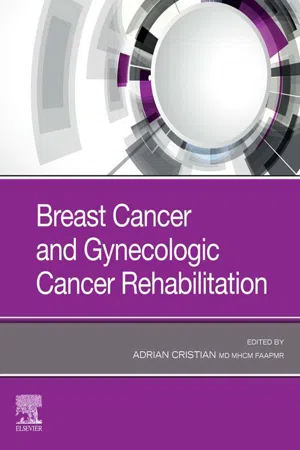
Breast Cancer and Gynecological Cancer Rehabilitation, edited by Adrian Cristian, MD, MHCM, provides today's clinicians with a concise, accessible resource covering the holistic rehabilitation of breast cancer patients. Beginning with a review of epidemiology, genetics, and pathophysiology of breast cancer, it then covers clinical assessment and treatment options before providing comprehensive coverage of rehabilitation. Containing practical information, best practices, and the latest advances and research, this book is a valuable reference for physical medicine and rehabilitation physicians and residents, as well as occupational and physical therapists.- Provides a clear understanding of the current medical, surgical, and radiation treatments for breast cancer.- Covers the whole spectrum of breast cancer rehabilitation, including the role of physical and occupational therapy, treatment of anxiety and depression, pain syndromes, integrative care, nutritional rehabilitation, palliative care, and more.- Offers a timely and convenient resource written by leading experts in breast cancer and rehabilitation.
- 336 pages
- English
- ePUB (mobile friendly)
- Available on iOS & Android
eBook - ePub
Breast Cancer and Gynecological Cancer Rehabilitation
About this book
Information
Topic
MedicinaSubtopic
Terapia ocupacionalSection I
Outline
Chapter 1
Cascade of Disability in Breast and Gynecologic Cancer
Adrian Cristian, MD, MHCM
Abstract
Earlier detection and improved treatments have been very beneficial to improving survivorship from breast and gynecologic cancers. However, the combination of a person’s precancer level of health, other medical illnesses, cancer characteristics, and cancer-related physical impairments can all contribute to loss of function. This cascade of disability can lead to a decreased quality of life. It is important for rehabilitation clinicians to be able to identify the various layers of disability in this cascade phenomenon early and introduce interventions that can minimize functional loss.
Keywords
Breast cancer; gynecologic cancer; impairments
Introduction
According to the American Cancer Society, as of January 1, 2019, there were 3,861,520 women living with breast cancer; 807,860 women living with uterine cancer; 283,120 women living with cervical cancer; and 249,320 women living with ovarian cancer. The 5-year survival rates are 91% for breast cancer, 65.8% for cervical cancer, 81.2% for uterine cancer, and 47.6% for ovarian cancer.1–3 As women are surviving breast and gynecologic cancers longer, it is perhaps not surprising that the projection for people living with breast and gynecologic cancers is to see these numbers increase. The projection is that by 2030 there will be 4,957,960 living with breast cancer; 1,023,290 living with uterine cancer; 297,580 living with ovarian cancer; and 288,710 living with uterine cervix cancer. Women are also living substantially longer post diagnosis as well. For example, 19% of women are living 20+ years since diagnosed with breast cancer, 29% since diagnosed with ovarian cancer, 49% since diagnosed with cervical cancer, and 22% with uterine cancer. The number of women living with metastatic breast cancer is greater than 150,000. Women are also diagnosed with breast or gynecologic cancer more often later in life. For example, age at prevalence for women diagnosed with breast cancer in the 65–84 age-group was 51% for breast cancer, 47% for ovarian cancer, 39% for uterine cancer, and 56% for uterine corpus.
These statistics illustrate that there are a significant number of women diagnosed with breast and gynecologic cancers, often later in life and living longer post treatments for their cancer. The most common treatments for these types of cancers include a combination of surgery, radiation therapy, chemotherapy, and antihormonal therapy. Whereas these treatments can be very successful in treating the cancer, they can also have an adverse impact on healthy tissues such as muscle, nerve, and connective. The adverse impact on healthy tissues can at times be very close to the onset of the treatment; however, these adverse effects often develop slowly over time leading to a gradual loss of function that can be imperceptible to both the individual and the treatment team. Often the loss of function cannot be directly linked to any one treatment, but rather to a combined effect of several treatments as well the patient’s own precancer state of health, nutritional status, and preexisting diseases such as diabetes mellitus.
Rehabilitation medicine should be an integral part of the care of the person with breast or gynecologic cancer from time of diagnosis, through active treatment and in the survivorship period. Following diagnosis and precancer treatment, physiatrists can assess the patient for any preexisting physical impairments of key body structures that would be subjected to the effects of multimodality cancer treatment. For the person with newly diagnosed breast cancer, this can include shoulder dysfunction, assessment of preexisting peripheral neuropathy, preexisting painful joint conditions affecting the hands, knees, and lower back, and lymphedema. For the person with newly diagnosed gynecologic cancer, this can include assessment of preexisting peripheral neuropathy, preexisting lymphedema of leg, impaired balance, decreased fine motor skills and strength in hands, and history of pelvic floor dysfunction. In addition, an assessment of nutritional status, preexisting cognitive impairment, depression, and anxiety is also very important.
Physiatrists can also provide useful and timely information to medical, surgical, and radiation oncologists with respect to potential impact of cancer treatment on loss of function, which can then in turn be useful in the planning of the cancer treatment. This is based on their knowledge of functional anatomy of the musculoskeletal and nervous systems as well as assessment of functional loss. This information would ideally be discussed at multidisciplinary tumor boards. Another role that physiatrists can have in the planning of cancer treatment is to assess the patient for frailty since frailty can have an adverse impact on a person’s ability to tolerate cancer treatments.
Once these preexisting impairments are identified, a coordinated effort of various team members such as physical therapy, occupational therapy, psychology, and nutrition to minimize them is critical. At times, it is not realistic to address all of these impairments prior to start of treatment since the patient’s focus as well as that of the cancer treatment team is on initiating treatment as soon as possible, therefore prioritization is key. For example, a patient with a preexisting reduction in range of motion of the shoulder would need this limitation to be addressed to help her undergo radiation therapy. Rehabilitative interventions can be continued during active cancer treatment; however, this depends on the patient’s ability to tolerate both cancer treatment and rehabilitative interventions concurrently. Periodic surveillance for subjective and objective evidence of loss of physical function becomes important at times during active treatment as well as during survivorship.
Assessment of Breast and Gynecologic Cancer Patient with a Focus on Physical Impairments and Loss of Function
The physiatrist should approach the assessment of the person with breast or gynecologic cancer by having a good working knowledge of the common physical, cognitive, and psychologic impairments affecting the breast and gynecologic cancer patients and utilizing appropriate clinical assessment tools.
A review of pertinent past medical history and past surgical history can help identify the areas of potential loss of function. For example, preexisting peripheral neuropathy from diabetes may worsen once the patient is treated with chemotherapy, thereby adversely affecting hand function and balance. Another example is a patient with a history of limited shoulder function due to adhesive capsulitis that could potentially lead to a worsening of the condition following treatment of breast cancer with surgery and radiation therapy.
Review of prior imaging studies such as PET/CT scans, bone scans, MRIs, and plain X-rays can help identify the areas with metastatic disease. Results of echocardiograms and pulmonary function studies, if available, can provide information about heart and lung function, respectively. That knowledge can then be used in setting precautions during rehabilitation to minimize the risk of harm for the patient. Review of laboratory studies such as hemoglobin, platelet, and white blood cell counts can yield importa...
Table of contents
- Cover image
- Title page
- Table of Contents
- Copyright
- Dedication
- List of Contributors
- Preface
- Section I
- Section II
- Section III
- Section IV
- Index
Trusted by 375,005 students
Access to over 1.5 million titles for a fair monthly price.
Study more efficiently using our study tools.
Frequently asked questions
Yes, you can cancel anytime from the Subscription tab in your account settings on the Perlego website. Your subscription will stay active until the end of your current billing period. Learn how to cancel your subscription
No, books cannot be downloaded as external files, such as PDFs, for use outside of Perlego. However, you can download books within the Perlego app for offline reading on mobile or tablet. Learn how to download books offline
Perlego offers two plans: Essential and Complete
- Essential is ideal for learners and professionals who enjoy exploring a wide range of subjects. Access the Essential Library with 800,000+ trusted titles and best-sellers across business, personal growth, and the humanities. Includes unlimited reading time and Standard Read Aloud voice.
- Complete: Perfect for advanced learners and researchers needing full, unrestricted access. Unlock 1.5M+ books across hundreds of subjects, including academic and specialized titles. The Complete Plan also includes advanced features like Premium Read Aloud and Research Assistant.
We are an online textbook subscription service, where you can get access to an entire online library for less than the price of a single book per month. With over 1.5 million books across 990+ topics, we’ve got you covered! Learn about our mission
Look out for the read-aloud symbol on your next book to see if you can listen to it. The read-aloud tool reads text aloud for you, highlighting the text as it is being read. You can pause it, speed it up and slow it down. Learn more about Read Aloud
Yes! You can use the Perlego app on both iOS and Android devices to read anytime, anywhere — even offline. Perfect for commutes or when you’re on the go.
Please note we cannot support devices running on iOS 13 and Android 7 or earlier. Learn more about using the app
Please note we cannot support devices running on iOS 13 and Android 7 or earlier. Learn more about using the app
Yes, you can access Breast Cancer and Gynecological Cancer Rehabilitation by Adrian Cristian in PDF and/or ePUB format, as well as other popular books in Medicina & Terapia ocupacional. We have over 1.5 million books available in our catalogue for you to explore.