'Sometimes called coining, spooning or scraping, Gua sha is defined as instrument-assistedunidirectional press-stroking of a lubricated area of the body surface that intentionally creates'transitory therapeutic petechiae' representing extravasation of blood in the subcutis.'Gua sha has been used for centuries in Asia, in Asian immigrant communities and byacupuncturists and practitioners of traditional East Asian medicine worldwide. With theexpansion of traditional East Asian medicine, Gua sha has been used over broad geographicareas and by millions of people. It is valuable in the treatment of pain and for functionalproblems with impaired movement, the prevention and treatment of acute infectious illness, upper respiratory and digestive problems, and many acute or chronic disorders. Research hasdemonstrated Gua sha radically increases surface microperfusion that stimulates immune andanti-inflammatory responses that persist for days after treatment.The second edition expands on the history of Gua sha and similar techniques used in earlyWestern Medicine, detailing traditional theory, purpose and application and illuminated byscience that focuses its relevance to modern clinical practice as well as scholarly inquiry.This book brings the technique alive for practitioners, with clear discussion of how to do it –including correct technique, appropriate application, individualization of treatment – and whento use it, with over 50 case examples, and superb color photographs and line drawings thatdemonstrate the technique.NEW TO THIS EDITION• New chapter on immediate and significant Tongue changes as a direct result of Gua sha• Research and biomechanisms• Literature review from Chinese language as well as English language medical journal database• New case studies• Over 30 color photographsNew chapter on immediate and significant Tongue changes as a direct result of Gua shaResearch and biomechanismsLiterature review from Chinese language as well as English language medical journal databaseNew case studiesFully updated and revised throughoutOver 30 colour photographs
- 208 pages
- English
- ePUB (mobile friendly)
- Available on iOS & Android
eBook - ePub
About this book
Information
1
Gua sha and the history of traditional medicine, West and East
I wish I could make a petechial fever; in other words I wish I could produce upon the skin that state of counteraction existing when petechial spots are formed.
(Boerhave (1668–1738) quoted in Epps (1832))
Counteraction medicine: the crisis is the cure
Although Western historians refer to Hippocrates (459–377 bc) as the father of medicine, this is as accurate as the assertion that Columbus discovered America. American Indians had, of course, discovered the continent and themselves. Furthermore, Viking ships were known to have visited the Americas long before Columbus, as evidenced by the dating of mollusk fossils that are thought to have hitched a ride by attaching themselves to the ships.
The bulk of medical knowledge collected and practiced by Hippocrates was Egyptian in origin, not Greek. Egyptian physicians taught in Greece, Persia and Arabia. Atkinson (1956) notes that the principles of the Hippocratic Oath date back to the Egyptian Ebers Papyrus, written in 1553 bc. The Ebers Papyrus is one of the oldest, most complete and unspoiled books in existence. It verifies that Egyptian medical and surgical knowledge was as advanced at the time of its writing as it was 1500 years later during the time of Galen.
Medical education in Greek society passed from father to son. Hippocrates’ own grandfather studied with an Egyptian. What distinguished Hippocrates as a practitioner of the medicine of his day was his bedside observations and the recording of his patients’ symptoms and treatments that make up the Hippocratic Canon: ‘The intention of the physician should be called to the position of the patient in bed, to the nature of his expectoration, and to the character of his breathing’ (Atkinson 1956). Scholars do not think the Hippocratic Canon was written by one person, but rather, constructed over time by many authors following principles attributed to Hippocrates. As in Greece, so in China. Ch’i Po, the legendary physician whose conversations with Emperor Huang Di were recorded in the Huang Di Nei Ching Su Wen (2nd century bc), states in chapter 5:
… by observing the external symptoms one gathers knowledge about internal disturbances. One should watch beyond the ordinary limits … one should observe minute and trifling things as if they were of normal size, and when they are thus treated they cannot become dangerous.
(Veith 1966)
In Celestial Lancets, Lu Gwei-djen and Joseph Needham (1980) note that the Chinese medical classics, the Nei Ching and early Han texts of the 2nd and 1st centuries bc, correspond in large measure with the Hippocratic Corpus. The Nei Ching (~ 200 bc) is a record of a constructed conversation between the Yellow Emperor Huang ti and his physician, Ch’i Po. Nigel Wiseman (personal communication, 2000) has noted that in early Chinese, a mono- and disyllabic language, the name ‘Hippocrates’ (~ 400 bc), would have been pronounced as ‘chee-po’, or the softer ‘hee-po’, which is remarkably akin to the name of the Nei Ching physician ‘Ch’i Po’. This correspondence was noted in 1685 by Willem ten Rhijne (1647–1700). According to Baldry (1989), ten Rhijne is credited as the first person to give the modern Western world a detailed account of Chinese acupuncture and moxibustion.
The shared understanding of ancient medical traditions will be considered below. Their very correspondence indicates common origins, collaboration or profound synchronicity. If exchange of medical ideas among ancient cultures cannot be dated, it can be assumed to have coincided with trade of goods. With traffic of goods came traffic of diseases and epidemics, and the opportunity for trade in notions and materials of medicine.
In Plagues and Peoples, McNeill (1989) contends that when travel from China and India to the Mediterranean became regularly organized and routine, a homogenization of the germ pool occurred. From the study of disease and epidemic patterns, he believes that something approximating this did, in fact, occur, beginning in the 1st century ad. Chinese silk was exchanged by traders from these ancient civilizations and their route of trade is well documented along the famous Silk Road.
The Silk Road
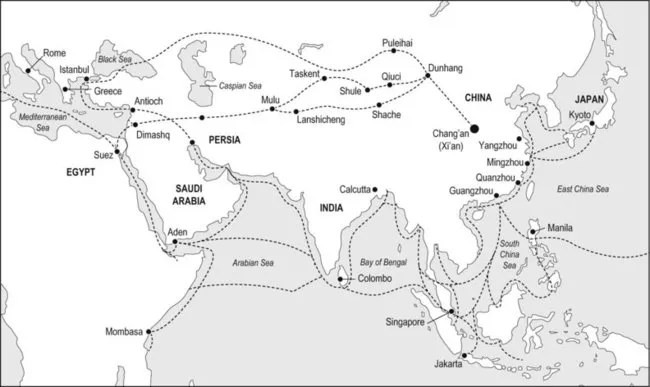
Chinese silk was traded via the Silk Road (see Figure 1.1) long before the Christian Era. According to The Silk Road on Land and Sea (China Pictorial Publications 1989), the Silk Road was the artery for the exchange of commerce, technology and culture, and was a significant influence on the development of the great civilizations of China, India, Egypt, Persia, Arabia, Greece and Rome:
Inscriptions on bones and tortoise shells of the Shang Dynasty (c. 16th–11th century bc) bear the characters for ‘silkworm’, ‘mulberry’, ‘silk’ and ‘silk fabric’. In the Book of Isaiah in the Old Testament, which was written between 740–701 bc, the Chinese are referred to as ‘Sinim’ (silk men) and the Chinese silk is mentioned in the Book of Ezekiel.
One Roman poet wrote that Chinese silk yarn was finer than a spider’s threads. Julius Caesar (100–44 bc) is said to have appeared in the theater dressed in a toga of Chinese silk, and his garment became the focus of attention as an unprecedented luxury, so that from then on aristocratic families considered it an honor to wear Chinese silk.
Agents did not necessarily travel the Silk Road end-to-end but transported goods to exchange at markets in towns or oases along the route. Various groups or tribes, the Scythians for example, demanded compensation for passage of goods (Wood 2002). When Anxi (Iran) tried to control the silk trade by obstructing the overland route, this necessitated a route by sea. As The Silk Road on Land and Sea explains: ‘In 166CE[AD], Roman Emperor Marcus Aurelius succeeded in dispatching an envoy to China via Rinan (Vietnam) with ivory, rhinoceros horns, and hawksbill tortoises, initiating direct trade between Rome and China’.
The most recent archeological studies suggest that the silk trading trade across Eurasia started even earlier than was previously thought. Strands of silk known to have been Chinese in origin were found in the hair of an Egyptian mummy dated 1000 bc. The mummy was found at a burial ground of the King’s workers at Thebes. These findings give greater credibility to previous reports of silk fabrics being excavated from 7th century bc German sites and 5th century bc burial sites in Greece. When this discovery was first reported in the New York Times, Wilford (1993) wrote:
Caravans headed east with gold, woolens, ivory, amber, and glass. From China the camels were laden with furs, ceramics and lacquer, as well as silk. By the first century bc the Romans could not get enough of this commodity, which to them was synonymous with China. The Romans had learned of the Chinese from the Greeks, who called them ‘Seres’ and the Latin word for silk became ‘serica’.
McNeill (1989) sees striking similarities in Roman and Chinese history. He postulates that the similar religious and political trends were cultural accommodations of similar disease trends, which reflected homogenization of infections from repeated trade contact.
Scythians and other nomadic peoples ranged widely across Eurasia and had fairly extensive contact with both Greek and Chinese cultures. Hippocrates noted in his text Airs, Waters and Places that the Scythians, cauterized and let blood. Moreover, Scythian bloodletting presupposed ties between remote parts of the body similar to the perceptions of the Greeks and Chinese (Kuriyama 1999).
An idea beyond the scope of this book, it nonetheless corroborates a connection between the two civilizations. Their medical approach suggests communication and a synchronous perception of and response to illness.
Hippocrates, Galen and Ch’i Po: humoral medicine
Galen (ad 129–200) was one of the most famous physicians in Rome during the reign of Marcus Aurelius, who established direct trade with China. A Greek, Galen followed the methods of medicine passed from Greece, known as Hippocratic. The four elements of Fire, Water, Earth and Air combined to form t...
Table of contents
- Cover image
- Title page
- Table of Contents
- Copyright
- Dedication
- Biographies
- Foreword
- Preface
- Acknowledgments
- Chapter 1: Gua sha and the history of traditional medicine, West and East
- Chapter 2: Evidence for Gua sha: A review of Chinese and Western literature
- Chapter 3: Physiology of Gua sha: Western biomodels and East Asian functional perspective
- Chapter 4: San Jiao
- Chapter 5: Sha syndrome and Gua sha, cao gio, coining, scraping
- Chapter 6: Application of Gua sha
- Chapter 7: Immediate and significant Tongue changes as a direct result of Gua sha
- Chapter 8: Classical treatment of specific disorders: location, quality, mutability and association
- Chapter 9: Cases
- Appendix A: Gua sha handout
- Appendix B: List of common acupuncture points by number and name
- Appendix C: Directions for Neti wash and Croup tent
- Appendix D: Tabled articles and studies with full citations: Gua sha literature review
- Glossary of terms
- Color Page
- Index
Trusted by 375,005 students
Access to over 1.5 million titles for a fair monthly price.
Study more efficiently using our study tools.
Frequently asked questions
Yes, you can cancel anytime from the Subscription tab in your account settings on the Perlego website. Your subscription will stay active until the end of your current billing period. Learn how to cancel your subscription
No, books cannot be downloaded as external files, such as PDFs, for use outside of Perlego. However, you can download books within the Perlego app for offline reading on mobile or tablet. Learn how to download books offline
Perlego offers two plans: Essential and Complete
- Essential is ideal for learners and professionals who enjoy exploring a wide range of subjects. Access the Essential Library with 800,000+ trusted titles and best-sellers across business, personal growth, and the humanities. Includes unlimited reading time and Standard Read Aloud voice.
- Complete: Perfect for advanced learners and researchers needing full, unrestricted access. Unlock 1.5M+ books across hundreds of subjects, including academic and specialized titles. The Complete Plan also includes advanced features like Premium Read Aloud and Research Assistant.
We are an online textbook subscription service, where you can get access to an entire online library for less than the price of a single book per month. With over 1.5 million books across 990+ topics, we’ve got you covered! Learn about our mission
Look out for the read-aloud symbol on your next book to see if you can listen to it. The read-aloud tool reads text aloud for you, highlighting the text as it is being read. You can pause it, speed it up and slow it down. Learn more about Read Aloud
Yes! You can use the Perlego app on both iOS and Android devices to read anytime, anywhere — even offline. Perfect for commutes or when you’re on the go.
Please note we cannot support devices running on iOS 13 and Android 7 or earlier. Learn more about using the app
Please note we cannot support devices running on iOS 13 and Android 7 or earlier. Learn more about using the app
Yes, you can access Gua sha by Arya Nielsen in PDF and/or ePUB format, as well as other popular books in Medicine & Alternative & Complementary Medicine. We have over 1.5 million books available in our catalogue for you to explore.