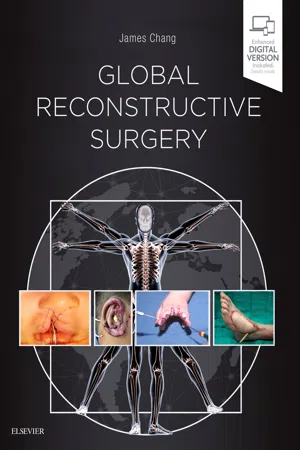
As the surgical community steps up to tackle the global burden of surgical disease in developing countries, Global Reconstructive Surgery is the first reference of its kind to offer focused, pertinent coverage of key areas surgeons need to understand to fully participate in this endeavor. It provides authoritative, real-world guidance on common surgeries performed around the world to help optimize outcomes in difficult environments and for a variety of conditions.- Offers practical wisdom and experience from surgeons who have lived and worked in challenging global settings. The clear, organized format is based on the way clinicians examine, prepare for, and treat patients in resource-limited circumstances.- Each chapter matches the clinical pathway and thought processes of care delivery, from the clinical problem and pre-operative assessment to operative intervention, post-operative care, and possible complications and options for management.- Covers perioperative management, cleft and craniofacial surgery, hand surgery, burns, trauma, and key techniques commonly performed by surgeons across the globe.- Includes the surgical steps of each procedure, photographs of clinical cases, and surgical pearls for resource-poor settings.- Discusses alternative approaches related to cultural considerations and unavailability of state-of-the-art equipment.- Ideal for plastic surgeons, otolaryngologists, craniofacial surgeons. oral and maxillofacial surgeons, general surgeons – both those who volunteer for surgical trips and those training in local communities.
- 432 pages
- English
- ePUB (mobile friendly)
- Available on iOS & Android
eBook - ePub
Global Reconstructive Surgery
About this book
Information
Topic
MedicineSubtopic
Ear, Nose & Throat MedicineSection 1
Perioperative Management
1.1
Pre-Operative Screening
Katherine D. Gallagher
Synopsis
Elective surgery in resource-limited countries is often performed by mobile surgical teams, either as an outreach within the country itself, or as a volunteer group from another country. These teams provide a needed service; however, they are often operating in unfamiliar settings and with limited ancillary support. Careful screening of the patients with respect to overall health and post-operative requirements is necessary to ensure maximum benefit from the surgery, with minimum risk to the patient. This chapter offers guidelines for pre-operative screening, including a targeted medical history, the medical examination, and appropriate laboratory testing. Specific concerns are outlined. Sample medical history checklist and an immediate pre-operative checklist are included.
Introduction
You are planning to do surgery in a resource-limited country. The need is great. The surgical team is willing. Your goal is to help as many people as possible. In this setting, how can you ensure the maximum benefit for your patients with the least risk? Appropriate evaluation of the site and careful screening of the prospective patients are vital to ensure patient safety and to produce good outcomes. Site requirements and patient selection will vary according to area, team expertise, and the types of surgeries planned. The following are some general guidelines and considerations to aid in the process.
Screening of the Site
When planning surgery in a new and unfamiliar venue, the site should be evaluated. The more complex the surgery and the longer the recovery, the more important are the physical environment and the services available. Guidelines for the operating room (OR) and post-anesthesia care unit (PACU) needs are discussed in their respective chapters. The following are considerations for optimal post-operative care.
Ward Needs
- • Adequate number of beds for anticipated patient days (number of patients × length of stay per patient).
- • Hygiene: adequate bathroom and handwashing facilities.
- • Ability to keep surgical sites clean post-operatively.
- • Ability to ensure patient comfort (which in turn facilitates pain control). This includes temperature conditioning (AC units, fans, heaters) and positioning.
- • Reasonable proximity to OR and PACU to allow monitoring and ease of transport. Ramps or elevators to move between levels may be needed.
Nursing Support
- • Adequate trained nurses to carry out any patient care and medication administration that exceed the family's capabilities (e.g., IV medications).
- • Staff comfortable with monitoring patients for post-operative complications (bleeding, poor circulation, poor intake, uncontrolled pain).
Ancillary Support
- • Availability of an intensive care unit (ICU) and arrangements for transfer of care, if needed.
- • A laboratory able to perform blood counts, routine chemistries and, when appropriate, HIV tests, sickle cell anemia screens, and malaria screens.
- • Access to a blood bank with the ability to obtain screened blood and to perform a type and cross-match in a reasonable length of time (1–2 hours).
- • A pharmacy in-house or within a reasonable distance that can supply medications that are needed and that were not brought into the country by the team.
Follow-Up Care
- • A designated, willing, and available practitioner is needed for the care needs during the time period when the team is no longer present (dressing changes, graft monitoring, pins, catheters, etc.). This individual should be identified before surgery and must realistically have time available. Optimally this person will be able to work with the operating surgeons while they are on-site and communicate with them after they leave, to discuss care concerns and to provide follow-up information.
- • Physical/occupational therapy may be needed to monitor patients and provide splinting and exercises to preserve surgical improvements. Speech therapy is ideal after the correction of a cleft palate.
These follow-up care requirements are ideal. If certain requirements cannot be met, it does not necessarily mean that surgery is not possible. It does, however, limit the types of surgery that can be safely performed at the targeted venue and in the time allotted.
Patient Selection
Initial patient selection is made taking into account the expertise of the team and the time and facilities available. Patients can then be prioritized according to need and urgency. Generally, functional corrections take precedence over cosmetic improvements; however, the adverse effect of some cosmetic defects on a patient's life may increase the urgency of repair.
Consideration is given to timing “windows” such as early repair of cleft lips, timing of cleft palate repair for development of clear speech, and correction of strabismus or ptosis to prevent amblyopia. Expectations of the patient and the family should be explored. Families often expect the surgery to produce a “normal” appearance and function and need to understand the limitations of a procedure. In the case of multiple anticipated surgeries, the family and the surgical team together should establish priorities and the order of surgical interventions.
Finally, the ability of the patient and the environment to sustain improvements achieved by surgery should be considered. How vital is ongoing care (speech therapy, physical therapy, splinting) to the final success of the surgery, and is it available to the patient? This is a difficult judgment to make, because there are countless variables. It is, however, worth some thought. All surgery carries some risk, and the long-term benefits need to justify this risk.
Once a patient is selected for surgery, a more detailed history and examination is necessary to identify and evaluate any surgical or anesthetic risk factors. This screening is best accomplished by involving the surgeon, the anesthesiologist, and the pediatrician or internist. Each brings specific expertise and concerns to the screening process.1
Patient Screening: History
A targe...
Table of contents
- Cover image
- Title Page
- Table of Contents
- Copyright
- Preface
- Foreword
- List of Contributors
- Acknowledgments
- Dedication
- Video Contents
- Section 1 Perioperative Management
- Section 2 Key Techniques
- Section 3 Cleft and Craniofacial Surgery
- Section 4 Burns
- Section 5 Hand Surgery
- Section 6 Trauma
- Index
Trusted by 375,005 students
Access to over 1.5 million titles for a fair monthly price.
Study more efficiently using our study tools.
Frequently asked questions
Yes, you can cancel anytime from the Subscription tab in your account settings on the Perlego website. Your subscription will stay active until the end of your current billing period. Learn how to cancel your subscription
No, books cannot be downloaded as external files, such as PDFs, for use outside of Perlego. However, you can download books within the Perlego app for offline reading on mobile or tablet. Learn how to download books offline
Perlego offers two plans: Essential and Complete
- Essential is ideal for learners and professionals who enjoy exploring a wide range of subjects. Access the Essential Library with 800,000+ trusted titles and best-sellers across business, personal growth, and the humanities. Includes unlimited reading time and Standard Read Aloud voice.
- Complete: Perfect for advanced learners and researchers needing full, unrestricted access. Unlock 1.5M+ books across hundreds of subjects, including academic and specialized titles. The Complete Plan also includes advanced features like Premium Read Aloud and Research Assistant.
We are an online textbook subscription service, where you can get access to an entire online library for less than the price of a single book per month. With over 1.5 million books across 990+ topics, we’ve got you covered! Learn about our mission
Look out for the read-aloud symbol on your next book to see if you can listen to it. The read-aloud tool reads text aloud for you, highlighting the text as it is being read. You can pause it, speed it up and slow it down. Learn more about Read Aloud
Yes! You can use the Perlego app on both iOS and Android devices to read anytime, anywhere — even offline. Perfect for commutes or when you’re on the go.
Please note we cannot support devices running on iOS 13 and Android 7 or earlier. Learn more about using the app
Please note we cannot support devices running on iOS 13 and Android 7 or earlier. Learn more about using the app
Yes, you can access Global Reconstructive Surgery by James Chang in PDF and/or ePUB format, as well as other popular books in Medicine & Ear, Nose & Throat Medicine. We have over 1.5 million books available in our catalogue for you to explore.