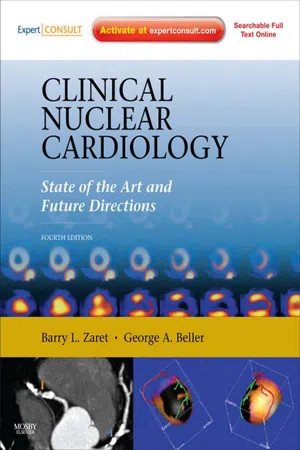
Clinical Nuclear Cardiology—now in its fourth edition—covers the tremendous clinical growth in this field, focusing on new instrumentation and techniques. Drs. Barry L. Zaret and George A Beller address the latest developments in technology, radiopharmaceuticals, molecular imaging, and perfusion imaging. Thoroughly revised to include 20 new chapters—Digital/Fast SPECT, Imaging in Revascularized Patients, and more—this new edition provides state-of-the-art guidance on key areas and hot topics with stunning visuals. Online access to the fully searchable text at expertconsult.com includes highly illustrated case studies that let you see the problem using a variety of imaging modalities. In other words, this is an invaluable resource no clinician or researcher in nuclear cardiology should be without.- Features an editorial and contributing team of worldwide leaders in nuclear cardiology to provide you with current and authoritative guidance.- Includes a section focusing on acute coronary syndromes to provide you with practical management tools for these conditions.- Presents a full-color design that allows color images to be integrated throughout the text.- Includes access to the fully searchable contents of the book online at expertconsult.com, along with highly illustrated case studies that let you see the problem using a variety of imaging modalities.- Features 20 new chapters including Cellular Mechanisms of Tracer Uptake and Clearance; Attenuation/Scatter Corrections: Clinical Aspects; Hybrid Imaging; Digital/Fast SPECT; Imaging in Revascularized Patients; and more.- Focuses on perfusion imaging in a section dedicated to this hot topic so you get all the information you need to stay current.
eBook - ePub
Clinical Nuclear Cardiology: State of the Art and Future Directions E-Book
- 896 pages
- English
- ePUB (mobile friendly)
- Available on iOS & Android
eBook - ePub
Clinical Nuclear Cardiology: State of the Art and Future Directions E-Book
About this book
Information
Topic
MedicineSubtopic
CardiologySection 1
Radiopharmaceuticals/Tracer Kinetics
Chapter 1 Overview of Tracer Kinetics and Cellular Mechanisms of Uptake
INTRODUCTION
The kinetics of tracer transport provides a skeletal framework that supports the body of clinical imaging using radionuclide tracers. This underlying framework provides an essential basis for understanding and clinical interpretation of tracers, including the sensitivity of different tracers to indicate reduction of coronary flow reserve, the use and limitations of redistribution and reinjection, and the applications of tracers for indication of myocardial viability and prediction of recovery of myocardial contractile function.
Tracer transport kinetics are most compactly and simply understood in terms of “models.” A model is a mathematical function that defines a relationship. An example would be the curve that relates tracer uptake as a function of myocardial blood flow. There are certain basic relationships that govern the extraction, washout, and recirculation of tracers. These basic generic relationships facilitate the understanding of many different tracers used in various ways.
As an introduction to perfusion tracers, the first part of this chapter will review the basic properties and cellular uptake mechanisms of a few of the single-photon emission computed tomography (SPECT) myocardial perfusion agents. Next, we will present the “bare bones” of tracer extraction, retention, and recirculation. We will employ a common solute absorption model to help understand the relationship of tracer extraction to capillary perfusion and use a simplified compartmental exchange model to help understand tracer redistribution. Comparing model predictions to experimental data will add some fascinating light to the mechanism of myocardial vasoregulation. Following this introduction, and in the light of our improved understanding of tracer kinetics, we will discuss specific clinical applications of the tracers commonly used for myocardial imaging.
CELLULAR UPTAKE OF MYOCARDIAL PERFUSION AGENTS
Before delving into a modeling approach to better understand the complex behavior of a myocardial perfusion imaging agent after intravenous injection, we will briefly review the physical and/or chemical properties of a few classes of these agents that play a role in their cellular uptake in the myocardium.
Thallium-201
Thallium-201 (201Tl) is a radioactive potassium analog. The initial myocardial uptake of 201Tl is dependent upon myocardial blood flow and its first-pass extraction fraction, which is approximately 85% under resting flow conditions.1,2 At higher flow rates, such as those obtained during pharmacologic vasodilation, the extraction of 201Tl is not linear with respect to flow.3 The plateau in extraction results in an underestimation of the true maximal flow. This phenomenon is true of all diffusible flow tracers and will be discussed in detail in the next section of this chapter.
The intracellular uptake of 201Tl predominantly involves active exchange across the sarcolemmal membrane of the myocytes via the Na+/K+ adenosine triphosphate (ATP) transport system.4 Because this system is energy dependent, thallium transport can only occur in viable myocardium. Once inside the myocyte, 201Tl is not bound intracellularly and can diffuse back out into the circulation. As will be discussed in detail later, these uptake and redistribution kinetic properties form the basis of clinical assessment of myocardial perfusion and viability using 201Tl. Although the introduction of 201Tl in the mid-1970s represented a major advance in nuclear cardiology, its physical properties are not ideal for gamma camera imaging. The low-energy 69- to 80-keV x-ray photopeak can result in attenuation artifacts and the relatively long 73-hour half-life limits the maximal dose that can be safely administered.
Monovalent Cationic Technetium-99m-Labeled Tracers
Technetium-99m (99mTc) is a generator-produced isotope that is readily available and has a number of advantages over 201Tl for gamma camera imaging. The higher-energy 140-keV principle photopeak is ideal for detection using standard collimated gamma cameras with less attenuation, and its short 6-hour half-life allows for a higher administered dose yielding improved count statistics.
Over the years, there have been a number of 99mTc-labeled myocardial perfusion imaging agents that have been investigated as replacements for 201Tl. The most successful ones to date are the lipophilic monovalent cationic agents, 99mTc-sestamibi (sestamibi, Cardiolite) and 99mTc-tetrofosmin (tetrofosmin, Myoview), that are now widely used for clinical studies. Following an intravenous injection, the first-pass extraction fractions of sestamibi and tetrofosmin are approximately 65% and 54%, respectively, under basal resting flow conditions.5,6 Because of their lower extraction fractions compared with 201Tl, the plateau in tracer uptake observed during hyperemia occurs at lower flow rates. The effect of this “roll-off” in extraction at lower flow rates is to diminish the relative difference in tracer activities between high-flow regions and those myocardial regions subtended by a coronary stenosis, making it more difficult to detect milder stenoses.
Although these agents are members of two distinct chemical classes of compounds, isonitriles and diphosphines, respectively, they share several common properties. Unlike 201Tl, which utilizes a specific membrane-active transporter, these tracers are passively drawn across the sarcolemmal and mitochondrial membranes along a large electronegative transmembrane potential gradient, owing to their lipophilicity and positive charge.7 Once inside the mitochondria, these cationic tracers are tightly bound by the potential gradient such that there is a very slow net efflux resulting in prolonged myocardial retention times. Although ATP is not directly required for the intracellular sequestration of cationic tracers, as it is for 201Tl, the influx and retention of these tracers are energy dependent because the presence of a normal electronegative transmembrane gradient is required. With irreversible injury, the mitochondrial and sarcolemmal membranes are depolarized, and the uptake of these cationic tracers is impaired.8 Accordingly, like 201Tl, the cationic 99mTc-labeled agents can be used to assess myocardial viability.
In addition to the lower plateau in extraction mentioned, another disadvantage to both sestamibi and tetrofosmin is the problem of photon scatter from the adjacent liver that can interfere with the interpretation of myocardial perfusion defects, particularly in the inferior left ventricular wall. Accordingly, there has been renewed interest in recent years to design improved cationic 99mTc-labeled tracers that exhibit more rapid liver clearance. 99mTc-(N)(PNP5)(DBODC5)+ (DBODC5) is a lipophilic nitride that is rapidly taken up and retained by the myocardium in a manner that is mechanistically similar to sestamibi and tetrofosmin. However, studies in both rats and dogs demonstrated that DBODC5 cleared more rapidly from the liver than either of these other cationic tracers, with virtually no liver activity observed after only 1 hour.9,10 The first-pass extraction fraction of DBODC5 is intermediate to that of sestamibi and tetrofosmin.10 Although there is no improvement in the ability of DBODC5 to track myocardial blood flow at hyperemic flow rates, its more favorable biodistribution properties offer a potential advantage that warrants further investigation.
Another new lipophilic cationic tracer with improved biodistribution and very rapid liver clearance is 99mTc-[N(MPO)(PNP5)]+ (MPO). The myocardial uptake of MPO in Sprague Dawley rats was reported to be between that of sestamibi and DBODC5 over 2 hours.11 Interestingly, the heart-liver ratio of MPO at 30 minutes after injection was more than twice that of DBODC5 and approximately 4 times higher tha...
Table of contents
- Cover
- Title Page
- Front matter
- Copyright
- Dedication
- Contributors
- Preface
- Table of Contents
- Section 1: Radiopharmaceuticals/Tracer Kinetics
- Section 2: Instrumentation
- Section 3: Ventricular Function
- Section 4: Perfusion Imaging
- Section 5: Disease/Gender-Specific Issues
- Section 6: Acute Coronary Syndromes
- Section 7: Viability
- Section 8: Tracer Specific Imaging Techniques
- Section 9: New Molecular Approaches
- Case 1
- Case 2
- Case 3
- Case 4
- Case 5
- Case 6
- Case 7
- Case 8
- Case 9
- Case 10
- Case 11
- Case 12
- Case 13
- Case 14
- Case 15
- Case 16
- Case 17
- Case 18
- Case 19
- Case 20
- Case 21
- Case 22
- Case 23
- Case 24
- Case 25
- Case 26
- Case 27
- Case 28
- Case 29
- Case 30
- Case 31
- Case 32
- Case 33
- Case 34
- Case 35
- Index
- Instructions for online access
Trusted by 375,005 students
Access to over 1.5 million titles for a fair monthly price.
Study more efficiently using our study tools.
Frequently asked questions
Yes, you can cancel anytime from the Subscription tab in your account settings on the Perlego website. Your subscription will stay active until the end of your current billing period. Learn how to cancel your subscription
No, books cannot be downloaded as external files, such as PDFs, for use outside of Perlego. However, you can download books within the Perlego app for offline reading on mobile or tablet. Learn how to download books offline
Perlego offers two plans: Essential and Complete
- Essential is ideal for learners and professionals who enjoy exploring a wide range of subjects. Access the Essential Library with 800,000+ trusted titles and best-sellers across business, personal growth, and the humanities. Includes unlimited reading time and Standard Read Aloud voice.
- Complete: Perfect for advanced learners and researchers needing full, unrestricted access. Unlock 1.5M+ books across hundreds of subjects, including academic and specialized titles. The Complete Plan also includes advanced features like Premium Read Aloud and Research Assistant.
We are an online textbook subscription service, where you can get access to an entire online library for less than the price of a single book per month. With over 1.5 million books across 990+ topics, we’ve got you covered! Learn about our mission
Look out for the read-aloud symbol on your next book to see if you can listen to it. The read-aloud tool reads text aloud for you, highlighting the text as it is being read. You can pause it, speed it up and slow it down. Learn more about Read Aloud
Yes! You can use the Perlego app on both iOS and Android devices to read anytime, anywhere — even offline. Perfect for commutes or when you’re on the go.
Please note we cannot support devices running on iOS 13 and Android 7 or earlier. Learn more about using the app
Please note we cannot support devices running on iOS 13 and Android 7 or earlier. Learn more about using the app
Yes, you can access Clinical Nuclear Cardiology: State of the Art and Future Directions E-Book by Barry L. Zaret,George A. Beller in PDF and/or ePUB format, as well as other popular books in Medicine & Cardiology. We have over 1.5 million books available in our catalogue for you to explore.