Grounded in scientific and clinical evidence, this highly illustrated new guide gives an introduction to the diagnosis and treatment of musculoskeletal disorders using the Fascial Manipulation (FM) method developed by Luigi Stecco – the foremost scientifically valid method of evaluating and treating fascial dysfunction. It describes FM's history, anatomy and physiology of fasciae, indications and contraindications, mechanisms of action, and details of the subjective and physical techniques used to manage disorders.A Practical Guide to Fascial Manipulation focuses on concepts around evaluating the fascia based on functional testing, movement and direction in specific spatial planes, and the location of specific areas to treat safely. With an emphasis throughout on accessible practical information, the book is also supported by a website – www.guidefascial.com – containing procedural video clips and an image bank.
“The most important thing is to be enthusiastic and to have the passion for the work you do.”
Luigi Stecco
Italian physiotherapist Luigi Stecco (born in 1949) is the inventor of fascial manipulation (FM). Nothing illustrates his motto better than the image of Luigi Stecco as a boy developing an early fascination for vertebrate anatomy as he dissected a fish his mother had brought home for dinner. Over the next decades, this interest became focused on the thus far little studied but ubiquitous tissue: the fascia. Eventually, the understanding of the fascia as a system—a system with specific vital functions—led Stecco and his colleagues to develop a method of evaluating and treating dysfunctional fascia.
Luigi Stecco has devoted his career to developing and teaching others to develop “knowing hands” in their treatment of pain and dysfunctions. Manus sapiens, potens est (a knowledgeable hand is a powerful one). Knowing more will enhance your skills more. Better results in treatments will come with practice and knowledge. In this way FM can be your map of understanding (Fig. 1.1) (see Video 1).
Fig. 1.1 Luigi treating one of the participants in the fascial manipulation course.
The evolution of FM began over 40 years ago when Luigi was working as a trainee in a hospital. He started developing his own biomechanical model because he realized that many of the treatment techniques he had been taught as a physical therapist were not effective enough—some were even useless. He wanted to find a better way. He started to observe the work bonesetters were doing and realized that they were helping people. However, he was dissatisfied with even these techniques, so he decided to explore different treatments more thoroughly. Luigi gradually started to create his own technique, the Stecco method, later known as FM.
From 1972 to 1984, Luigi worked on his own treatment techniques, building on the inspiration of other treatment methods and basing everything on careful and incessant dissection to gain a profound understanding of anatomical function. He explored osteopathic techniques, then relaxation techniques with the idea that pain could come from psychosomatic factors. Subsequently, he investigated psychomotricity, postural gymnastics, and the Vayer method, which concentrate on dynamic balance and coordination. He was still dissatisfied with the level of clinical results: they were not good enough. He wanted more. He wanted to find a way to turn practitioners’ hands into more effective healing hands (Fig. 1.2).
Fig. 1.2 Building blocks of fascial manipulation.
In 1976 Luigi was introduced to connective tissue massage and he identifies this as the turning point for meaningful improvement in patient results. This heightened his determination to explore the architecture of connective tissue. He studied the works of Elisabeth Dicke, who was a physiotherapist in Germany in the late 1920s. She especially influenced Luigi’s focus on the importance of connective tissue. He became an expert in transverse friction massage. A study of James Cyriax, the father of orthopedic medicine, underscored the importance of the use of the therapist’s hands and manual therapy. Combining the knowledge of transverse friction massage and acupuncture meridians confirmed Luigi’s theories on the tensional network of the body. The vectorial forces, which act along this network, can be understood and thus lead the practitioner to the areas in the network that need treatment.
Luigi’s understanding of the “tensional network” of the human body was enriched by the studies of Ida Rolf and by works on trigger points as elucidated by Travell and Simmons in the early 1980s. The powerful work on kinetic chains by Francoise Mézières and Herman Kabat was also important in the foundation of Luigi’s theoretical understanding. The previous findings and good results from treatments encouraged him to write down all that he had learned through years of clinical experience and studies.
His understanding of the tensional network of the human body had produced good results in clinical settings so Luigi was finally ready to share his insights in his first book, Myofascial Sequences and Acupuncture Meridians (1987). At the time, Luigi theorized that the excellent clinical results he was getting were a result of freeing the nerve within the connective tissue, so he named this the “neuroconnective technique.” This early technique was the first step in the development of FM as it is known and taught today (Table 1.1).
Table 1.1
Timeline of Luigi Stecco’s Publications
Title
Publication Year
Language
Myofascial Sequences and Acupuncture Meridians
1987
Italian
Pain and the Neuromyofascial Sequences
1990
Italian
La Manipolizione Neuroconnectivale
1996
Italian
Fascial Manipulation for Musculoskeletal Pain
2004
English
Fascial Manipulation Practical Part
2009
English
Fascial Manipulation for Internal Dysfunction
2013
English
Manipolazione fasciale per le Disfunzioni Interne—Parte Pratica
2014
Italian
Atlante di Fisiologia della Fascia Muscolare
2016
Italian
Luigi continued to study and explore. The anatomic work of Chiarugi, Testut, Gray, and Beninghoff inspired Luigi to deepen his understanding of anatomy. Then, in 1989, at the First International Symposium on Myofascial Pain and Fibromyalgia, the idea of the myofascial unit was launched. At this conference, he presented that points formed the centers of vectors caused by muscular tractions operating within a particular plane of fascia. He wrote that the referral of pain due to these points was related to planes of altered fascia. In the symposium Luigi stated: “Knowing the location of the myofascial unit, it is easier to find the starting point of myofascial pain.” This reasoning resulted in what is now defined as the myofascial unit (MFU).
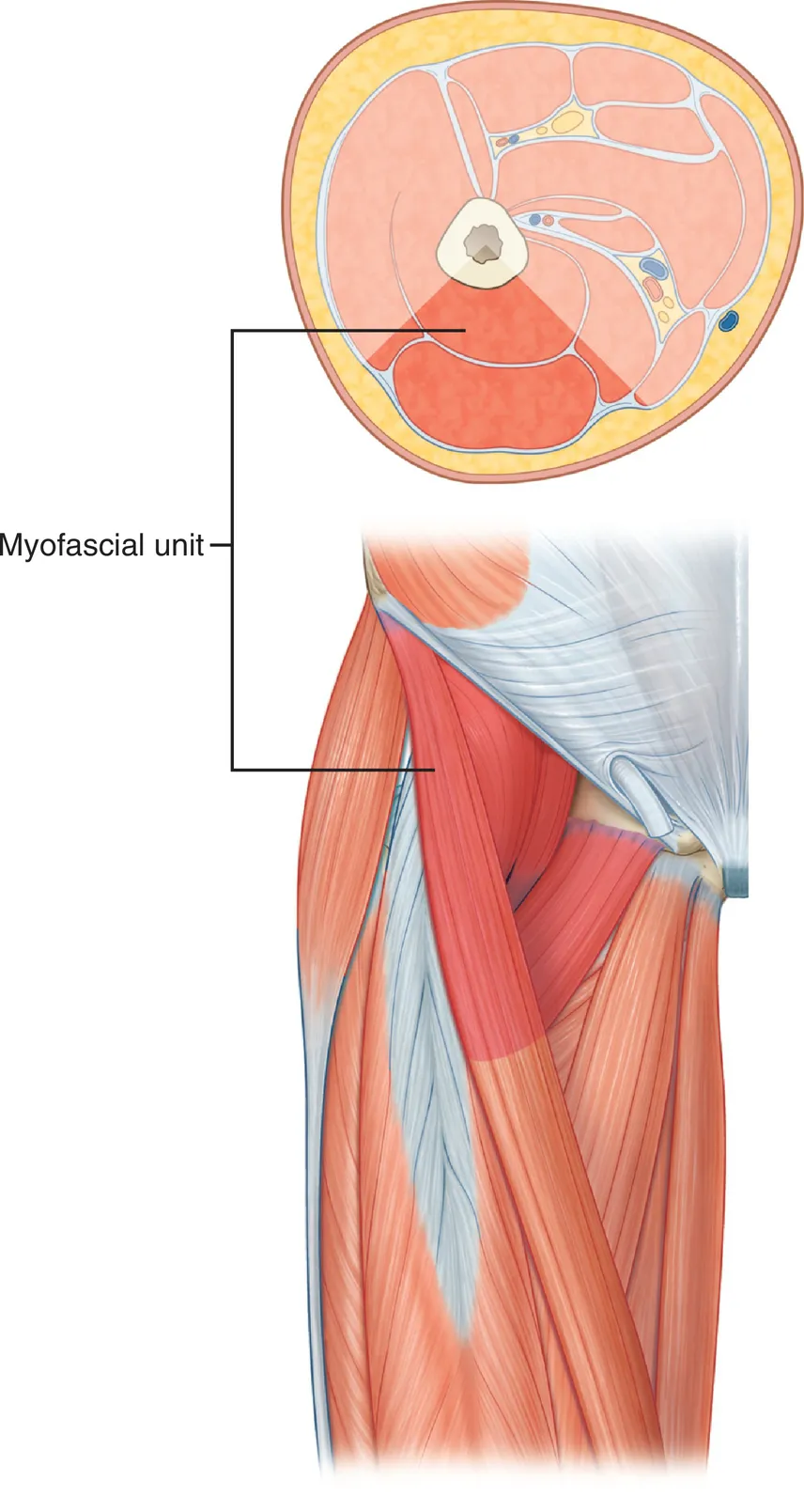
An MFU is a key element in FM (Fig. 1.3). It is composed of a group of motor units that activate monoarticular and biarticular muscle fibers that move a body part in a particular direction, for example, antemotion or antepulsion (movement forward in the sagittal direction). The MFU is also composed of nerves (efferent, receptors, afferents) and vascular components. All of these elements are connected within the fascia and they are responsible for the normal movement of the joint. Since the brain is responsible for a motor direction rather than movement of specific muscles, it must depend upon the MFUs to provide the necessary information to allow the body to function in a unified coordinated manner. Brains only interpret the movement patterns and changes in directions. In the motor cortex, entire areas are controlled (eg, hands, lips, or legs). This point is critical for the understanding of motor function. The muscles function by way of MFUs as they move in different directions and in various ways (Stecco, 2004; Stecco, 2009).
Fig. 1.3 One key element of fascial manipulation: the myofascial unit. The image area highlights the AN-CX; it is located on the anterior part of the thigh, inferior to the inguinal ligament, medial to the sartorius muscle. AN - forward movement, antemotion; CX - area of the hip.
To explain different dysfunctions we need terms and language that our brains can understand. Luigi invented the idea of segments and MFUs to explain the body in an easier way and find the impaired movement in a more specific way. Based on some of the above information, for ease of analysis, Luigi proposed the idea of rela...
Table of contents
Cover image
Title page
Table of Contents
Copyright
Video List
Forewords
Acknowledgements
Introduction
Chapter 1: History of Fascial Manipulation
Chapter 2: Anatomy of the Fascia from the Clinical Point of View
Chapter 3: Physiology of the Fascia from the Clinical Point of View
Chapter 4: Fascial Manipulation
Chapter 5: What Kind of Disorders and Dysfunctions to Treat with Musculoskeletal Fascial Manipulation
Chapter 6: Fascial Manipulation for Internal Dysfunctions
Chapter 7: Veterinary Fascial Manipulation
Chapter 8: Conclusion
Index
Trusted by 375,005 students
Access to over 1.5 million titles for a fair monthly price.
Study more efficiently using our study tools.
Frequently asked questions
Yes, you can cancel anytime from the Subscription tab in your account settings on the Perlego website. Your subscription will stay active until the end of your current billing period. Learn how to cancel your subscription
No, books cannot be downloaded as external files, such as PDFs, for use outside of Perlego. However, you can download books within the Perlego app for offline reading on mobile or tablet. Learn how to download books offline
Perlego offers two plans: Essential and Complete
Essential is ideal for learners and professionals who enjoy exploring a wide range of subjects. Access the Essential Library with 800,000+ trusted titles and best-sellers across business, personal growth, and the humanities. Includes unlimited reading time and Standard Read Aloud voice.
Complete: Perfect for advanced learners and researchers needing full, unrestricted access. Unlock 1.5M+ books across hundreds of subjects, including academic and specialized titles. The Complete Plan also includes advanced features like Premium Read Aloud and Research Assistant.
Both plans are available with monthly, semester, or annual billing cycles.
We are an online textbook subscription service, where you can get access to an entire online library for less than the price of a single book per month. With over 1.5 million books across 990+ topics, we’ve got you covered! Learn about our mission
Look out for the read-aloud symbol on your next book to see if you can listen to it. The read-aloud tool reads text aloud for you, highlighting the text as it is being read. You can pause it, speed it up and slow it down. Learn more about Read Aloud
Yes! You can use the Perlego app on both iOS and Android devices to read anytime, anywhere — even offline. Perfect for commutes or when you’re on the go. Please note we cannot support devices running on iOS 13 and Android 7 or earlier. Learn more about using the app
Yes, you can access A Practical Guide to Fascial Manipulation by Tuulia Luomala,Mika Pihlman, Warren I Hammer in PDF and/or ePUB format, as well as other popular books in Medicine & Physiotherapy, Physical Medicine & Rehabilitation. We have over 1.5 million books available in our catalogue for you to explore.