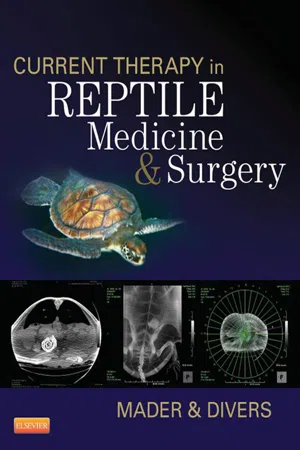
Current Therapy in Reptile Medicine and Surgery is a valuable reference that emphasizes topics of real clinical relevance in reptile and amphibian medicine. With details on therapeutic regimens, this text also features coverage of infectious diseases, anesthesia, surgery, and advances in biology and conservation. Colorful illustrations showcase exotic animals, and numerous tables and figures provide quick access to essential information."This is a great book for anyone interested in herptile medicine and surgery, worth every penny and I am sure will go on to become a regular series." Reviewed by: Jonathan Cracknell. Date: 25/07/2014- Selected topics of real clinical significance from the latest veterinary scientific literature explore today's reptile and amphibian practice.- A discussion of the most current theory and practical applications of diagnostic endoscopy in reptiles provides insight into minimally-invasive endoscopic procedures, including biopsy techniques.- Expert contributors combine forces to bring you the most cutting-edge information available, offering authoritative and sometimes controversial opinions in particular areas.- Expert contributors offer the most current thoughts on diagnosing new and emerging diseases, including a thorough review of molecular diagnostics.- The latest therapeutics are discussed, and the most up-to-date formulary and library of normal clinical pathology values is provided.- The most current and comprehensive discussion of amphibian medicine in print in the last decade!
eBook - ePub
Current Therapy in Reptile Medicine and Surgery
- 488 pages
- English
- ePUB (mobile friendly)
- Available on iOS & Android
eBook - ePub
Current Therapy in Reptile Medicine and Surgery
About this book
Information
Topic
MedicineSubtopic
Veterinary MedicineAppendix 1
Developing Your Reptile Medicine IQ: Learning How to Get the Most from and Contribute to the Herpetological Literature
Mark A. Mitchell
Veterinarians source knowledge in a number of different ways. As students, the majority of our knowledge is provided in the classroom. In Western civilization, students have become so reliant on this source of knowledge that they are less likely to pursue other resources (e.g., books or peer-reviewed literature). Certainly, the specialists (faculty) providing this knowledge have expertise in their fields, but the information being delivered is a subjective review of their own experiences. This type of knowledge sourcing is important, but it is only suitable earlier in our training as veterinary professionals. As we develop and begin careers in veterinary medicine, our ability to source knowledge changes. For many veterinary clinicians, their sources of knowledge come through continuing education presentations and books. Continuing education seminars, much like classroom teaching in veterinary school, are subjective. They represent a potentially good method of acquiring current, up-to-date knowledge regarding a field, but they remain a collection of the opinions and interpretations of the speaker. Books are also a relevant and quick source of knowledge, such as this text. However, they too are ultimately a collection of the authors’ experiences and interpretations of the literature. Again, they represent an opportunity to obtain knowledge, but they have the potential for introducing the biases of the author. Additionally, by the time many books are published, the information provided is typically at least 1 to 2 years old. Ultimately, as we grow and develop as veterinarians, we need to rely on objective sources of knowledge. Although many of the previous examples rely on these types of information, the best opportunity we have for acquiring this type of information is to delve into the scientific literature itself. Peer-reviewed literature provides us our best opportunity to obtain objective data with minimal potential for misclassification bias. It is important to retain the caveat of minimal in such a description because even the peer-reviewed literature is not perfect. The primary limitations associated with this source of knowledge are related to the limitations of the reviewers and editorial staff. Not all of the individuals reviewing manuscripts are comfortable with the concepts of study design and statistical methods. If these things are not fully vetted at the review process, there is the potential for misclassification. This becomes important when we consider how we develop our knowledge. It can be likened to a foundation on a house. We hope to develop a solid foundation of knowledge based on objective, defendable information; however, it is possible that, through no fault of our own, we build a foundation with some weak supports. A number of reviewers for journals, as well as members of the editorial staff, may be uncomfortable with evaluating the statistical analysis used in a study. Unless a statistician is consulted, it is possible that flawed methods are being used to draw flawed conclusions. To minimize the likelihood for building a “weakened” knowledge base from which we rely on to manage our patients and clients, we need to become more self-reliant in our ability to objectively review the literature serving as our foundation of knowledge.
A typical peer-reviewed article is divided into four sections: Introduction, Materials and Methods, Results, and Discussion. There is certainly some degree of variability within this construct (e.g., separate Statistical Methods or Conclusion sections), but, for the most part, journals adhere to a format following this pattern. In the author’s experience (subjective assessment), the majority of the peer reviewers of the journals for which he serves as editor (Journal of Herpetological Medicine and Surgery and Journal of Exotic Pet Medicine) and clinicians he trains are comfortable with reading and understanding the Introduction and Discussion sections of an article but are less confident in their ability to comprehend the statistical methods and thus the results. Likewise, many authors of peer-reviewed manuscripts are also not comfortable with these sections of their own works for the same reason. It is these types of limitations that can potentially introduce misclassification bias into the scientific literature and our own knowledge base. To minimize the potential for such a shortcoming, we need to develop some level of skill with interpreting these sections, along with the other components of the article. While it is beyond the scope of this article to provide a detailed review of statistics, it is possible to develop flow charts to show common patterns for interpreting whether data was handled correctly. It is important for veterinary clinicians to realize that becoming comfortable with statistics or study design comes with practice and experience; however, this should come as no surprise to the readers of this text because many veterinarians working with reptiles and amphibians developed their skills using a basis of knowledge and practical experience acquired from nonherpetologic species (e.g., dogs, cats, and horses).
The purpose of this chapter is to provide the reader with a step-by-step approach for constructively analyzing a peer-reviewed article. The series of questions outlined in Box A-1 serve as the basis for this analysis. In addition to using these questions/methods for training veterinary professionals, the author also utilizes these methods for reviewing manuscripts for peer-reviewed journals. A secondary purpose of this chapter is to provide an outline for prospective veterinary clinicians to follow when conducting research. For the field of herpetologic medicine to develop, it will require clinicians to share the findings of their work. Historically, clinicians have contributed to the literature by publishing case reports; however, because there is a general lack of financial resources to study herpetologic medicine, it will require a grassroots effort from those in the field (or clinic) to generate scientific information to improve the way we practice medicine and surgery on these species. The information provided in this chapter can also be used by clinicians as a basis for formulating projects using data they collect at their own hospital.
Question 1: What was the Purpose of the Study?
The purpose of a study should be clearly defined in the Introduction, providing the reader with an opportunity to determine a clear direction of the study. There are times when the Introduction does not appear to define a clear direction for the article; in these cases, it is important for the reader to understand that if the authors did not have a clear vision, the research itself might also be flawed. Being able to answer questions 2 and 3 will assist the reader in determining whether the author(s) have defined the direction of the research.
Question 2: What were the Objectives and Hypotheses? Are they Clearly Defined?
Advancement in science occurs because researchers set objectives and hypotheses to answer specific questions of interest. Although it is generally expected that this approach is used in veterinary medicine, it is often difficult to discern the specific hypotheses being pursued by some authors because these directives are not clearly defined. Many articles do include objectives, but objectives are typically written as being less specific and more general in their direction. This generality can sometimes be seen in the limitations of the results, in that some authors only provide descriptive statistics or limited comparisons when more robust statistical methods could have been used. Additionally, in many examples, it appears that the hypotheses are generated after the research is completed and the data collected. In these cases, it is often difficult to answer certain hypotheses post-hoc. Whether graduate students are being taught or colleagues are consulting on a research study, the first question to ask regarding the research is, what are the hypotheses to be answered? By starting with specific hypotheses, it is possible to determine the type of study required to test the hypotheses, the sample size required for the study, and the statistical methods that will be required to complete the study. It is rare (<5%) for the specific hypotheses of research studies to be included in peer-reviewed articles in the exotic and zoologic medicine journals (Mitchell M: unpublished data Oct, 2012).
One of the more common reasons veterinary researchers misuse statistics is that they do not appear to have a solid grasp on their intended hypothesis(es). By specifically stating the hypothesis in the article,1-6 it can be used as a guide for the reader to determine the direction of the study and evaluate the “correctness” of the methods. Remember, just because something is published does not mean it is correct. Studies have found a significant number of errors in published articles.7 Although it is the intent of the peer-review process to catch and prevent the publication of incorrect information, it is ultimately a subjective review process. So what does this mean to the clinician trying to interpret the findings or place a value on the information provided in the article? It reinforces the importance of being able to understand the “methods” used for a study. If we can appreciate that a design is flawed, than we may be more cautious in how we use and apply the results from a particular study. If we do not, we are susceptible to building a foundation of knowledge with structural flaws.
For those developing research projects, it is best to define hypotheses based on some biologically relevant question. By starting with what is biologically (or clinically) relevant, it is easier to determine what type of data need to be collected and how they may be useful to the reader (or clinician). The hypothesis should define the outcome to be tested (dependent variable(s)) and any risk factors (independent variables). The number of hypotheses required will depend on how many different scientific questions the author hopes to answer. The primary limitation associated with the number of hypotheses that can be answered is associated with the size of the study population (sample size). When the sample size is small, the likelihood is increased for a Type II error (accepting a null hypothesis when it is false). To limit the likelihood for introducing error, researchers should focus on testing the most important question(s) with the sample size that is available (see Question 6: Was the sample size sufficient?).
Question 3: Did the Introduction Satisfactorily Present the Research Problem?
The Introduction to an article should provide the reader with an overall review of the reason the research was done. Most Introductions comprise three paragraphs, although some are shorter (one to two paragraphs) and some are longer (more than three paragraphs).8-13 Typically, the first paragraph (or section) of an Introduction will provide insight into the species or problem to be studied, the second paragraph (section) will indicate why there is need for the study, and the third paragraph (section) will outline the specific purpose or objectives of the study. This is also the point that the specific hypotheses to be tested should be introduced. Sufficient references to describe the material presented in the Introduction should be provided. It is important for the reader to evaluate the types of references used. In the herpetologic literature, many of the references are based on proceeding abstracts and book chapters. As stated earlier, while these references can certainly be invaluable, they are not rigorously peer reviewed. The date of the references should also be noted. It is important that citations include the original reference to a specific topic. It is not uncommon in the veterinary literature for a reference to cite the most recent report of a topic, rather than the original citation. When this occurs, there is the possibility for a loss of detail through the translation. The quality of an article can often be determined by the degree and/or extent that references are used.
Question 4: What Type of Study was Used?
A number of different study types can be used to conduct research, from nonexperimental to experimental studies. It is important to recognize the different methods used to conduct these studies because the success of the research in each case is dependent on meeting the assumptions of the studies’ inherent designs. For the individual reading the scientific literature, it is important to understand the various intricacies of each study type to ensure that the information being published is not biased by a flaw in the study design.
The most common types of studies used in clinical research are experimental or interventional studies. These types of studies typically are set up as true experimental studies and use preselected study subjects or are set up as clinical trials, in which patients presented to a practice are used as the study subjects. The former type of study is typically done in academia, and the latter is typically done at the clinic level. Clinical trials represent an excellent opportunity for practitioners to contribute to the scientific literature.
Experimental trials require the researcher/clinician to assign the exposure to the various study subjects. The exposure is typically defined as the independent risk factor being tested. Typically, one group is given a specific treatment or exposure, while another group serves as a control.4,8,10,12,13 Although it is possible to evaluate multiple exposures in a study, it is best to limit them to...
Table of contents
- Cover image
- Title page
- Table of Contents
- Copyright
- In Memoriam
- Contributors
- Foreword
- Preface
- Acknowledgments
- Specialization in Reptile Medicine
- Section I: Advances in Reptile Medicine
- Section II: Advances in Anesthesia, Surgery, and Analgesia
- Section III: Advances in Amphibian Medicine
- Section IV: Advances in Biology, Conservation, Law, and Research
- Appendix 1: Developing Your Reptile Medicine IQ: Learning How to Get the Most from and Contribute to the Herpetological Literature
- Appendix 2: Reptile Viruses
- Appendix 3: Reptile Formulary and Laboratory Normals
- Appendix 4: Abridged Formulary for Amphibians
- Appendix 5: Weights and Measures Conversions
- Appendix 6: Celsius Versus Fahrenheit Conversions
- Appendix 7: U.S./IU (Blood Values) Conversion
- Appendix 8: Pharmacology Abbreviations
- Appendix 9: Reptile and Amphibian History Form
- Glossary
- Index
Trusted by 375,005 students
Access to over 1.5 million titles for a fair monthly price.
Study more efficiently using our study tools.
Frequently asked questions
Yes, you can cancel anytime from the Subscription tab in your account settings on the Perlego website. Your subscription will stay active until the end of your current billing period. Learn how to cancel your subscription
No, books cannot be downloaded as external files, such as PDFs, for use outside of Perlego. However, you can download books within the Perlego app for offline reading on mobile or tablet. Learn how to download books offline
Perlego offers two plans: Essential and Complete
- Essential is ideal for learners and professionals who enjoy exploring a wide range of subjects. Access the Essential Library with 800,000+ trusted titles and best-sellers across business, personal growth, and the humanities. Includes unlimited reading time and Standard Read Aloud voice.
- Complete: Perfect for advanced learners and researchers needing full, unrestricted access. Unlock 1.5M+ books across hundreds of subjects, including academic and specialized titles. The Complete Plan also includes advanced features like Premium Read Aloud and Research Assistant.
We are an online textbook subscription service, where you can get access to an entire online library for less than the price of a single book per month. With over 1.5 million books across 990+ topics, we’ve got you covered! Learn about our mission
Look out for the read-aloud symbol on your next book to see if you can listen to it. The read-aloud tool reads text aloud for you, highlighting the text as it is being read. You can pause it, speed it up and slow it down. Learn more about Read Aloud
Yes! You can use the Perlego app on both iOS and Android devices to read anytime, anywhere — even offline. Perfect for commutes or when you’re on the go.
Please note we cannot support devices running on iOS 13 and Android 7 or earlier. Learn more about using the app
Please note we cannot support devices running on iOS 13 and Android 7 or earlier. Learn more about using the app
Yes, you can access Current Therapy in Reptile Medicine and Surgery by Douglas R. Mader,Stephen J. Divers, Douglas R. Mader, Stephen J. Divers in PDF and/or ePUB format, as well as other popular books in Medicine & Veterinary Medicine. We have over 1.5 million books available in our catalogue for you to explore.