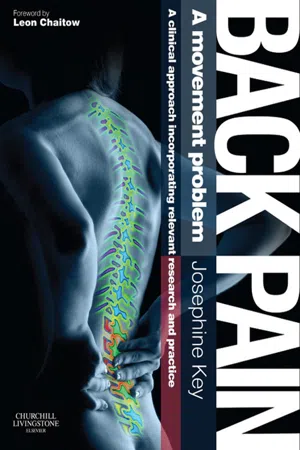
Back Pain: a movement problem is a practical manual to assist all students and clinicians concerned with the evaluation, diagnosis and management of the movement related problems seen in those with spinal pain disorders. It offers an integrative model of posturomovement dysfunction which describes the more commonly observed features and related key patterns of altered control. This serves as a framework, guiding the practitioner's assessment of the individual patient.- Examines aspects of motor control and functional movement in the spine, its development, and explores probable reasons why it is altered in people with back pain- Maps the more common clinical patternsof presentation in those with spinal pain and provides a simple clinical classification system based upon posturomovement impairments- Integrates contemporary science with the insights of extensive clinical practice- Integrates manual and exercise therapy and provides guiding principles for more rational therapeutic interventions: - which patterns of movement in general need to be encouraged- which to lessen and how to do so- Abundantly illustrated to present concepts and to illustrate the difference between so-called normal and dysfunctrional presentations- Written by a practitioner for practitioners
eBook - ePub
Back Pain - A Movement Problem
A clinical approach incorporating relevant research and practice
- 400 pages
- English
- ePUB (mobile friendly)
- Available on iOS & Android
eBook - ePub
Back Pain - A Movement Problem
A clinical approach incorporating relevant research and practice
About this book
Information
Topic
MedicineChapter 1 Introduction
Back pain is usually a symptom of dysfunction in the musculoskeletal system.
Janda1 suggests that pain, however undesirable, serves an important biological function acting as a warning signal that all is not well in the movement system. It may be functioning in a harmful way and rather like the warning light on your dashboard reminding you the car needs a service, pain heralds the ‘tipping point’ in a continuum of dysfunction. Addressing the dysfunction will generally ameliorate the pain. However, classical Western medicine has by and large tended to view pain within a ‘disease model’, hunting for ‘the pathological’ structure in order to arrive at diagnosis and ‘fix it’. As we all know, the results have been less than promising and there is now a shift towards the possibility that disturbed function may be more important than structural damage as the physical basis of back pain.1 When the dysfunction and pain continue unabated, secondary factors such as disability and psychosocial factors begin to create a complex picture of interlocking dysfunctions. The ‘biopsychosocial model of dysfunction’2 acknowledges the multifactorial nature of the ‘problem of back pain’ and contemporary treatment approaches generally embrace addressing each aspect as indicated.
Back pain is fundamentally a physical problem and the focus of this book is to primarily address the ‘bio’ aspect – the physical perspective of back pain.
Gracovetsky3 has said ‘restoring the function of the injured patient implies knowing what the normal function is, something which is still the subject of speculation’. In similar vein, Van Dieën4 states ‘the relationship between low-back pain and motor behavior is poorly understood. Consequently the (para) medical disciplines involved lack a theoretical basis for treatment and outcome evaluation’. Moseley5 asks ‘what is it about pain that changes the way people move?’ Conversely, one could ask: ‘what is it about the way people move that causes pain?’
The aim in this work is an attempt to assist the understanding of normal movement function and the nature of movement dysfunction seen in spinal pain patients. Understanding how and why movement is altered goes a long way towards effectively redressing it.
An integrative model of neuromusculoskeletal dysfunction is offered as both a theoretical and a practical framework to aid the understanding of dysfunction and enhance current clinical practice skill. It describes the consistently observed, more common altered patterns of postural and movement control seen clinically in patients with spinal pain and related disorders. While each person with back pain presents individually, we can observe the tendency for common features which can be collated into a general paradigm of dysfunction. In general, the kinematic patterns of movement adopted during the simple repetitive activities of daily living are altered as a result of changed posturomovement control, and contribute to repetitive microtrauma and ‘injury’. Most back pain is a developmental movement disorder – a simple event often called an ‘injury’ can end up being a major problem. This helps explain the development and perpetuation of pain and related symptoms.
The model is somewhat of a paradigm shift – one of functional adaptation and maladaptation of posturomovement control as a common underlying genesis of most spinal pain disorders. It also provides a clinical classification system based upon posturomovement dysfunction providing a framework guiding assessment and management. Without a conceptual practical framework, there is a risk that ‘evidence based research’ is often misinterpreted and inappropriately applied to all patients regardless of that patient's presenting dysfunction. The aim of treatment interventions, both manual and therapeutic exercise, is to restore function. Manual treatment is necessary initially to alleviate pain and help normalize the local neuromuscular dysfunction. Retraining control of movement protects the spine against reoccurrence and helps restore function.
An appreciation of these more common changed responses in motor control helps to formulate the choices and enhance the quality of teaching therapeutic exercise in the rehabilitation of spinal musculoskeletal pain syndromes. We are seeing a larger group of patients presenting with symptoms resulting from, or exacerbated by, inappropriate exercise therapy. Hopefully an improved understanding of the problem can help rescue and refine the art of exercise therapy.
The work has emanated from the fruits of over 40 years of extensive clinical practice, scientific ‘evidence’ to hand and the diverse influences of inspired thinkers within the realms of therapeutic practice and somatic movement education. The clinical practice combination of manual therapist and movement educator has helped in seeing and understanding the relationships between joint and myofascial dysfunction and movement disorders. Conducting therapeutic exercise and movement classes has provided more opportunity for observing and recognizing certain ‘patterns’ of response which appear to be somewhat common in people with a history of spinal pain disorders.
Significantly however, by our observation, it appears that the boundary between ‘normal’ and abnormal movement function is often quite blurred and dysfunction may represent subtle variations from normal.6 Similar patterns are often evident, albeit less marked, when observing the general public: students in a yoga class or similar exercise forum perhaps reflect common underlying tendencies in us all and which, when more pronounced, contribute to the development of pain syndromes. The presence of pain further compounds the dysfunction. Janda noted ‘the high incidence of functional impairment makes it extremely difficult to estimate the borders between the norm and evident pathology’. The prevalence of low back pain appears to be on the rise in affluent urbanized countries.7
This book is addressed to the clinician to practically assist in the physical aspect of the management of patients with spinal pain disorders. It attempts to examine and provide an overview of ideal normal movement function of the torso and the functional interrelationship of its parts. This includes the significant aspects of normal motor development and the important qualities in normal movement control. It also describes the commonly observed inefficient patterns of axial muscle control and the close relationship between these and the development of changed articular function and pain syndromes.
References
[1] Janda V. Introduction to functional pathology of the motor system. Proc: VII Commonwealth and International Conference on Sport, Physical Education, Recreation and Dance. 1982. vol. 3
[2] Waddell G. The Back Pain Revolution. Edinburgh: Churchill Livingstone, 2004.
[3] Gracovetsky S. Stability or controlled instability. In: Vleeming A., Mooney V., Stoeckart R., editors. Movement, stability & Lumbopelvic Pain: Integration of research and therapy. Edinburgh: Churchill Livingstone Elsevier, 2007.
[4] Van Dieën J.H. Low back pain and motor behavior: contingent adaptations, a common goal. Proc. 6th Interdisciplinary World Congress on Low Back and Pelvic Pain. 2007. Barcelona
[5] Moseley G.L. Psychosocial factors and altered motor control. Proc. 5th Interdisciplinary World Congress on Low Back and Pelvic Pain. 2004. Melbourne
[6] DonTigny R.L. A detailed and critical biomechanical analysis of the sacroiliac joints and relevant kinesiology: the implications for lumbopelvic function and dysfunction. In: Vleeming A., Mooney V., Stoeckart R., editors. Movement, stability & Lumbopelvic Pain: Integration of research and therapy. Edinburgh: Churchill Livingstone Elsevier, 2007.
[7] Volinn E. The epidemiology of low back pain in the rest of the world: a review of surveys in low and middle income countries. Spine. 22(15), 1997.
Chapter 2 The problem of back pain
Just about any book or paper you read on low back pain (LBP) introduces the subject by restating the fact of the increasing ‘epidemic’ of low back pain and its enormous cost to society. We can fly man to the moon yet despite the advances of modern science the effective diagnosis and treatment of back pain remains somewhat of an elusive dilemma. Is it perhaps a case of losing sight of basic principles? To utilize Feldenkrais’1 term, is it missing ‘the elusive obvious’?
According to Janda,2 excluding insidious pathology, most musculoskeletal pain is the result of impaired function in the motor system. Pain serves an important biological function,
It might even be said that the motor system suffers from our whims and thus has no other way of protecting itself than by producing pain’.2
The Eastern medical paradigm would tend to view pain as a valuable sign signalling harmful overstress in the system. Western medicine has had a vested interest in treating pain as a disease and back pain has certainly become this.
The diagnosis dilemma
Waddell3 says: ‘only with the introduction of western medicine does chronic back disability become common’. The approach of contemporary medicine is to search for a ‘pathological’ diagnosis, the cornerstone for instituting appropriate treatment. However, definite structural pathology is only evident in about 15% of patients with back pain.3-5 The relationship between imaging and symptoms is weak.4,6 There are inherent lim...
Table of contents
- Cover
- Title Page
- Front matter
- Dedication
- Copyright
- Foreword
- Preface
- Acknowledgements
- Table of Contents
- Chapter 1: Introduction
- Chapter 2: The problem of back pain
- Chapter 3: The development of posture and movement
- Chapter 4: The analysis of movement
- Chapter 5: Classification of muscles
- Chapter 6: Salient aspects of normal function of the torso
- Chapter 7: Changed control of posture and movement: the dysfunctional state
- Chapter 8: Common features of posturomovement dysfunction
- Chapter 9: The two primary patterns of torso dysfunction
- Chapter 10: Clinical posturomovement impairment syndromes
- Chapter 11: Examining probable contributions towards dysfunctional posture and movement
- Chapter 12: A ‘functional pathology of the motor system’ involves a pattern generating mechanism underlying most spinal pain disorders
- Chapter 13: Therapeutic approach
- Chapter 14: Inherent implications in this model
- Glossary
- Index
Trusted by 375,005 students
Access to over 1.5 million titles for a fair monthly price.
Study more efficiently using our study tools.
Frequently asked questions
Yes, you can cancel anytime from the Subscription tab in your account settings on the Perlego website. Your subscription will stay active until the end of your current billing period. Learn how to cancel your subscription
No, books cannot be downloaded as external files, such as PDFs, for use outside of Perlego. However, you can download books within the Perlego app for offline reading on mobile or tablet. Learn how to download books offline
Perlego offers two plans: Essential and Complete
- Essential is ideal for learners and professionals who enjoy exploring a wide range of subjects. Access the Essential Library with 800,000+ trusted titles and best-sellers across business, personal growth, and the humanities. Includes unlimited reading time and Standard Read Aloud voice.
- Complete: Perfect for advanced learners and researchers needing full, unrestricted access. Unlock 1.5M+ books across hundreds of subjects, including academic and specialized titles. The Complete Plan also includes advanced features like Premium Read Aloud and Research Assistant.
We are an online textbook subscription service, where you can get access to an entire online library for less than the price of a single book per month. With over 1.5 million books across 990+ topics, we’ve got you covered! Learn about our mission
Look out for the read-aloud symbol on your next book to see if you can listen to it. The read-aloud tool reads text aloud for you, highlighting the text as it is being read. You can pause it, speed it up and slow it down. Learn more about Read Aloud
Yes! You can use the Perlego app on both iOS and Android devices to read anytime, anywhere — even offline. Perfect for commutes or when you’re on the go.
Please note we cannot support devices running on iOS 13 and Android 7 or earlier. Learn more about using the app
Please note we cannot support devices running on iOS 13 and Android 7 or earlier. Learn more about using the app
Yes, you can access Back Pain - A Movement Problem by Josephine Key in PDF and/or ePUB format, as well as other popular books in Medicine & Alternative & Complementary Medicine. We have over 1.5 million books available in our catalogue for you to explore.