- NEW! Companion website features additional radiographic CT scans and more than 100 questions with answers and rationales.- NEW! Additional CT and 3D images have been added to each chapter to help clinicians better evaluate the detail of bony structures.- NEW! Breed-specific images of dogs and cats are included throughout the atlas to help clinicians better understand the variances in different breeds.- NEW! Updated material on oblique view radiography provides a better understanding of an alternative approach to radiography, particularly in fracture cases.- NEW! 8.5" x 11" trim size makes the atlas easy to store.
eBook - ePub
Atlas of Normal Radiographic Anatomy and Anatomic Variants in the Dog and Cat - E-Book
- 320 pages
- English
- ePUB (mobile friendly)
- Available on iOS & Android
eBook - ePub
Atlas of Normal Radiographic Anatomy and Anatomic Variants in the Dog and Cat - E-Book
About this book
Information
Topic
MedicinaSubtopic
Medicina veterinariaChapter 1
Basic Imaging Principles and Physeal Closure Time
How to Use This Atlas
As described in the Preface, a radiographic atlas is intended to help decide whether any given radiographic finding is normal or abnormal. Determining normal from abnormal is one of the most difficult parts of interpreting a radiograph (if not the most difficult). No atlas will be able to provide a definitive answer to the “What is that, and is it normal?” question in every circumstance, but the information in this atlas can help guide the decision-making process.
The best way to use this atlas is to spend some time with it, and get to know it. Of course, labeled images are provided—every atlas needs these. But, contrary to a pure picture atlas, some of the most valuable information in this atlas is contained in the text. Being familiar with the text, which is brief and focused, and noting the important principles that have been augmented with illustrative examples can help formulate a basis for interpretation that extends beyond structure identification alone.
What Is Normal?
Many dogs and cats have congenital or developmental changes that are apparent radiographically but insignificant clinically. Discussing some of these common variations in this atlas, along with normal structures, is justified even though they are not completely normal because they are often confused with disease. This book demonstrates much of the morphologic diversity currently present in domestic canine and feline companions that has come to be commonly accepted as normal or clinically insignificant.
Why Are Computed Tomography Images Included in This Atlas?
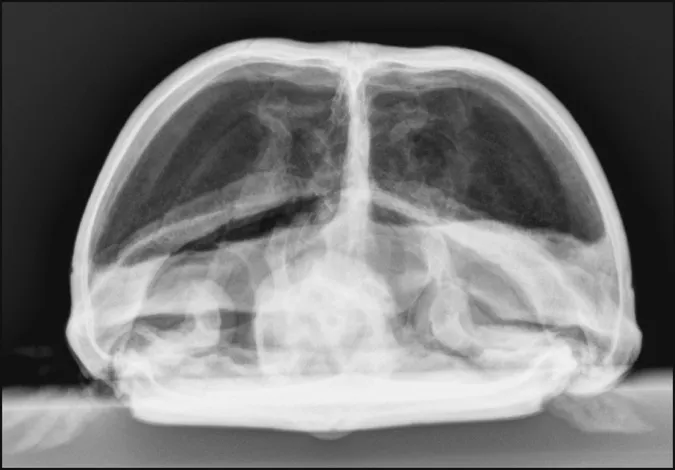
Because this is a radiographic atlas, the majority of images are radiographs. This book is not intended to be an atlas of normal computed tomography (CT) appearances, but some CT images are included to reinforce the appearance of selected structures in radiographs. A radiograph is a 2-dimensional image of a 3-dimensional (3-D) object, and, as a result, spatial localization of structures cannot always be done accurately, even with multiple views of the object or patient. CT images are tomographic, creating multiple image slices of the volume of interest. Slicing the patient solves the problem of spatial localization and can assist with understanding radiographic anatomy more thoroughly. Additionally, CT images, which are typically acquired in a transverse plane, can be reformatted into other planes, typically sagittal and dorsal planes, for clarification or to improve structure visualization. Transverse CT images can even be reformatted into volumetric images for illustration of complex structures. Therefore, a careful selection of planar and volumetric CT images has been included with this goal in mind.
Radiographic Terminology
This book uses the standard method for naming radiographic projections approved by the American College of Veterinary Radiology.1 In general, this naming method is based on anatomic directional terms (as defined by the Nomina Anatomica Veterinaria) combined with the point-of-entrance to point-of-exit of the primary x-ray beam. In other words, any radiograph can be named by knowing the point of entrance and point of exit of the primary x-ray beam. For example, a spinal radiograph made with a dog lying in dorsal recumbency would be cal...
Table of contents
- Cover image
- Title page
- Table of Contents
- Copyright
- Preface
- Acknowledgments
- The Images
- 1 Basic Imaging Principles and Physeal Closure Time
- 2 The Skull
- 3 The Spine
- 4 The Thoracic Limb
- 5 The Pelvic Limb
- 6 The Thorax
- 7 The Abdomen
- Index
- Color Plate
Trusted by 375,005 students
Access to over 1.5 million titles for a fair monthly price.
Study more efficiently using our study tools.
Frequently asked questions
Yes, you can cancel anytime from the Subscription tab in your account settings on the Perlego website. Your subscription will stay active until the end of your current billing period. Learn how to cancel your subscription
No, books cannot be downloaded as external files, such as PDFs, for use outside of Perlego. However, you can download books within the Perlego app for offline reading on mobile or tablet. Learn how to download books offline
Perlego offers two plans: Essential and Complete
- Essential is ideal for learners and professionals who enjoy exploring a wide range of subjects. Access the Essential Library with 800,000+ trusted titles and best-sellers across business, personal growth, and the humanities. Includes unlimited reading time and Standard Read Aloud voice.
- Complete: Perfect for advanced learners and researchers needing full, unrestricted access. Unlock 1.5M+ books across hundreds of subjects, including academic and specialized titles. The Complete Plan also includes advanced features like Premium Read Aloud and Research Assistant.
We are an online textbook subscription service, where you can get access to an entire online library for less than the price of a single book per month. With over 1.5 million books across 990+ topics, we’ve got you covered! Learn about our mission
Look out for the read-aloud symbol on your next book to see if you can listen to it. The read-aloud tool reads text aloud for you, highlighting the text as it is being read. You can pause it, speed it up and slow it down. Learn more about Read Aloud
Yes! You can use the Perlego app on both iOS and Android devices to read anytime, anywhere — even offline. Perfect for commutes or when you’re on the go.
Please note we cannot support devices running on iOS 13 and Android 7 or earlier. Learn more about using the app
Please note we cannot support devices running on iOS 13 and Android 7 or earlier. Learn more about using the app
Yes, you can access Atlas of Normal Radiographic Anatomy and Anatomic Variants in the Dog and Cat - E-Book by Donald E. Thrall,Ian D. Robertson in PDF and/or ePUB format, as well as other popular books in Medicina & Medicina veterinaria. We have over 1.5 million books available in our catalogue for you to explore.