The authors, specialists in the UK, draw on developmental theory to propose a model of practice specifically for dementia care. The number of people who suffer from dementia is increasing and in consequence the problems it presents are affecting a growing number of therapists and carers. Many of these problems are peculiar to dementia and the models of care used with other client groups have proved inadequate when dealing with the provision of quality of care to people who have dementia. This revised edition contains a new opening chapter which brings our understanding of dementia up-to-date. The book looks at the relationship between occupation, wellbeing and dementia and examines the critical role of the carer in developing therapeutic interventions.- Proposes a realistic model of practice for dementia care which centres on the unique occupational potential of the person with dementia.- Offers positive strategies to improve wellbeing.- Current information on assessment tools.- Written by therapists with extensive experience in working with this client group.
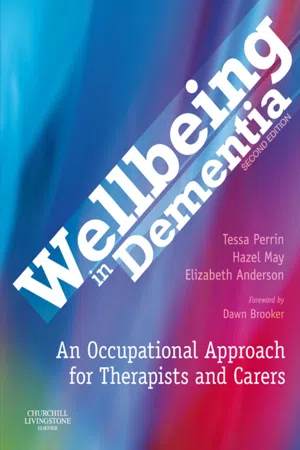
eBook - ePub
Wellbeing in Dementia
An Occupational Approach for Therapists and Carers
- 176 pages
- English
- ePUB (mobile friendly)
- Available on iOS & Android
eBook - ePub
Wellbeing in Dementia
An Occupational Approach for Therapists and Carers
About this book
Information
Chapter 1. Understanding dementia
CHAPTER CONTENTS
Introduction1
What is dementia?2
Living with primary dementia6
The nature of the neurological impairment8
Memory19
Conclusion23
INTRODUCTION
The question ‘What is dementia?’ is easy to ask and hard to answer. It may be easier to begin with what dementia is not. One thing that dementia is not, and has never been defined to be, is a disease. Rather, dementia has always been defined to be a syndrome of intellectual decline. ‘Syndrome’ sounds daunting but all it means is ‘a collection of symptoms’. These symptoms are usually some or all of the following:
▪ memory loss
▪ language difficulties
▪ difficulties with spatial awareness and skilled movement
▪ a loss of knowledge and understanding of the world
▪ problems with reasoning, planning and judgement
▪ changes in personality, behaviour and emotional control.
Even these sub-categories are quite broad and cover a lot of different specific problems and difficulties and there is considerable variation from one person to the next in the particular mix of symptoms they experience. The aim of this chapter is to explain what dementia is and what causes it. To work successfully with people with dementia it is important to have a sound understanding of the condition they are living with. As part of this explanation, the chapter will outline the basic organisation of the human brain and reveal the parts that are most vulnerable and least vulnerable to damage in dementia. This provides a basis not only for understanding why certain symptoms are common amongst people with dementia, but also for why we need to recognise the individuality of the person with dementia. It is important that we do not assume that the dementia is simply ‘global intellectual decline’ but undertake a careful assessments of both lost and preserved abilities in a person with dementia. The chapter will also explain why brain damage must be set in a wider context that covers the person's past and present circumstances. The chapter will show how we can use knowledge about the brain, and in particular the organisation of memory functions, to move into the mind of the person with dementia and take on their perspective of the world. This perspective is central to understanding the needs and behaviour of a person with dementia and providing care that promotes their wellbeing.
WHAT IS DEMENTIA?
The current definition of dementia by the World Health Organization (1993), in the 10th edition of its International Classification of Diseases (ICD-10), is:
‘A syndrome due to disease of the brain, usually of a chronic or progressive nature, in which there is disturbance of multiple higher cortical functions, including memory, thinking, orientation, comprehension, calculation, learning capacity, language and judgement. Consciousness is not clouded. The impairments of cognitive function are commonly accompanied, and occasionally preceded, by deterioration in emotional control, social behaviour or motivation. This syndrome occurs in Alzheimer's disease, in cerebrovascular disease, and in other conditions primarily or secondarily affecting the brain.’
This definition makes it clear that the core symptoms of dementia (that is, the problems with memory, the confusion, the difficulties with language and understanding, the changes in emotion and behaviour) are primarily due to damage to the brain. The above definition also makes clear that there are many different challenges to the brain that can cause the symptoms of dementia. Thus, the word ‘dementia’ does not refer to a specific disease, but rather is an umbrella term which covers many different forms of disease and damage to the brain that affect its ‘higher’ or ‘cognitive’ functions. The most common causes of dementia are summarised in Table 1.1.
| Common primary causes | Common secondary causes |
|---|---|
| Alzheimer's disease | Vitamin B deficiency |
| Vascular dementia | Hypothyroidism |
| Lewy body dementia | Depression |
| Frontotemporal dementia |
Some of these causes affect the brain directly (primary causes) whilst others are indirect (secondary causes). Secondary causes cause some kind of disruption to normal processing within the brain but do not damage the structure of the brain. Because the structure of the brain has not been damaged these dementias can often be reversed through successful treatment of the underlying condition. Table 1.1 shows that the most common secondary causes are vitamin B deficiency, hypothyroidism and depression. For people with secondary dementia the prognosis is good and they do not face the long-term challenges associated with the primary dementias.
The focus of this book is to improve the prospects for quality of life and wellbeing for those with primary dementia, for whom the prognosis is more challenging. These are the dementias that directly damage the brain and are irreversible and usually progressive. The most common form of primary dementia is Alzheimer's disease (accounting for 50–60% of all dementias). Alzheimer's disease is a neurodegenerative disease that slowly strips cells out of the most developed parts of the brain. The usual duration of the disease is 4–6 years, although there is huge variation, with some people dying within a year or two and others experiencing a gentler trajectory of decline that can span over two decades (Corey-Bloom & Fleisher 2005). The disease is recognised at post-mortem by its hallmarks, senile plaques and neurofibrillary tangles, within the brain tissue. In recent years much has been learnt about this disease, but it is a complex process and debate continues about what causes it: whether the plaques and tangles cause cell death, or whether they are simply the only visible by-products of dysfunctional cellular processes that have yet to be revealed and understood (for a review see Whalley 2001).
Cerebrovascular damage (vascular dementia) is also a significant cause of dementia, accounting for about 20% of all dementias. The term vascular dementia covers all dementias which are primarily caused by a problem with the blood supply to the brain. The most common form is multi-infarct dementia, a condition in which the person develops a vulnerability to tiny strokes (sometimes called ‘mini strokes’ or ‘strokelets’). In the early stages the brain damage that results from these small strokes is too minimal to cause any noticeable change to the person's skills and intellect, but as the damage accumulates the symptoms of dementia emerge and develop.
Other recently recognised significant causes of dementia are Lewy body dementia and frontotemporal dementia. Like Alzheimer's disease, these are both neurodegenerative processes that progressively kill brain cells. The causes and mechanisms of these processes, like those of Alzheimer's disease, remain only partially understood. The process underlying Lewy body dementia leaves a different pathological hallmark within affected nerve cells – the Lewy body, a small, spherical deposit of insoluble protein. Post-mortem studies have revealed that Lewy body disease and Alzheimer's disease often exist together. Indeed, mixed causes of dementia, sometimes called ‘the mixed dementias’, are common (Esiri et al 2001). The processes underlying the frontotemporal dementias are recognised by the very severe atrophy, or thinning, of brain tissue in the frontal and temporal lobes of the brain (key areas of the brain which will be introduced and explained in the latter half of this chapter). Pick's disease is a particular form of frontotemporal dementia, again recognised at post-mortem by a particular neuropathological hallmark within damaged cells called the Pick body.
If you wish to learn more about the nature of these diseases, the best place to start is the Alzheimer's Society website which has an excellent factsheet about each one. Were you to delve into medical textbooks on the topic you would find that whilst these are the major causes of dementia there are numerous other rare causes of primary dementia, including Creutzfelt–Jakob disease. It is possible to generate lists of causes with over 50 entries but taken together the rare causes account for only 1–2% of all primary dementias.
It remains impossible to diagnose the underlying cause of a primary dementia with 100% accuracy. There are no clinical tests that can confirm that the pathology of Alzheimer's disease, Lewy body disease or frontotemporal dementia is developing within a person's brain. Vascular dementia is related to general indices of vascular health (e.g. diabetes, high cholesterol ...
Table of contents
- Cover image
- Table of Contents
- Copyright
- Foreword
- Preface to 2nd edition
- Chapter 1. Understanding dementia
- Chapter 2. Occupational therapy revisited
- Chapter 3. The altered world of dementia
- Chapter 4. The significance of the carer
- Chapter 5. The playful practitioner
- Chapter 6. Principles of good practice in dementia care
- Chapter 7. Non-verbal communication
- Chapter 8. A model for dementia care
- Chapter 9. Assessing capacity for doing and promoting engagement
- Chapter 10. The dementia therapist
- Index
Trusted by 375,005 students
Access to over 1.5 million titles for a fair monthly price.
Study more efficiently using our study tools.
Frequently asked questions
Yes, you can cancel anytime from the Subscription tab in your account settings on the Perlego website. Your subscription will stay active until the end of your current billing period. Learn how to cancel your subscription
No, books cannot be downloaded as external files, such as PDFs, for use outside of Perlego. However, you can download books within the Perlego app for offline reading on mobile or tablet. Learn how to download books offline
Perlego offers two plans: Essential and Complete
- Essential is ideal for learners and professionals who enjoy exploring a wide range of subjects. Access the Essential Library with 800,000+ trusted titles and best-sellers across business, personal growth, and the humanities. Includes unlimited reading time and Standard Read Aloud voice.
- Complete: Perfect for advanced learners and researchers needing full, unrestricted access. Unlock 1.5M+ books across hundreds of subjects, including academic and specialized titles. The Complete Plan also includes advanced features like Premium Read Aloud and Research Assistant.
We are an online textbook subscription service, where you can get access to an entire online library for less than the price of a single book per month. With over 1.5 million books across 990+ topics, we’ve got you covered! Learn about our mission
Look out for the read-aloud symbol on your next book to see if you can listen to it. The read-aloud tool reads text aloud for you, highlighting the text as it is being read. You can pause it, speed it up and slow it down. Learn more about Read Aloud
Yes! You can use the Perlego app on both iOS and Android devices to read anytime, anywhere — even offline. Perfect for commutes or when you’re on the go.
Please note we cannot support devices running on iOS 13 and Android 7 or earlier. Learn more about using the app
Please note we cannot support devices running on iOS 13 and Android 7 or earlier. Learn more about using the app
Yes, you can access Wellbeing in Dementia by Tessa Perrin,Hazel May,Elizabeth Milwain,Elizabeth Anderson in PDF and/or ePUB format, as well as other popular books in Medicina & Terapia occupazionale. We have over 1.5 million books available in our catalogue for you to explore.