- UPDATED anesthetic drug information and NEW pain management techniques provide the latest on indications, toxicities, and recommended dosages.- EXPANDED step-by-step overviews of anesthetic and analgesic techniques make it easier to review and perform procedures.- UPDATED coverage of euthanasia, including the most current AVMA guidelines, provides today's accepted protocols for the provision of euthanasia.- UPDATED complementary and alternative strategies provide non-pharmacologic interventions for pain management.- UPDATED research findings and clinical applications address special anesthetic considerations necessary in cats.
- 616 pages
- English
- ePUB (mobile friendly)
- Available on iOS & Android
eBook - ePub
Handbook of Veterinary Anesthesia
About this book
Information
Topic
MedicineSubtopic
Veterinary Medicine1
Introduction to Anesthesia
“There are no safe anesthetic agents; there are no safe anesthetic procedures; there are only safe anesthetists.”
ROBERT SMITH
Overview
The applied practice of veterinary anesthesia is based on a general understanding of the following: (1) the terms used to describe the drugs, techniques, and consequences of anesthesia (2) the pharmacology, pharmacokinetics, pharmacodynamics, and toxicology of the drugs used to produce and antagonize anesthesia, (3) the current methods for delivering and assessing the anesthetic drugs’ effects, and (4) and appropriate therapy for anesthetic-related complications or emergencies. This chapter defines commonly used terms, outlines general uses for anesthetic drugs, their combinations, and conventional methods used to produce immobilization and anesthesia in animals.
General Considerations
I Anesthesia’s purpose is to produce a convenient, safe, effective, and economical means of facilitating medical and surgical procedures while minimizing stress, pain, discomfort, and adverse side effects to the subject and attending personnel.
II Criteria for selection of drugs and techniques
A Species, breed, age, weight, and body type
B Behavior
C Physical status and coexisting disease processes
D Nature, location, and severity of pain
E Current and past medications
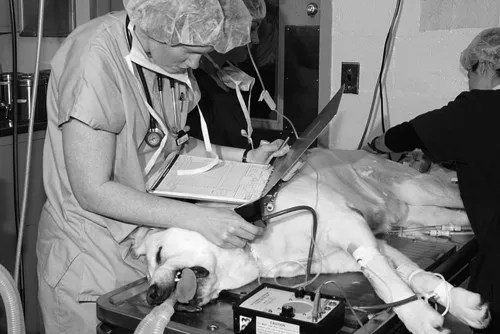
F Knowledge and experience of personnel (Fig. 1-1)
G Familiarity with available equipment and techniques
H Duration and type of procedure to be performed
III Responses vary because drug doses and techniques are initially developed for the “average, normal, healthy” animal; thus, it is essential that drugs, drug dosages, and anesthetic techniques are selected based on the subject’s physical status (developed by the American Society of Anesthesiologists: ASA)
A Physical Status 1— A normal healthy patient
B Physical Status 2—A patient with mild systemic disease
C Physical Status 3—A patient with severe systemic disease
D Physical Status 4—A patient with severe systemic disease that is a constant threat to life
E Physical Status 5—A moribund patient who is not expected to survive without the operation
IV Definitions
A Medical terms used in the practice of anesthesia: Most definitions of anesthesia incorporate a loss of feeling (analgesia) and/or awareness (unconsciousness). Muscle relaxation and a reduction in the stress response are added benefits.
Acupuncture: The stimulation of specific trigger points based on traditional Chinese medicine
Additive: An effect in which two substances or actions used in combination produce a total effect the same as the sum of the individual effects.
Agonist: A drug that produces an effect by interacting with a specific receptor site (e.g., opioid agonist morphine)
Akinesia: Loss of motor response (movement) usually caused by blockade of motor nerves
Allodynia: Pain evoked by a stimulus that does not normally cause pain
Analeptic: a central nervous system (CNS) stimulant or respiratory stimulant
Analgesia: Loss of sensitivity to pain; relief of pain without loss of consciousness
Anesthesia: Total loss of sensation in a body part or in the whole body, generally induced by a drug or drugs that depress the activity of nervous tissue either locally, regionally, or generally (centrally). The act of producing anesthesia is generally divided into phases that include the preanesthetic, anesthetic, and postanesthetic periods (see box)
Balanced anesthesia: Surgical anesthesia produced by a combination of two or more drugs or anesthetic techniques, each contributing its own pharmacologic effects; includes tranquilizers, opioids, nitrous oxide, muscle relaxants, and inhalants
Dissociative anesthesia: A CNS state ...
Table of contents
- Cover image
- Title page
- Table of Contents
- Copyright
- Dedication
- Preface
- Chapter 1: Introduction to Anesthesia
- Chapter 2: Animal Evaluation and Preparation
- Chapter 3: Preanesthetic and Perioperative Medications
- Chapter 4: Local Anesthetic Drugs and Techniques
- Chapter 5: Local Anesthesia in Ruminants and Pigs
- Chapter 6: Local Anesthesia in Horses
- Chapter 7: Local Anesthesia in Dogs and Cats
- Chapter 8: Injectable Anesthetic Drugs
- Chapter 9: Inhalant Anesthesia and Inhalant Anesthetics
- Chapter 10: Neuromuscular Blocking Drugs
- Chapter 11: Equipment for Tracheal Intubation and Securing the Airway
- Chapter 12: Anesthetic Machines and Breathing Systems
- Chapter 13: Ventilation and Mechanical Assist Devices
- Chapter 14: Monitoring During Anesthesia
- Chapter 15: Acid-Base Balance and Blood Gases
- Chapter 16: Perioperative Fluid Administration
- Chapter 17: Temperature Regulation During Anesthesia: Anesthetic-Associated Hypothermia and Hyperthermia
- Chapter 18: Pain and Pain Therapy
- Chapter 19: Integrative Medicine: Acupuncture Analgesia
- Chapter 20: Anesthetic Procedures and Techniques in Dogs
- Chapter 21: Anesthetic Procedures and Techniques in Cats
- Chapter 22: Anesthetic Procedures and Techniques in Horses
- Chapter 23: Anesthetic Procedures and Techniques in Ruminants
- Chapter 24: Anesthetic Procedures and Techniques in Pigs
- Chapter 25: Anesthetic Procedures and Techniques in Camelids
- Chapter 26: Anesthetic Procedures in Exotic Animals
- Chapter 27: Anesthesia for Cesarean Section
- Chapter 28: Respiratory Emergencies
- Chapter 29: Cardiovascular Emergencies
- Chapter 30: Euthanasia
- Physical Principles of Anesthesia
- Drug Schedules
- Guiding Principles for Research Involving Animals and Human Beings
- Index
Trusted by 375,005 students
Access to over 1.5 million titles for a fair monthly price.
Study more efficiently using our study tools.
Frequently asked questions
Yes, you can cancel anytime from the Subscription tab in your account settings on the Perlego website. Your subscription will stay active until the end of your current billing period. Learn how to cancel your subscription
No, books cannot be downloaded as external files, such as PDFs, for use outside of Perlego. However, you can download books within the Perlego app for offline reading on mobile or tablet. Learn how to download books offline
Perlego offers two plans: Essential and Complete
- Essential is ideal for learners and professionals who enjoy exploring a wide range of subjects. Access the Essential Library with 800,000+ trusted titles and best-sellers across business, personal growth, and the humanities. Includes unlimited reading time and Standard Read Aloud voice.
- Complete: Perfect for advanced learners and researchers needing full, unrestricted access. Unlock 1.5M+ books across hundreds of subjects, including academic and specialized titles. The Complete Plan also includes advanced features like Premium Read Aloud and Research Assistant.
We are an online textbook subscription service, where you can get access to an entire online library for less than the price of a single book per month. With over 1.5 million books across 990+ topics, we’ve got you covered! Learn about our mission
Look out for the read-aloud symbol on your next book to see if you can listen to it. The read-aloud tool reads text aloud for you, highlighting the text as it is being read. You can pause it, speed it up and slow it down. Learn more about Read Aloud
Yes! You can use the Perlego app on both iOS and Android devices to read anytime, anywhere — even offline. Perfect for commutes or when you’re on the go.
Please note we cannot support devices running on iOS 13 and Android 7 or earlier. Learn more about using the app
Please note we cannot support devices running on iOS 13 and Android 7 or earlier. Learn more about using the app
Yes, you can access Handbook of Veterinary Anesthesia by William W. Muir,John A. E. Hubbell in PDF and/or ePUB format, as well as other popular books in Medicine & Veterinary Medicine. We have over 1.5 million books available in our catalogue for you to explore.