The latest edition of the critically acclaimed Small Animal Endoscopy presents informative, practical, and up-to-date guidance on endoscopic indications, instrumentation, patient preparation, and techniques. Todd R. Tams and Clarence A. Rawlings, the foremost experts in veterinary endoscopy, provide the novice as well as the advanced practitioner with the information needed to deliver the safest, high-quality endoscopic services for small animals, including avian and exotics. Chapters are organized consistently and lavishly illustrated to help you easily find and understand key concepts and procedures. This edition includes a companion website with expert demonstrations of techniques.- Enables you to deliver the safest, high quality care and a wider range of services to the pets of increasingly concerned and savvy owners.- Features cutting-edge information on minimally invasive procedures to improve diagnostic accuracy, reduce operating time, improve success, minimize post-operative stress and pain, and promote faster healing.- Helps you recognize the many indications for endoscopy in everyday practice.- Covers a vast range of topics in a clear, concise and readable style.- Describes instrumentation, examination, and sample procurement techniques in detail.- Shows both normal and abnormal findings you may encounter during a procedure in an atlas of images in relevant chapters.- Provides minimally invasive examination and surgical options for veterinarians treating uniquely sensitive avian and exotic patients.- Provides step-by-step instructions on specific techniques.- Helps beginners master endoscopic diagnosis and treatment and more experienced endoscopists utilize their endoscopic equipment to its fullest capacity.
- 696 pages
- English
- ePUB (mobile friendly)
- Available on iOS & Android
eBook - ePub
Small Animal Endoscopy
About this book
Information
Topic
MedicineSubtopic
Veterinary MedicinePart One
Flexible Endoscopy
Chapter 1 Endoscopic Instrumentation and Documentation for Flexible and Rigid Endoscopy
Most endoscopic instrumentation is produced for human medicine and surgery. There are literally thousands of products designed for every possible application of endoscopy in people. From this overwhelming array of sometimes cost-prohibitive choices, the savvy veterinary practitioner must carefully select the most versatile products that provide an efficacious solution to the medical and surgical challenges best addressed by a minimally invasive approach. This chapter presents a general and practical overview of the most popular flexible and rigid instrumentation—its proper care, economic implications, and common applications in veterinary medicine.
Endoscope System
The endoscopy imaging chain includes a light source, light-transmitting cable, endoscope, camera, and monitor (Figure 1-1). Each component is essential, and the resulting endoscopic image can only be as good as the weakest link in that chain. On many flexible endoscopes, the light-transmitting cable is permanently attached to the endoscope and has a connector that plugs directly into the light source (Figure 1-2).
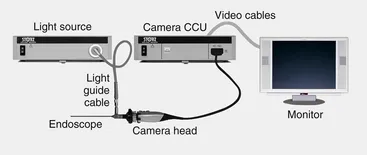
Figure 1-1 Endoscopy imaging chain begins with a light source and ends with a monitor.
(Photo courtesy of Karl Storz GmbH & Co. KG, Tuttlingen, Germany.)
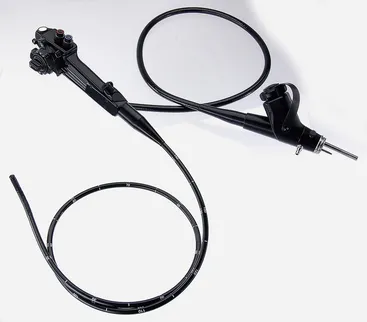
Figure 1-2 Multipurpose flexible video endoscope with an outer diameter of 9 mm and working length of 140 cm. The umbilical cord has a connector (far right) that attaches directly to the light source with an integrated air pump for insufflation.
(Photo courtesy of Karl Storz GmbH & Co. KG, Tuttlingen, Germany.)
Numerous accessories and ancillary instruments may be added to the basic endoscope system. This equipment enhances functionality, diagnostic or therapeutic capability, and documentation of findings. Accessories may include various sheaths and instruments for biopsy, grasping, aspiration, fluid infusion, cytologic sampling, electrosurgery, and laser surgery; pumps for suction, insufflation, and irrigation; and image management systems for recording, printing, and digital storage or transmission of still photographs and video.
Flexible Endoscopes
The two basic types of flexible endoscopes are the fiberscope and the video endoscope. The difference between the two is in the method of sensing and transmitting images. In a fiberoptic endoscope, the image is carried from the distal tip of the endoscope to the eyepiece via bundles of optical glass fibers. In a true video endoscope, the image is transmitted electronically to a video monitor from the distal tip of the endoscope where it is “sensed” by a charge-coupled device (CCD) chip.
Video imaging offers distinct advantages in terms of operator comfort, client relations, teaching, and documentation. Video imaging also enables the endoscopist to work more effectively with any assistants who are helping with the procedure. For these reasons, it is advised that all practices performing endoscopy have at least some type of video imaging capability, as will be described later on.
The ability to view the endoscopic image on a video monitor and record or print this information is not unique to video endoscopes. Indirect video endoscopy can be accomplished by attaching an endoscopic CCD video camera to the eyepiece of a fiberscope or rigid endoscope (see “Endoscopic Imaging Systems” later in this chapter, Figure 1-25). Although true video endoscopes are preferred for superior visualization in gastrointestinal endoscopy, CCD video cameras are still necessary for use with rigid endoscopes (e.g., laparoscopes and arthroscopes), as well as smaller diameter fiberscopes. Fortunately, the combination of a good quality video camera and fiberoptic endoscope can provide very good images. The smallest flexible video endoscopes currently available for medical use are approximately 5 or 6 mm in outer diameter, depending on chip technology and mechanical functions, such as channel size and deflection capability. Until the technologic limitations on the miniaturization of CCD chips are overcome, the production of very small diameter video endoscopes is not feasible.
Although fiberscopes are less expensive than video endoscopes, the cost of the latter has recently come down and the image quality of video endoscopes is far superior to that of fiberscopes (Figure 1-3). Because the image produced by a video endoscope is not fiberoptic, it will never contain the honeycomb pattern or broken fibers seen as black dots in a fiberoptic image. The features of fiberscopes and video endoscopes are compared in Table 1-1.
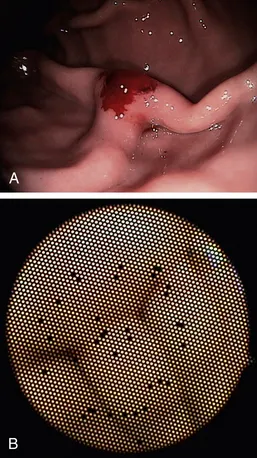
Figure 1-3 A, Video endoscopic image of a gastric biopsy site with an average amount of bleeding after sample procurement (center of field on a rugal fold). B, Fiberoptic image (older model scope with compromised image and broken fibers).
Table 1-1 Features of Fiberscopes versus Video Endoscopes
| Feature | Fiberscope | Video endoscope |
|---|---|---|
| Image quality | Good | Excellent |
| Broken fibers seen as “black dots” | Likely over time | N/A (image is electronic, not fiberoptic) |
| Cost | Moderate | High |
| Diameters available | Wide range available | Smaller diameters not available∗ |
| Video capability | Requires attachable charge coupled device (CCD) camera | Integral |
∗ Due to limitations on chip miniaturization.
Flexible endoscopes are available in diameters ranging from 14 mm to less than 1 mm. Most flexible scopes greater than 2 mm in diameter are equipped with an accessory channel and a deflectable tip. The working channel is the section of the endoscope through which ancillary instruments like biopsy forceps (Figure 1-4) are advanced into the patient. Because of their versatility, the most popular endoscopes in small animal practice are gastroscopes, which have four-way tip deflection. The tip’s two-plane deflection capability (i.e., up, down, left, and right) is crucial to the successful navigation of the gastrointestinal tract, particularly in the most challenging maneuvers through the pylorus and ileocolic orifice. A gastroscope less than 9 mm in diameter and at least 130 cm in length is suitable for both upper and lower gastrointestinal endoscopy in most cats and dogs, as well as tracheobronchoscopy in medium and large size dogs.
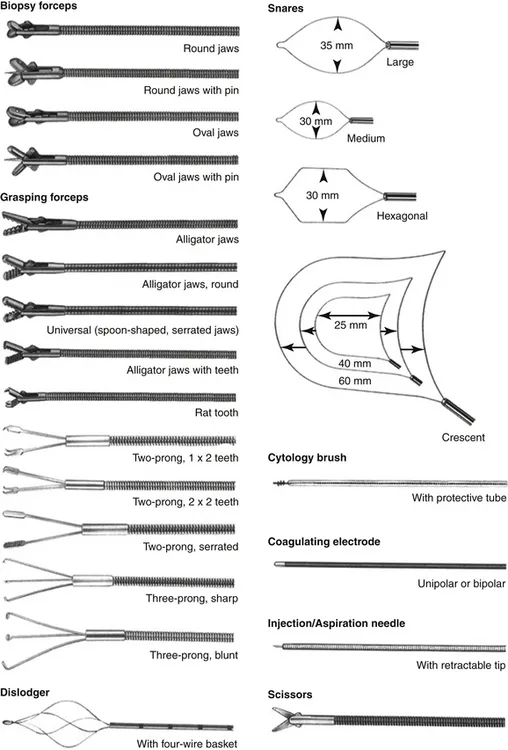
Figure 1-4 Flexible instruments for use with endoscopes that have an accessory channel.
Because most gastroscopes have an outer diameter of 7.8 mm or greater, they cannot be used in smaller dogs and cats for such procedures as bronchoscopy, rhinoscopy, and urethrocystoscopy. Consequently, the second and third most popular flexible endoscopes in small animal practice are small-diameter fiberscopes that are used primarily for endoscopy of the airways and urinary tract (Figure 1-5). These smaller diameter fiberscopes, ranging from 2 mm to 6 mm, generally have limited tip deflection capability (one-way or two-way) and smaller working channels.
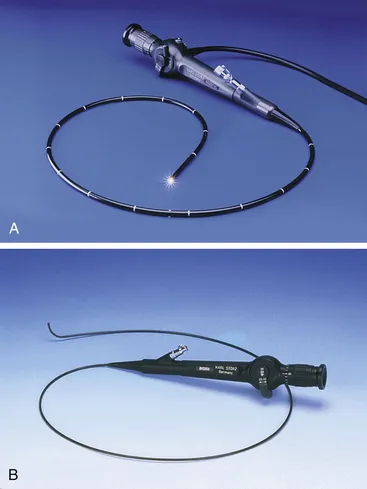
Figure 1-5 A, Small animal bronchofiberscope, 5.2-mm diameter, 85-cm length. This bronchoscope is suitable for both upper and lower airway examinations in dogs and cats. B, Specialty fiberscope, 3-mm diameter, 100-cm working length. This endoscope is ideal for urethrocystoscopy in male dogs and can also be used for respiratory endoscopy.
(Photos courtesy of Karl Storz GmbH & Co. KG...
Table of contents
- Cover
- Title Page
- Front Matter
- Copyright
- Contributors
- Preface
- Acknowledgments
- Table of Contents
- Part One: Flexible Endoscopy
- Part Two: Rigid Endoscopy
- Index
Trusted by 375,005 students
Access to over 1.5 million titles for a fair monthly price.
Study more efficiently using our study tools.
Frequently asked questions
Yes, you can cancel anytime from the Subscription tab in your account settings on the Perlego website. Your subscription will stay active until the end of your current billing period. Learn how to cancel your subscription
No, books cannot be downloaded as external files, such as PDFs, for use outside of Perlego. However, you can download books within the Perlego app for offline reading on mobile or tablet. Learn how to download books offline
Perlego offers two plans: Essential and Complete
- Essential is ideal for learners and professionals who enjoy exploring a wide range of subjects. Access the Essential Library with 800,000+ trusted titles and best-sellers across business, personal growth, and the humanities. Includes unlimited reading time and Standard Read Aloud voice.
- Complete: Perfect for advanced learners and researchers needing full, unrestricted access. Unlock 1.5M+ books across hundreds of subjects, including academic and specialized titles. The Complete Plan also includes advanced features like Premium Read Aloud and Research Assistant.
We are an online textbook subscription service, where you can get access to an entire online library for less than the price of a single book per month. With over 1.5 million books across 990+ topics, we’ve got you covered! Learn about our mission
Look out for the read-aloud symbol on your next book to see if you can listen to it. The read-aloud tool reads text aloud for you, highlighting the text as it is being read. You can pause it, speed it up and slow it down. Learn more about Read Aloud
Yes! You can use the Perlego app on both iOS and Android devices to read anytime, anywhere — even offline. Perfect for commutes or when you’re on the go.
Please note we cannot support devices running on iOS 13 and Android 7 or earlier. Learn more about using the app
Please note we cannot support devices running on iOS 13 and Android 7 or earlier. Learn more about using the app
Yes, you can access Small Animal Endoscopy by Todd R. Tams,Clarence A. Rawlings in PDF and/or ePUB format, as well as other popular books in Medicine & Veterinary Medicine. We have over 1.5 million books available in our catalogue for you to explore.