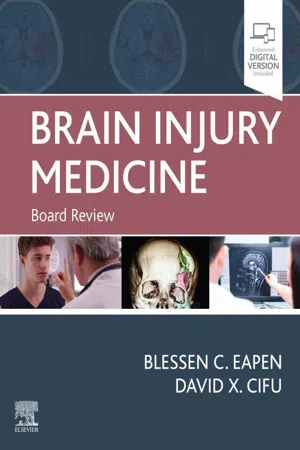
The only review book currently available in this complex field, Brain Injury Medicine: Board Review focuses on the prevention, diagnosis, treatment, and management of individuals with varying severity levels of brain injury. Focused, high-yield content prepares you for success on exams and in practice, with up-to-date coverage of traumatic brain injury (TBI), stroke, CNS neoplasms, anoxic brain injury, and other brain disorders. This unique review tool is ideal for residents, fellows, and practitioners studying or working in the field and preparing to take the brain injury medicine exam.- Supports self-assessment and review with 200 board-style questions and explanations.- Covers the information you need to know on traumatic brain injury by severity and pattern, neurologic disorders, systemic manifestations, rehabilitation problems and outcomes, and basic science.- Includes questions on patient management including patient evaluation and diagnosis, prognosis/risk factors, and applied science.- Discusses key topics such as neurodegeneration and dementia; proteomic, genetic, and epigenetic biomarkers in TBI; neuromodulation and neuroprosthetics; and assistive technology.- Reviews must-know procedures including acute emergency management and critical care; post-concussion syndrome assessment, management and treatment; diagnostic procedures and electrophysiology; neuroimaging, and brain death criteria.- Ensures efficient, effective review with content written by experts in physical medicine and rehabilitation, neurology, and psychiatry and a format that mirrors the board exam outline.
eBook - ePub
Brain Injury Medicine E-Book
Board Review
- 352 pages
- English
- ePUB (mobile friendly)
- Available on iOS & Android
eBook - ePub
Brain Injury Medicine E-Book
Board Review
About this book
Section 1:
Brain Anatomy and Physiology
Outline
- 1. Neuroanatomy correlates
- 2. Basic brain neuroscience and pathophysiology
1: Neuroanatomy correlates
Jason R. Soble, PHD, ABPP-CN, Samantha Dedios-Stern, PHD, David Andrés González, PHD, ABPP-CN, K. Chase Bailey, PHD, ABPP-CN
Abstract:
This chapter provides a foundational overview of basic structural and functional neuroanatomy as relevant in the context of brain injury. It includes a review of the general organization of the brain with specific elucidation of the pertinent cortical and subcortical structures that underlie key human cognitive, emotional, and behavioral functions. Specifically, the skull and meninges, cranial nerves, brainstem, cerebellum, and four paired lobes comprising the cerebral cortex are discussed, along with the vasculature and cerebrospinal fluid systems. Finally, the functional brain connectivity and associated pathways underlying aspects of higher order human neurobehavioral abilities (e.g., vision, language, memory) are outlined.
Functional neuroanatomy
structural neuroanatomy
brain injury
cerebral cortex
human cognition
This chapter provides a foundational overview of basic structural and functional neuroanatomy relevant to brain injury. As such, the coverage is not exhaustive, and the reader is referred to authoritative texts1-3 for more comprehensive detail. Moreover, although descriptive, the summary of each neuroanatomical structure/connection is not prescriptive, in that similar structural lesions can result in strikingly diverse functional neurobehavioral presentations among individual patients.4-5 Finally, neuroanatomical structures and associated functions are presented as discrete units here for review, but the human brain is a highly complex, connected, and integrated organ such that lesions rarely produce a singular functional deficit.
Structural organization of the brain
The command center of the human CNS, the brain is enclosed in the skull and meninges and structurally divided into the brainstem, cerebellum, and cerebrum. Beneath the cerebral cortex lie several key subcortical structures and connective pathways. The brain is made up of gray matter (cell bodies), which comprises the cortex and some subcortical structures (e.g., basal ganglia), and myelinated white matter, which transmits information to and from connected gray matter for integration/processing. The cortex is folded to allow for greater surface area within the skull, which produces its characteristic grooves (sulci) and folds (gyri). Cardinal directions and key landmarks within the brain are summarized later (Box 1.1; Figs. 1.1 and 1.2).
Skull and meni...
Table of contents
- Cover image
- Title page
- Table of Contents
- Copyright
- Dedication
- Contributors
- Preface
- Acknowledgements
- List of Tables
- List of Illustrations
- Section 1. Brain Anatomy and Physiology
- Section 2. Traumatic Brain Injury Severity and Patterns
- Section 3. Epidemiology and Risk Factors
- Section 4. Emergency Room and Intensive Care Management
- Section 5. Evaluation and Diagnosis
- Section 6. Complications and Management
- Section 7. Rehabilitation Concepts
- Section 8. Special Topics
- Answer key
- Answer key
- Index
Trusted by 375,005 students
Access to over 1.5 million titles for a fair monthly price.
Study more efficiently using our study tools.
Frequently asked questions
Yes, you can cancel anytime from the Subscription tab in your account settings on the Perlego website. Your subscription will stay active until the end of your current billing period. Learn how to cancel your subscription
No, books cannot be downloaded as external files, such as PDFs, for use outside of Perlego. However, you can download books within the Perlego app for offline reading on mobile or tablet. Learn how to download books offline
Perlego offers two plans: Essential and Complete
- Essential is ideal for learners and professionals who enjoy exploring a wide range of subjects. Access the Essential Library with 800,000+ trusted titles and best-sellers across business, personal growth, and the humanities. Includes unlimited reading time and Standard Read Aloud voice.
- Complete: Perfect for advanced learners and researchers needing full, unrestricted access. Unlock 1.5M+ books across hundreds of subjects, including academic and specialized titles. The Complete Plan also includes advanced features like Premium Read Aloud and Research Assistant.
We are an online textbook subscription service, where you can get access to an entire online library for less than the price of a single book per month. With over 1.5 million books across 990+ topics, we’ve got you covered! Learn about our mission
Look out for the read-aloud symbol on your next book to see if you can listen to it. The read-aloud tool reads text aloud for you, highlighting the text as it is being read. You can pause it, speed it up and slow it down. Learn more about Read Aloud
Yes! You can use the Perlego app on both iOS and Android devices to read anytime, anywhere — even offline. Perfect for commutes or when you’re on the go.
Please note we cannot support devices running on iOS 13 and Android 7 or earlier. Learn more about using the app
Please note we cannot support devices running on iOS 13 and Android 7 or earlier. Learn more about using the app
Yes, you can access Brain Injury Medicine E-Book by Blessen C. Eapen,David X. Cifu,Blessen Eapen, Blessen Eapen, David X. Cifu in PDF and/or ePUB format, as well as other popular books in Medicine & Neurology. We have over 1.5 million books available in our catalogue for you to explore.