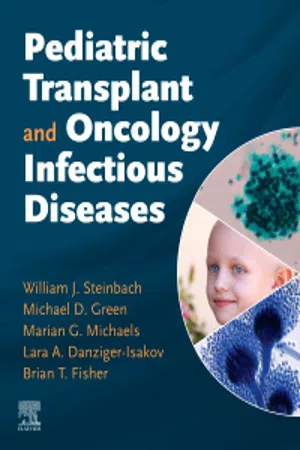
As the number and types of pediatric transplants increase and the complexity of chemotherapy regimens continues to evolve, there is a greater need for authoritative guidance, clinically actionable strategies, and easy-to-find information in the challenging area of immunocompromised pediatric patients. Pediatric Transplant and Oncology Infectious Diseases offers up-to-date, targeted coverage of this complex field, compiled by world-renowned editors and authors into one convenient volume.- Covers the must-know principles for diagnosing and managing opportunistic infections in immunocompromised populations and detailed aspects of their care – information not specifically covered in pediatric infectious disease textbooks or pediatric oncology books.- Features algorithms in every chapter that provide visual, accessible overviews of treatment protocols.- Discusses key topics such as microbiome implications in transplantation and oncology, antimicrobial resistant Gram-negative bacteria, EBV-associated post-transplant lymphoproliferative disorders, and many others.- Offers well-referenced, evidence-based content throughout, with targeted suggested readings provided.
eBook - ePub
Pediatric Transplant and Oncology Infectious Diseases E-Book
Pediatric Transplant and Oncology Infectious Diseases E-Book
- 288 pages
- English
- ePUB (mobile friendly)
- Available on iOS & Android
eBook - ePub
Pediatric Transplant and Oncology Infectious Diseases E-Book
Pediatric Transplant and Oncology Infectious Diseases E-Book
About this book
Information
Topic
MedicinaSubtopic
Malattie infettive SECTION 1
General Immunocompromised Host Infection Principles
Outline
- 1. The surgical and immunosuppressive basis for infections in the pediatric solid organ transplant recipient
- 2. Immunologic recovery and basis for infections in the pediatric hematopoietic stem cell transplant recipient
- 3. Cancer and antineoplastic therapies and the risk of infection in the pediatric cancer patient
1
The surgical and immunosuppressive basis for infections in the pediatric solid organ transplant recipient
Yeh-Chung Chang, MD, MSCE, Andrew Barbas, MD
Balanced immunosuppression is essential to ensure acceptance of a solid organ transplant and an overall successful patient outcome. The fundamental purpose of immunosuppression is to modulate the immune system’s ability to recognize the transplanted organ. However, an overly suppressed immune system increases the risk of certain infections in pediatric solid organ transplant recipients. The goal of balanced immunosuppression is to carefully walk the fine line between too little immunosuppression, which predisposes patients to organ rejection, and too much immunosuppression, which predisposes patients to opportunistic infections.
Although the focus on immunosuppression and its link to infection is warranted, there are other risk factors for infection in pediatric solid organ transplant recipients. Before transplant these may be similar between children and adults. Chronic disease alone is a key risk factor. Potential transplant recipients may undergo multiple rounds of antibiotic treatment for pneumonia, cholangitis, peritonitis, and urinary tract infection, thus increasing their chances of an antibiotic-resistant or opportunistic pathogen. Many potential recipients may also need hospitalization, thus increasing their exposure to multiple types of infections. Transplant candidates are often dependent on the use of central venous catheters, peritoneal dialysis catheters, hemodialysis catheters, ventricular assist devices or extracorporeal membrane oxygenation, all of which increase the risk of systemic invasion by various microorganisms.
Sources of infection after transplant broadly include donor-derived infections, infections acquired perioperatively, reactivation of latent infections, and other infections acquired throughout the patient’s lifetime after transplantation, when there is the added effect of immunosuppressive medications. Postoperatively, poor wound healing is common, and there may be open chests or open abdomens that increase infection risk.
There are also unique issues in pediatric solid organ transplant recipients that contribute to the overall risk of infection. Pediatric recipients are more likely to have malnutrition, which can affect normal immune responses. The actual transplant surgical procedure can involve smaller vascular structures, with higher risk of complications (hematoma, thrombosis). The pediatric solid organ transplant recipient is often naïve to numerous infections, as there is less lifetime exposure to infectious agents. Compounding this is the fact that many children cannot complete the full primary immunization series before transplant. All of these factors contribute to an underdeveloped protective immunity. The following sections review the important surgical and immunologic risk factors for infection in more detail, with a focus on pediatric considerations when appropriate.
Surgical considerations
Surgical infections in the pediatric solid organ transplant recipient are an important source of morbidity, particularly in the early period after transplantation. Surgical infections are broadly classified as either superficial or deep surgical site infections. The risk and nature of these infections differ by organ type.
Superficial surgical site infections
Superficial surgical site infections refer primarily to wound infections in the skin from incisions made during the transplant procedure. Most commonly, these are caused by gram-positive organisms that colonize the skin. Antimicrobial prophylaxis administered before skin incision has been proven to reduce the incidence of these infections and has been adopted for transplant procedures.1 Treatment of typical superficial surgical site infection includes antibiotic therapy with coverage of gram-positive organisms and local wound care. Local wound care may include exploration of any areas of induration and redness, which may harbor purulent drainage in the subcutaneous space. If such areas are found, treatment consists of reopening the skin and subcutaneous tissue, evacuating the subcutaneous fluid collection, sending any diagnostic samples for microbiologic cultures, and leaving the wound open to heal by secondary intention (granulation from the subcutaneous layer upward). Local wound care thereafter typically includes wet-to-dry dressing changes or the application of a negative-pressure dressing (wound vacuum-assisted closure).
Necrotizing wound infections represent a rare but severe form of wound infection that must be diagnosed and treated expeditiously, particularly in immunosuppressed individuals. These severe necrotizing infections are commonly polymicrobial, but can also be caused by group A Streptococcus and clostridial organisms. Presentation includes severe pain at the surgical site, high fevers, leukocytosis, and electrolyte abnormalities. These infections are characterized by rapid progression along soft tissue planes including fascia. Treatment requires intravenous antibiotic therapy and urgent operative debridement of involved tissues, which typically includes skin, subcutaneous tissue, and deeper fascia.2
Deep surgical site infections.
Deep surgical site infections occur in body cavities that are exposed during the surgical procedure. Most commonly, these infections are related to the development of fluid collections in these compartments, which are either primarily or secondarily infected. The causes of deep surgical site infections vary by the type of surgical procedure performed and are discussed by organ type. In many cases, catheter-based drainage of these infected fluid collections combined with antimicrobial therapy allows prompt resolution, but in some cases surgical debridement and drainage is required.
Heart transplantation.
The most common deep space infection after heart transplantation is mediastinitis, which is characterized by a deep infection of the sternum. The incidence after heart transplantation is 2.5% to 7.5%, and risk factors include younger age (<1 year), epicardial pacing wires, and red blood cell transfusion.3,4 Mediastinitis is typically a monomicrobial infection, with the most common etiology being both methicillin-sensitive Staphylococcus aureus and methicillin-resistant S. aureus. Treatment generally requires operative debridement of infected tissues, complex chest closure incorporating soft tissue flaps, and prolonged antimicrobial therapy.
Lung transplantation.
After lung transplantation, deep space surgical infections most commonly occur in the pleural space. Fluid and hematoma can accumulate in the pleural space and become secondarily infected, developing into an empyema if the infection progresses. Infected pleural fluid is typically managed with chest tube drainage, but if an empyema develops, surgical debridement and drainage are warranted. The incidence of empyema is approximately 3% to 5% in the lung transplant population and is associated with a significant increase in morbidity and mortality.5,6
Kidney transplantation.
Deep space infection after kidney transplantation arises from infected fluid collections in the surgical bed. Kidney grafts can be implanted in either an intraperitoneal or retroperitoneal location, depending on the size of the recipient. In younger/smaller recipients, the graft is typically placed in an intraperitoneal location, using the distal aorta and inferior vena cava as sites for vascular inflow and outflow, respectively. In this setting, fluid collections that arise thereafter are located in the peritoneal cavity. Fluid collections may consist of hematoma, lymphatic fluid, or, less commonly, urine from a urine leak between the transplanted ureter and recipient bladder. Most common among these are hematomas, which can serve as a rich source of nutrient media for microorganisms.
In older/larger pediatric recipients, the kidney graft is usually placed in a retroperitoneal position, using the external iliac artery and vein for inflow and outflow, respectively. The retroper...
Table of contents
- Cover image
- Title page
- Table of Contents
- Copyright
- Dedication
- Contributors
- Preface
- Foreword
- SECTION 1. General Immunocompromised Host Infection Principles
- SECTION 2. Common Immunocompromised Host Infection Situations
- SECTION 3. Specific Infections in Transplant Recipients and Oncology Patients
- Index
Trusted by 375,005 students
Access to over 1.5 million titles for a fair monthly price.
Study more efficiently using our study tools.
Frequently asked questions
Yes, you can cancel anytime from the Subscription tab in your account settings on the Perlego website. Your subscription will stay active until the end of your current billing period. Learn how to cancel your subscription
No, books cannot be downloaded as external files, such as PDFs, for use outside of Perlego. However, you can download books within the Perlego app for offline reading on mobile or tablet. Learn how to download books offline
Perlego offers two plans: Essential and Complete
- Essential is ideal for learners and professionals who enjoy exploring a wide range of subjects. Access the Essential Library with 800,000+ trusted titles and best-sellers across business, personal growth, and the humanities. Includes unlimited reading time and Standard Read Aloud voice.
- Complete: Perfect for advanced learners and researchers needing full, unrestricted access. Unlock 1.5M+ books across hundreds of subjects, including academic and specialized titles. The Complete Plan also includes advanced features like Premium Read Aloud and Research Assistant.
We are an online textbook subscription service, where you can get access to an entire online library for less than the price of a single book per month. With over 1.5 million books across 990+ topics, we’ve got you covered! Learn about our mission
Look out for the read-aloud symbol on your next book to see if you can listen to it. The read-aloud tool reads text aloud for you, highlighting the text as it is being read. You can pause it, speed it up and slow it down. Learn more about Read Aloud
Yes! You can use the Perlego app on both iOS and Android devices to read anytime, anywhere — even offline. Perfect for commutes or when you’re on the go.
Please note we cannot support devices running on iOS 13 and Android 7 or earlier. Learn more about using the app
Please note we cannot support devices running on iOS 13 and Android 7 or earlier. Learn more about using the app
Yes, you can access Pediatric Transplant and Oncology Infectious Diseases E-Book by William Steinbach,William J. Steinbach in PDF and/or ePUB format, as well as other popular books in Medicina & Malattie infettive. We have over 1.5 million books available in our catalogue for you to explore.