This new edition of ESSENTIAL CHEMISTRY FOR SAFE AROMATHERAPY provides an accessible account of the key theoretical aspects of chemistry and their application into the safe practice of aromatherapy. For readers with a limited science background, this book offers a clear and concisely written guide to essential information in chemistry. For practitioners, the book applies chemistry to the practical and therapeutic use of essential oils, and leads to a better understanding of composition, properties and technical data related to essential oils.- Takes the fear and mystery out of chemistry for aromatherapy students!- Presents crucial information in a clear and easily-digestible format, highlighting key points all along- Allows professional aromatherapists to practice with greater confidence, safety and skill, and to extend the range of their practice through a clearer understanding of chemical properties of essential oils.- Covers the scope of what is taught at major aromatherapy teaching centres, and structures the material to make sure each chapter provides the reader with a rounded understanding of the topic covered.- A glossary is included for easy reference.•Fully-updated and throughout•Chapter 5, Analytical Techniques completely brought up to date•Chapter 6 Oil Profiles updated to include those used in current training•New section entitled 'In perspectives' covers risks and benefits, interpretation of clinical trials and experimental data, use of essential oils in aromatherapy and functional groups in relation to therapeutic properties
- 320 pages
- English
- ePUB (mobile friendly)
- Available on iOS & Android
eBook - ePub
Essential Chemistry for Aromatherapy
About this book
Information
Chapter 1 Fundamentals of chemistry
A knowledge of the materials we are using will help us to understand their structure and properties. This in turn will allow us to use them more effectively and safely. In order to do this we need to apply some fundamental scientific concepts drawn mainly from chemistry.
AROMAFACT
Many people feel that if something contains ‘chemicals’ it must be bad. There is no escaping the fact that every substance we encounter is made up of chemicals. Your favourite organically grown lavender oil is composed of a mixture of up to 300 different chemicals. To say that it is bad because it contains chemicals is nonsense. However, an understanding of these chemicals and their properties is fundamental, and this is what chemistry is about.
The science that gives us the knowledge and understanding of chemistry can enhance the use of essential oils, and is important for safe handling and practical applications, especially when linked with the experience and intuition of the aromatherapist.
Essential oils have properties that reflect their chemical composition and the range and amounts of constituents are used for evaluation of qualities such as criteria for purity, in determining extraction methods and in defining aspects such as chemotypes.
ORGANIZATION OF MATTER
The British scientist John Dalton put forward an atomic theory of matter at the beginning of the nineteenth century. This remains a sound basis for understanding the world around us and the actions and reactions of its chemical components. Dalton proposed that all substances are made of matter, which occupies space and has mass, and his theory deals with the nature of this matter.
The main points of the theory are as follow:
• All substances are made up of small particles known as atoms.
• An element is a substance that cannot be broken down into other substances.
• All atoms of the same element are identical in mass,1 size and shape and differ from those of other elements.
• Atoms are indivisible and cannot be broken into smaller parts.
• Atoms can combine together in simple whole number proportions to form molecules.
Phases
Matter exists in three phases or states:
• solid
• liquid
• gas.
This can be easily explained with reference to water as an example. As a solid it is ice. Ice melts to liquid water. The liquid can then be boiled to form gaseous vapour (steam). Definite temperatures are associated with these changes (Fig. 1.1). Each substance has its own specific temperatures at which these changes of phase take place.
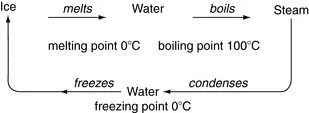
Figure 1.1 Changes of phase of water.
Properties such as boiling points are important as criteria for purity: pure water boils at 100 °C and freezes at 0 °C under the normal ambient atmospheric pressure. If a substance such as salt is added, the boiling point becomes higher and the freezing point becomes lower. This is useful in cold weather: salt put down on steps and roads prevents ice forming until the temperature is very much lower than the freezing point of pure water. We can also separate mixtures of liquids by distillation, which relies on the different boiling points of the components.
AROMAFACT
The most widespread extraction method for essential oils is steam distillation. This utilizes the volatility (the different boiling points) of the components of a mixture to allow them to be separated from other plant materials.
The arrangement and movement of the particles in matter account for its properties in the various phases. In a gas, the particles move freely and at great speed and collide frequently with one another with considerable energy; as a result, a gas completely fills the space available in any container. In a solid, there is no free movement of particles, which occupy fixed positions (although they vibrate around these positions); as a result, solids have definite shape and size. Liquids occupy an intermediate position: the particles are relatively free to move, so that a liquid flows to adopt the shape of its container, but they are attracted to each other sufficiently to keep them together and prevent the particles filling the whole space, as with a gas. The arrangements and motions of particles in the three phases of matter are shown in Figure 1.2. The movement of the particles gives them a property called kinetic energy; the more rapid the motion, the greater the kinetic energy. Heating increases the kinetic energy of molecules, changing them from solids to liquids, and then from liquids to gases.
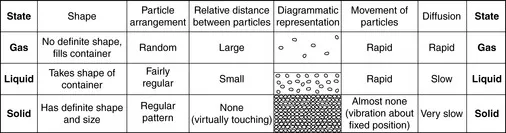
Figure 1.2 The arrangements and motions of particles in the three phases of matter.
AROMAFACT
The movement of gas particles is essential in aromatherapy. A substance must be constantly losing particles into the gas or vapour phase, which can enter the air and then the nose and be detected as an odour. Volatility is the property of a substance to evaporate (disperse as vapour). If a few drops of pure, concentrated essential oil are put out in a room on a dish, their presence will soon be detectable at any point in that room. Oil vapour molecules mix and collide with air molecules, gradually spreading evenly through a room (by the process of diffusion).
The process of mixing of gas particles is called diffusion: molecules move from an area of high concentration (such as liquid oil in a dish) to an area of low concentration such as the air in the room. We smell food as it is heated up and cooked due to molecules of gas forming, escaping and diffusing into the air. Diffusion also takes place in liquids as molecules of one substance intermingle and spread out among those of another. Diffusion is important for movement of substances in the body.
AROMAFACT
A volatile substance is one that readily evaporates. Essential oils are volatile, with the top notes having the lowest boiling points and coming off most readily.
Physical changes
Changes of phase such as melting and boiling, evaporation and condensation, the dissolving of solids in a liquid or diffusion of gases are called physical changes. No new substances are formed in these processes, although the properties of the new phases or mixtures may be different.
Chemical changes
Chemical...
Table of contents
- Cover
- Title Page
- Copyright
- Preface
- Acknowledgements
- Table of Contents
- Introduction
- Chapter 1: Fundamentals of chemistry
- Chapter 2: Organic chemistry
- Chapter 3: Families of compounds that occur in essential oils
- Chapter 4: Processing, extraction and purity
- Chapter 5: Analytical techniques
- Chapter 6: Health, disease and therapy
- Chapter 7: Composition of essential oils and other materials
- Chapter 8: Handling, safety and practical applications for use of essential oils
- Bibliography and sources of information
- Glossary
- Index
Trusted by 375,005 students
Access to over 1.5 million titles for a fair monthly price.
Study more efficiently using our study tools.
Frequently asked questions
Yes, you can cancel anytime from the Subscription tab in your account settings on the Perlego website. Your subscription will stay active until the end of your current billing period. Learn how to cancel your subscription
No, books cannot be downloaded as external files, such as PDFs, for use outside of Perlego. However, you can download books within the Perlego app for offline reading on mobile or tablet. Learn how to download books offline
Perlego offers two plans: Essential and Complete
- Essential is ideal for learners and professionals who enjoy exploring a wide range of subjects. Access the Essential Library with 800,000+ trusted titles and best-sellers across business, personal growth, and the humanities. Includes unlimited reading time and Standard Read Aloud voice.
- Complete: Perfect for advanced learners and researchers needing full, unrestricted access. Unlock 1.5M+ books across hundreds of subjects, including academic and specialized titles. The Complete Plan also includes advanced features like Premium Read Aloud and Research Assistant.
We are an online textbook subscription service, where you can get access to an entire online library for less than the price of a single book per month. With over 1.5 million books across 990+ topics, we’ve got you covered! Learn about our mission
Look out for the read-aloud symbol on your next book to see if you can listen to it. The read-aloud tool reads text aloud for you, highlighting the text as it is being read. You can pause it, speed it up and slow it down. Learn more about Read Aloud
Yes! You can use the Perlego app on both iOS and Android devices to read anytime, anywhere — even offline. Perfect for commutes or when you’re on the go.
Please note we cannot support devices running on iOS 13 and Android 7 or earlier. Learn more about using the app
Please note we cannot support devices running on iOS 13 and Android 7 or earlier. Learn more about using the app
Yes, you can access Essential Chemistry for Aromatherapy by Sue Clarke in PDF and/or ePUB format, as well as other popular books in Medicina & Medicina alternativa e complementare. We have over 1.5 million books available in our catalogue for you to explore.