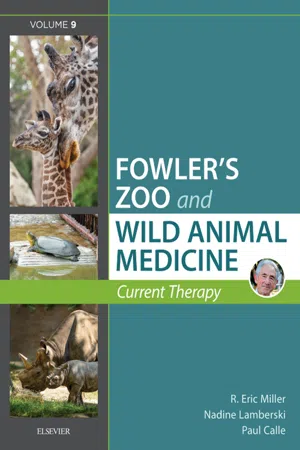
Bringing together a globally diverse range of timely topics related to zoo and wild animals, Fowler's Zoo and Wild Animal Medicine, Volume 9 is an invaluable tool for any professional working directly with wildlife and zoo animals. The text's user-friendly format guides readers through biology, anatomy, and special physiology; reproduction; restraint and handling; housing requirements; nutrition and feeding; surgery and anesthesia; diagnostics, and therapeutics for each animal. Two new co-editors and a globally diverse group of expert contributors each lend their expertise on a wide range of new topics — including a new section on emerging wildlife diseases covering topics like MERS, Equine Herpesvirus, and Ebola in great apes. Other new topics integrated into this ninth volume include: stem cell therapy in zoo medicine, cardiac disease in great apes, disease risk assessment in field studies, Tasmanian devil tumors, and the latest information on the elephant herpes virus. With all its synthesized coverage of emerging trends, treatment protocols, and diagnostic updates new to the field, Fowler's is a reference you don't want to be without.- Current therapy format ensures that each CT volume in the series covers all new topics that are relevant at the time of publication.- Synthesized topics offer the right amount of depth — often fewer than 10 pages — to maintain an accessible format.- General taxon-based format covers all terrestrial vertebrate taxa plus selected topics on aquatic and invertebrate taxa.- Updated information from the Zoological Information Management System (ZIMS) has been incorporated to keep readers up to date on this worldwide system.- Globally diverse panel of expert contributors each incorporate the latest research and clinical management of captive and free-ranging wild animals throughout the world.- NEW! Two new co-editors (for a total of three editors) each lend their expertise on a wide range of new wild and zoo animal topics.- NEW! Section on emerging wildlife diseases includes chapters on MERS, SARS, Ebola in great apes, and a variety of other emerging wildlife diseases.
eBook - ePub
Miller - Fowler's Zoo and Wild Animal Medicine Current Therapy, Volume 9
- 768 pages
- English
- ePUB (mobile friendly)
- Available on iOS & Android
eBook - ePub
Miller - Fowler's Zoo and Wild Animal Medicine Current Therapy, Volume 9
About this book
Information
Topic
MedicineSubtopic
Veterinary MedicineSection 1
General
Introduction
- 1 The Role of Veterinary Advisors in Animal Management Plans, 2
- 2 Risk Analysis Framework Guidance for Wildlife Health Professionals, 4
- 3 Wildlife Technologies, 11
- 4 International Sample Movement: Overview of Convention on International Trade in Endangered Species of Wild Fauna and Flora and Selected National Regulations, 16
- 5 A Practical Guide for Statistics in Wildlife Studies, 21
- 6 Opportunities to Inspire the Next Generation of Veterinarians, 28
- 7 Strategic Planning for Zoo Veterinary Operations, 34
- 8 Organizational Influence: Navigating the Leadership Road for Zoo Veterinarians, 39
- 9 Contingency Planning for All Hazards and Foreign Animal Disease, 45
- 10 Veterinary Occupational Health and Safety in the Zoo and Wildlife Setting, 53
- 11 Research Study Design, 59
1
The Role of Veterinary Advisors in Animal Management Plans
Julia E. Napier
Introduction
The Veterinary Advisor is a member of the Veterinary Advisory Group (VAG), which is a subcommittee of the Association of Zoos and Aquariums (AZA) Animal Health Committee (AHC) and was established with three main goals in mind:
- 1. To act as a support and advisory body for Species Survival Plans (SSP)/Taxon Advisory Groups (TAG) Veterinary Advisors;
- 2. To act as a source of information for protocols concerning the roles and responsibilities of Veterinary Advisors; and
- 3. To serve as an informational resource on veterinary issues that may impact conservation programs.
Background
The concept of the VAG originated with the Infectious Disease Committee (IDC) of the American Association of Zoo Veterinarians (AAZV) and the Conservation and Science Department of AZA, formerly the American Association of Zoological Parks and Aquariums (AAZPA) in 1993. The need for such a group was highlighted at the 1992 International Conference on Implications of Infectious Diseases for Captive Propagation and Reintroduction Programs of Threatened Species. This meeting, held in Oakland, California, was sponsored by AZA, AAZV, and the Captive Breeding Specialist Group of the International Union for the Conservation of Nature Species Survival Commission (CBSG/IUCN/SSC).1 It emphasized the impact of disease on reintroduction projects and highlighted the importance of risk assessment. A general lack of information on (1) incidence, distribution, and risks of disease in captive and wild populations, (2) effective quarantine protocols necessary to prevent disease transmission, and (3) definitive diagnostic tests to detect and monitor disease had resulted in the lack of a working database for informed risk assessment. The notion of a Veterinary Advisor to each SSP/TAG program was put forward as a way to generate and collect this missing information. The program was created in 1994 and has grown considerably since then (Table 1.1). The disparity in numbers from 1994 to 20162 provides a wealth of opportunities for zoo veterinarians to contribute their knowledge, time, and energy to a population that needs a Veterinary Advisor in the VAG.
TABLE 1.1
| Species Survival Plans | Taxon Advisory Groups | Veterinary Advisor | % Vets to Programs | |
|---|---|---|---|---|
| 1994 | 69 | 41 | 82 | 75 |
| 2016 | 611* | 46 | 132 | 20 |

*Now designated as red, yellow, or green, based on the potential long-term sustainability of the population.
Currently, the subcommittee is composed of SSP/TAG Veterinary Advisors (which includes clinicians and pathologists) and in a few instances, a nutritionist. The VAG Chair is appointed by the Chair of the AZA AHC. The original “Guidelines for Veterinary Advisors to Regional Conservation Plans” was submitted to the AZA Wildlife Conservation and Management Committee (WCMC) and accepted in 1993. These were revised in 1994 and again in 2001 and 2009. Another revision is underway as of the writing of this chapter. The benefits of these guidelines are twofold: (1) they offer the SSP Coordinator a reasonable expectation of the role of a Veterinary Advisor, and (2) they offer the Veterinary Advisor an outline of basic standards that should be met. Clearly, the exact role and responsibilities of the Veterinary Advisor will differ among the various SSP/TAG programs. The list of SSP/TAG Veterinary Advisors is maintained by the VAG Chair and is updated as necessary. This list is posted on the AAZV website.3 The AAZV site was chosen to encourage use by zoo veterinarians. In addition to the list of advisors, SSP/TAG veterinary and necropsy protocols, and Annual Report Forms are posted as they become available.
Veterinary Advisor Responsibilities
The traditional role of the Veterinary Advisor as stated in the guidelines includes making recommendations for diagnostic testing and evaluations, providing appropriate laboratory information for disease testing in their specific taxa, suggesting therapeutic protocols for treatment of disease and anesthetic protocols for immobilizations, and developing successful quarantine and preventative medicine measures. However, especially in the past 10–15 years, the role of the Veterinary Advisor as well as the clinical veterinarian in a zoological setting has evolved into something much more complex than just practicing medicine, formulating quarantine protocols, and detecting and preventing infectious disease.
The terms “animal welfare” or “wellness” are bandied about frequently, and although there are many interpretations, they universally refer to an animal's well-being in the environment they call home, which goes far beyond just treating illness or injury. Through social media and a variety of animal-related programming on television, a more informed public expects animals to thrive, not just survive in a zoological setting. To that end, zoo veterinarians and Veterinary Advisors have a responsibility not just to care for and cultivate these species but to communicate that goal to the animal management staff as well as the public. Collection veterinarians, and more specifically Veterinary Advisors, are viewed as subject matter experts due to their scientific background, for information on a variety of husbandry issues including but not limited to primary causes of morbidity and mortality, preventative medicine measures, behavior abnormalities and stereotypies, breeding management and success, contraception, exhibit design, enrichment and training protocols, nutrition, acceptable housing (i.e., space, flooring, substrate, lighting, humidity, and temperature), euthanasia guidelines, animal movements, zoonotic disease, and legislation that regulates animals in a zoological setting when it comes before state or federal legislatures.
In addition, Veterinary Advisors should provide annual SSP/TAG Veterinary Advisor Annual Report Forms to animal management staff, including facility veterinarians, that provide an overview of the most recent causes of morbidity and mortality, changes in nutrition, numbers of births and deaths in the population, successful immobilization protocols, and updates in necropsy protocols, as well as successes and failures in contraception.
Multiple functions regarding research may be accomplished by Veterinary Advisors in addition to doing projects on their own. Providing guidance to management groups as to whether proposed projects will be a worthwhile investment regarding the potential to benefit the species is a very useful service. They may maintain a list of current and past research projects, create a library of references, establish tissue banks, and provide direction on disease surveillance and monitoring in both the zoo and free-ranging populations.
The Veterinary Advisor has the unique ability not just to advocate for an animal's well-being in every aspect, but they are an invaluable resource to collection veterinarians, to specific managed populations in both captive and free-range settings, and to in situ and ex situ conservation field projects involving their species of expertise. They also benefit students, animal care staff, and veterinarians whose primary focus is not exotic species, as well as human medicine experts who may volunteer their time to the zoo community.
Additional Husbandry and Regulatory Roles
One of the most current contributions Veterinary Advisors are making that is key to all aspects of animal management is their contributions to the AZA Animal Care Manuals. These manuals provide guidelines for animal care and day-to-day husbandry issues for their respective SSP/TAG.
The veterinary portion encompasses a broad range of topics, including transportation guidelines (i.e., acceptable shipping temperatures) as well as those covered by International Air Transport Association (IATA), preshipment preparations, quarantine testing and duration, preventative medicine measures, therapeutic and vaccination protocols, parasite surveillance and treatment recommendations, and immobilization and anesthesia techniques.
In addition, they include successful reproduction strategies, neonate exam and annual exam checklists, necropsy protocols, special needs suggestions for pregnant and geriatric individuals, and information on zoonotic disease and personal protective equipment requirements for a specific species. AZA accreditation standards and regulatory information pertaining to those species that are covered under the United States Department of Agriculture/Animal and Plant Health Inspection Services (USDA-APHIS) Animal Welfare Act are also incorporated into the manuals.
Conclusion
It is the responsibility of the zoo veterinarian to take care of the animals in their collection. Veterinary Advisors, through proactive communication and collaboration, are in a unique position, with their invaluable expertise, to make the job of the collection veterinarian and animal management generally easier, more efficient, and more informed, thus enhancing the welfare and conservation of the extraordinary species they care for both in a zoo setting and in the wild.
Table of contents
- Cover image
- Title Page
- Table of Contents
- Copyright
- A Tribute to Murray E. Fowler
- Contributors
- Preface
- Acknowledgments
- Section 1 General
- Section 2 Animal Welfare
- Section 3 Conservation Medicine
- Section 4 Reproduction
- Section 5 Therapeutics
- Section 6 Anesthesia and Analgesia
- Section 7 Diagnostics
- Section 8 Emerging and Changing Infectious Diseases
- Section 9 Infectious Diseases
- Section 10 Aquatic
- Section 11 Amphibians and Reptiles
- Section 12 Avian
- Section 13 Marsupials
- Section 14 Small Mammals
- Section 15 Carnivores
- Section 16 Great Apes
- Section 17 Marine Mammals
- Section 18 Ruminants
- Section 19 Elephants and Rhinoceroses
- Index
Trusted by 375,005 students
Access to over 1.5 million titles for a fair monthly price.
Study more efficiently using our study tools.
Frequently asked questions
Yes, you can cancel anytime from the Subscription tab in your account settings on the Perlego website. Your subscription will stay active until the end of your current billing period. Learn how to cancel your subscription
No, books cannot be downloaded as external files, such as PDFs, for use outside of Perlego. However, you can download books within the Perlego app for offline reading on mobile or tablet. Learn how to download books offline
Perlego offers two plans: Essential and Complete
- Essential is ideal for learners and professionals who enjoy exploring a wide range of subjects. Access the Essential Library with 800,000+ trusted titles and best-sellers across business, personal growth, and the humanities. Includes unlimited reading time and Standard Read Aloud voice.
- Complete: Perfect for advanced learners and researchers needing full, unrestricted access. Unlock 1.5M+ books across hundreds of subjects, including academic and specialized titles. The Complete Plan also includes advanced features like Premium Read Aloud and Research Assistant.
We are an online textbook subscription service, where you can get access to an entire online library for less than the price of a single book per month. With over 1.5 million books across 990+ topics, we’ve got you covered! Learn about our mission
Look out for the read-aloud symbol on your next book to see if you can listen to it. The read-aloud tool reads text aloud for you, highlighting the text as it is being read. You can pause it, speed it up and slow it down. Learn more about Read Aloud
Yes! You can use the Perlego app on both iOS and Android devices to read anytime, anywhere — even offline. Perfect for commutes or when you’re on the go.
Please note we cannot support devices running on iOS 13 and Android 7 or earlier. Learn more about using the app
Please note we cannot support devices running on iOS 13 and Android 7 or earlier. Learn more about using the app
Yes, you can access Miller - Fowler's Zoo and Wild Animal Medicine Current Therapy, Volume 9 by R. Eric Miller,Nadine Lamberski,Paul P Calle,Paul Calle, R. Eric Miller, Nadine Lamberski, Paul Calle in PDF and/or ePUB format, as well as other popular books in Medicine & Veterinary Medicine. We have over 1.5 million books available in our catalogue for you to explore.