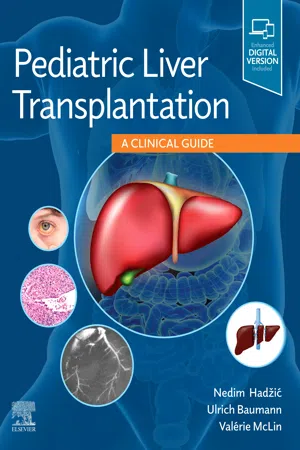
Written and edited by global leaders in the field, Pediatric Liver Transplantation: A Clinical Guide covers all aspects of treatment and management regarding this multifaceted procedure and unique patient population. This practical reference offers detailed, focused guidance in a highly templated, easy-to-consult format, covering everything from pre-transplantation preparation to surgical techniques to post-operative complications.- Provides an in-depth understanding of all aspects of pediatric liver transplantation, ideal for pediatric hepatologists, pediatric transplant surgeons, and others on the pediatric transplant team.- Covers all surgical techniques in detail, including split graft, living related, auxiliary, and domino.- Discusses pediatric liver transplantation consideration for an increasing number of additional metabolic, hematologic and renal conditions; breakthroughs in grafting and stem cell therapy; and techniques and present role of hepatocyte transplantation.- Uses a quick-reference templated format; each chapter includes an overview, pathophysiology, conventional management, controversies, and bulleted summary of key take-aways.- Includes state-of-the-art mini-reviews based on updated references and author experience throughout the text.- Features a full-color design with numerous algorithms, figures, and radiological and histopathological photos.
eBook - ePub
Pediatric Liver Transplantation
A Clinical Guide
- 512 pages
- English
- ePUB (mobile friendly)
- Available on iOS & Android
eBook - ePub
About this book
Information
Topic
MedicineSubtopic
Gastroenterology & HepatologySection 1
Evolution of Transplantation Medicine
1: Brief History of Pediatric Liver Transplantation
Jean-Bernard Otte
Abstract
In the first part, the author briefly reviews the principal historical milestones and breakthroughs in the field of pediatric liver transplantation (LT), including the technical aspects and variants of orthotopic liver transplantation, the history of initiation of clinical experience, the essential contribution of the National Institutes of Health (NIH) statement to the development of liver transplantation centers around the world, and the main lines of immunosuppression. In the second part, the current challenges confronting us are addressed: the persistent shortage of post-mortem liver donors compensated by living donation, the pioneering research of artificial liver preservation allowing recovery of the damaged organs, the attempts and risks of weaning immunosuppression, and the still-not-achieved dream of tolerance induction in clinical practice. The chapter is completed by a review of reports regarding the gradual development of unexplained graft inflammation and fibrosis despite normal liver biochemistry in children in the long term after LT (> 10–20 years). Evidence suggests that this histologic deterioration of the graft, very-long-term post-LT, is immune modulated, with a possible genetic predisposition in children with a gene expression pattern associated with T-cell-mediated rejection. Altogether, these observations should alert clinicians considering weaning of immunosuppression in children long term post-LT.
Keywords
Pediatric liver transplantation; techniques of orthotopic liver transplantation; immunosuppression; organ shortage; living donation; weaning of immunosuppression; graft histology long-term post-LT
Principal Historical Milestones and Breakthroughs
Technical Aspects
The basic technique of orthotopic liver transplantation was developed in dogs by Thomas E. Starzl in the early 1960s; the dog I watched myself when I was a research fellow with him in 1965 to 1966 lived for over 13 years under steroids and Imuran and served as the proof of concept.1 This original technique was successfully transposed to human beings with minor changes.2
The Piggyback Technique
To avoid caval occlusion and veno-venous bypass, Tzakis described the piggyback technique3: the native liver is excised with preservation of the retrohepatic vena cava (VC); the suprahepatic VC of the donor graft is implanted on the enlarged orifices of the recipient suprahepatic veins. Lateral clamping of the VC avoids the need for decompression of the lower part of the body. Decompression of the splanchnic bed during the anhepatic phase is not needed in cirrhotic children with portal hypertension because of spontaneous portosystemic collaterals. When the liver to be removed has a normal vascular resistance, like in metabolic diseases and hepatoblastoma, a swift vascular reconstruction is required.
This technique has become standard also for implantation of a segmental graft, both from cadaveric and from living donors.
Portal Vein Reconstruction
In children with biliary atresia, which is the most frequent pediatric liver transplantation (LT) indication, the very frequent hypoplasia of the portal vein must be appropriately corrected by portoplasty to avoid post-operative thrombosis.4 My first trainee in liver transplantation, Jean de Ville de Goyet, described the meso-Rex shunt for bypassing the thrombosed portal vein5; this has become the standard in most centers. This technique could also be used after LT.
Biliary Drainage
Except in larger children where end-to-end biliary reconstruction is possible, the most reliable technique is an end-to-side anastomosis on a Roux-en-Y intestinal loop of sufficient length (50 cm) to prevent reflux.
Initiation of Clinical Experience
Thomas E. Starzl (Fig. 1.1) performed in Denver, USA, the first attempts in children in the 1960s, with the first long-term survival obtained in a child transplanted in 1970 for biliary atresia with an incidental hepatocellular arcinoma who survived over 40 years, off medications for more than10 years.1

In Europe, the first attempts were performed by Roy Calne in Cambridge6 in a child with biliary atresia in 1968 (death from cardiac arrest 90 minutes after the surgery). We also tried LT in Brussels7 for the same indication in 1971 (death after 7 weeks from biopsy-related bleeding).
The National Institutes of Health Statement
The increasing number of successful adult and pediatric liver transplants in the United States and Europe led the National Institutes of Health (NIH) in 1984 to state that liver transplantation had become a clinical service.8 This statement triggered the development of several LT programs in the United States and Europe. In 1986, a symposium I organized in Brussels convened four US and three European centers that had started LT in the early 1980s and performed at least 20 cases (Starzl’s team, initially in Denver and later in Pittsburgh, had al...
Table of contents
- Cover image
- Title page
- Table of Contents
- Copyright
- Dedication
- Preface
- List of Contributors
- Section 1: Evolution of Transplantation Medicine
- Section 2: Setting for PLT
- Section 3: Preparation for PLT
- Section 4: Combined Transplant Options
- Section 5: Operation
- Section 6: Medical Management
- Section 7: Early Postoperative Complications
- Section 8: Late Postoperative Complications
- Section 9: Complementary Clinical Options to PLT
- Section 10: Chronic Management in Specific Indications
- Section 11: Long-Term Issues
- Index
Trusted by 375,005 students
Access to over 1.5 million titles for a fair monthly price.
Study more efficiently using our study tools.
Frequently asked questions
Yes, you can cancel anytime from the Subscription tab in your account settings on the Perlego website. Your subscription will stay active until the end of your current billing period. Learn how to cancel your subscription
No, books cannot be downloaded as external files, such as PDFs, for use outside of Perlego. However, you can download books within the Perlego app for offline reading on mobile or tablet. Learn how to download books offline
Perlego offers two plans: Essential and Complete
- Essential is ideal for learners and professionals who enjoy exploring a wide range of subjects. Access the Essential Library with 800,000+ trusted titles and best-sellers across business, personal growth, and the humanities. Includes unlimited reading time and Standard Read Aloud voice.
- Complete: Perfect for advanced learners and researchers needing full, unrestricted access. Unlock 1.5M+ books across hundreds of subjects, including academic and specialized titles. The Complete Plan also includes advanced features like Premium Read Aloud and Research Assistant.
We are an online textbook subscription service, where you can get access to an entire online library for less than the price of a single book per month. With over 1.5 million books across 990+ topics, we’ve got you covered! Learn about our mission
Look out for the read-aloud symbol on your next book to see if you can listen to it. The read-aloud tool reads text aloud for you, highlighting the text as it is being read. You can pause it, speed it up and slow it down. Learn more about Read Aloud
Yes! You can use the Perlego app on both iOS and Android devices to read anytime, anywhere — even offline. Perfect for commutes or when you’re on the go.
Please note we cannot support devices running on iOS 13 and Android 7 or earlier. Learn more about using the app
Please note we cannot support devices running on iOS 13 and Android 7 or earlier. Learn more about using the app
Yes, you can access Pediatric Liver Transplantation by Nedim Hadzic,Ulrich Baumann,Valérie MCLIN in PDF and/or ePUB format, as well as other popular books in Medicine & Gastroenterology & Hepatology. We have over 1.5 million books available in our catalogue for you to explore.