- English
- ePUB (mobile friendly)
- Available on iOS & Android
eBook - ePub
Information
Topic
MedicineChapter 1
Traditional Chinese Medicine: Herbal Tea and Heritage
“Are those the famous Po Chai pills from Hong Kong? What do people use them for?” I asked the attending store clerk who’s in charge of the pharmacy area at Jai Ho Supermarket in Boston’s Chinatown.
Being away from home in Vietnam, I go to Jai Ho every now and then to shop for food, and my favorite thing about this small supermarket is the pharmacy counter just to the left of the entrance, with clear shelves displaying medicines and supplements imported from Asia. I always spend a few minutes crouching in the small space near the entrance and marvel at the intricate details and colors on each medicine package.
“Yeah, this is Po Chai. It’s for everything, you know, mostly stomach problems, indigestion, diarrhea…Is it for your grandparents? It’s mostly older people that use this,” he explained while gesturing at his stomach. “We also have these Seirogan pills that are similar but they’re from Japan, not Hong Kong.”
“It’s not for my grandparents. Recently I’ve been researching traditional Chinese medicine for a personal project and was surprised to find Po Chai here,” I said, to which the clerk told me to feel free to take photos of the pills and to come back anytime if I have any questions. Although I’ve never used Po Chai pills myself nor am I from Hong Kong, I felt a strange sense of joy when I found them in the middle of Boston, a city famous for Western biomedicine and pharmaceuticals.
When I told one of my friends from Singapore, Gaea, about my book and that I found Po Chai pills in Chinatown, her eyes lit up with excitement. She said, “Oh my god yes, I know Po Chai! Our family always has them around the house, and I can’t go anywhere without them.”
Clearly, this is a popular household medicine that transcends borders; even though it was made in Hong Kong, people from Singapore to Boston seem to have it in their medicine cabinets. Although I was initially interested in the artistic elements on Po Chai’s boxes when writing my art history paper on packaging design, the medicine’s popularity also got me interested in the story behind the medicine and its cultural significance.
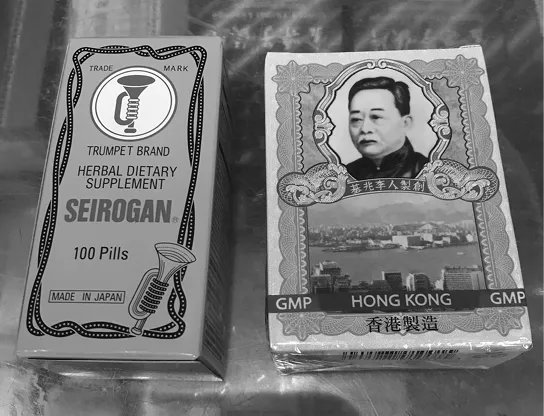
Left, Seirogan pills; right, Po Chai pills
Po Chai pills are a “cure-all” medicine Chinese families have relied on for decades. Made to relieve stomach pains, the pills are also reputed to reduce menstrual cramps and even cold symptoms. These tiny herbal pills were developed in 1896 by Li Shiu-kei in Guangdong province and were manufactured there until 1949 when the Li family fled to Hong Kong following the Communist Revolution.12 As their factory in the mainland was nationalized, the Li family opened a new facility in Hong Kong, and by then, Po Chai pills were already a household name in the city with a high level of trust from consumers. There was even a series of animated TV commercials in the 1970s and 80s that boosted Po Chai’s popularity, and today, social media campaigns such as Facebook ads demonstrate an effort to adapt to modern marketing strategies.13
When it comes to marketing, it’s impossible to not talk about the packaging of Po Chai pills which hasn’t changed much over the years and the legendary designer behind it, Leung Chi Mui. Leung was born in 1910 in Canton, now known as Guangzhou, China. In Canton, his father owned a joss stick shop called Tak Ming Chai.14 Also known as incense, joss sticks release fragrant smoke when burned and are an important element of Chinese folk religion and other Asian cultures.
Growing up Vietnamese, I was also taught to burn incense for important occasions such as my grandparents’ death anniversaries or Lunar New Year’s when we would visit Buddhist pagodas. Packs of incense are often wrapped in colorful paper of red and yellow with intricate patterns depicting gods and goddesses, such as Phật Bà Quan Âm (also known as Guan Yin in Mandarin) who is a Buddhist bodhisattva—a person on the path to Buddhahood who works for the collective enlightenment of all beings.
A young Leung saw that his father’s joss sticks were wrapped in paper with simplistic designs and thought they were too old-fashioned, so he started redesigning these packages for the family shop. This marked the beginning of Leung Chi Mui’s packaging design career, and after graduating from art school in 1937, he started designing packages for medicine brands, including the famous Li Chung Sing Tong Po Chai pills and Wong Lo Kat herbal tea.15
Although Po Chai pills today are made using more advanced technologies and packaged with machines imported from Europe, the packaging remains the same with the company crest featuring Li Shiu Kei’s portrait and the stylized design signature of Leung Chi Mui. Features such as elaborate borders and baroque-inspired patterns make Po Chai pills stand out from many other traditional Chinese medicine brands today that have opted to modernize their packaging and eliminated decorative elements. The Po Chai brand is popular among the Chinese diaspora and in the 2016–2017 fiscal year, 74 million Hong Kong dollars’ worth of pills were sold.16
“The heritage and credibility are so important,” explains Kevin Chu, the general manager of Li Chung Shing Tong.17
The public and the brand are certainly connected, and as Chu puts it, “I think Hong Kong-made products give people a sense of belonging.”18 Familiarity and nostalgia have a special effect on packaging design for any product, for both immigrants and those who are born and raised in the homeland. Learning from heritage brands with a strong base of loyal customers, companies today who consider going global have become aware that “what paying customers especially ask for is a native experience…handling of currencies, date and telephone number formats, different character sets, time zone differences, right-to-left writing, and other culture-related conventions,” said Maren Baetje-Mbaye, who manages localization projects.19
Chu’s words ring true, as I’ve heard Po Chai mentioned by multiple friends, and it’s not only sold in Asian supermarkets like Jai ...
Table of contents
- Introduction
- Chapter 1
- Chapter 2
- Chapter 3
- Chapter 4
- Chapter 5
- Chapter 6
- Chapter 7
- Chapter 8
- Chapter 9
- Chapter 10
- Chapter 11
- Conclusion
- Acknowledgements
- Bibliography
Trusted by 375,005 students
Access to over 1.5 million titles for a fair monthly price.
Study more efficiently using our study tools.
Frequently asked questions
Yes, you can cancel anytime from the Subscription tab in your account settings on the Perlego website. Your subscription will stay active until the end of your current billing period. Learn how to cancel your subscription
No, books cannot be downloaded as external files, such as PDFs, for use outside of Perlego. However, you can download books within the Perlego app for offline reading on mobile or tablet. Learn how to download books offline
Perlego offers two plans: Essential and Complete
- Essential is ideal for learners and professionals who enjoy exploring a wide range of subjects. Access the Essential Library with 800,000+ trusted titles and best-sellers across business, personal growth, and the humanities. Includes unlimited reading time and Standard Read Aloud voice.
- Complete: Perfect for advanced learners and researchers needing full, unrestricted access. Unlock 1.5M+ books across hundreds of subjects, including academic and specialized titles. The Complete Plan also includes advanced features like Premium Read Aloud and Research Assistant.
We are an online textbook subscription service, where you can get access to an entire online library for less than the price of a single book per month. With over 1.5 million books across 990+ topics, we’ve got you covered! Learn about our mission
Look out for the read-aloud symbol on your next book to see if you can listen to it. The read-aloud tool reads text aloud for you, highlighting the text as it is being read. You can pause it, speed it up and slow it down. Learn more about Read Aloud
Yes! You can use the Perlego app on both iOS and Android devices to read anytime, anywhere — even offline. Perfect for commutes or when you’re on the go.
Please note we cannot support devices running on iOS 13 and Android 7 or earlier. Learn more about using the app
Please note we cannot support devices running on iOS 13 and Android 7 or earlier. Learn more about using the app
Yes, you can access Pills, Teas, and Songs by Debby Nguyen in PDF and/or ePUB format, as well as other popular books in Medicine & Alternative & Complementary Medicine. We have over 1.5 million books available in our catalogue for you to explore.