This book invites you to know yourself and enjoy the delight your Creator has in you. By finding your voice you will be able to engage more confidently in the life that lies ahead of you and welcome generous relationships with those who share the journey with you. So whether you are just starting out on life or sensing a later change of direction, you are encouraged to explore your creation and spiritual gifts and make your contribution around the table of leadership, participating fully in joining your voice to the conversation. The God who created you, and now redeems you, purposefully gifted you that voice and invites you to uncover it and offer it to the world in service as well as in self-expression.
From her own lifetime of discovery, the author shares many stories of her journey and tackles some of the obstacles that are more acute for women on the way to finding their voice. But because we all need people around us understanding and encouraging us, the hope is that men will read these pages too in the spirit of #HeForShe, and so offer women their whole-hearted support.
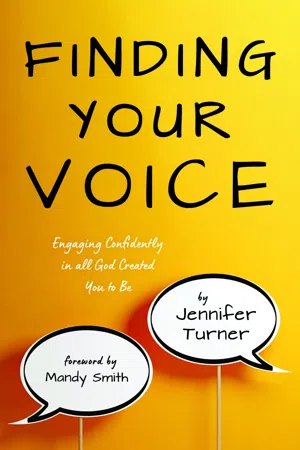
- 160 pages
- English
- ePUB (mobile friendly)
- Available on iOS & Android
eBook - ePub
About this book
Information
Subtopic
Religion1
Start by Telling your Story
Words mean more than what is set down on paper. It takes the human voice to infuse them with shades of deeper meaning.
—Her teacher encouraging Maya Angelou to begin to speak. (I Know why the Caged Bird Sings )
We all love a story. Stories entertain, they provide humor and laughter and perspective. They enliven a discussion and shift both the teller and the hearer from head down to the heart. They help us recognise our own pain and awaken empathy in us for others and pass on wisdom that connects us to the past and prepares us for the future. They may even prompt us to join important movements for change or become advocates for those who cannot speak for themselves. And they are a first step in the journey to finding your voice.
As I share some of my stories, I am hoping in them you will hear echoes of your own and find a way to tell yours. My life has come to feel like a pilgrimage directed by God’s good hand, and I have learned a lot about myself and others as I travel it. You will too, if you take the time to look back, reflect, and identify God’s footprints through your personal history.
A miscarriage story
One evening in the days when we lived in the United States and before we had children, we were hosting a dinner party for my husband’s colleagues in our apartment. I was recovering from a miscarriage—the second one in the space of a year—and my mind kept turning to it over and over as I prepared the food. I did not know our dinner guests very well and besides, it was not usual to speak of personal matters in such a setting. Perhaps today it would be more acceptable, but certainly not in the 1970s. You did not talk about personal or sensitive things outside of friends and family, and even rarely with them. But for some reason, I mentioned the miscarriages as we sat around the dining table.
There was an embarrassed hush. Then several women in turn recounted their own pregnancy loss story and I realised for the first time how common miscarriage was. Each woman began her story by acknowledging that prior to this occasion, they had not told anyone outside their family about it. Clearly, the very hiddenness of the pregnancy loss had increased our pain because we had not been able to openly grieve it nor receive the release that comes from finding others who could enter personally into our distressing experience. In the presence of these women (and their husbands too), sharing my story was unexpectedly a gift to myself. It was a gift to them too, because healing comes through telling, hearing and sharing. How true it is that “there is no agony like bearing an untold story inside of you.”1
Sharing what we have in common
In the years since, I have experienced many groups sharing the story their members have in common. Sometimes, it has been as simple and expected as home group members describing their spiritual journey, but at other times, it has been a confronting, even risky thing to do.
In Canberra, the capital of Australia where we moved from the United States, a number of child sexual abuse survivors found each other and gathered in our church. They grouped themselves under the name of Tamar—the beautiful Old Testament woman, daughter of King David and sister of Absalom who was raped by her half-brother (2 Sam 13:1–29). These women found understanding and acceptance in each other. And even though many of our church members were reluctant to acknowledge the experience these women shared, the Tamar women had the courage to talk about the issue more widely. The recent #MeToo movement has similarly provided an umbrella for women to identify with a growing sexual harassment awareness and tell their own story in a way most would not have dared to do, even a few years previously.
At that time in Canberra, we also began playgroups. In contrast to the Tamar sexual abuse survivor group, playgroups, though also a new phenomenon at the time, were readily appreciated and applauded. We embraced this innovative movement to give our pre-school children friends to play with because few of us in this newly built city had extended family nearby. The bonus was that the playgroups also provided a setting for young mothers to share stories of child-raising, and so learn from each other. Playgroups still do that today, though there are fathers and grandparents included now and a greater acknowledgement that they are valuable for both the children and the caregivers.
The emotional bonus of telling our story
It is great to hear others’ stories, especially when they encourage us to share our own, but there is an even greater bonus that comes through the actual act of telling. Every story is unique and has meaning, but my own story is uniquely mine. Mine to tell. It comes with feelings, consequences, and perhaps explanations. You too have a story which is unique to you. It is rewarding to have a safe place to tell it and examine what it shows you about yourself, identifying what is most important to you. And it can open you to a new understanding of how God is leading you into the fullness of finding your voice.
The benefit that comes with telling our story operates at several levels. First is the biological reason: neuroscientists have demonstrated through their research that the active part of our brain associated with motivation and pleasure, lights up when we talk about what is happening in our life.2 We are rewarded for talking about ourselves! The dopamine hit it gives us feels very good—a safe way of getting a high! No wonder the increased opportunities to do this through social media have become so popular.
Research shows that we experience this positive neural activity whether anyone hears us or not, but the satisfying effect is greatly enhanced if we share our thoughts and experiences with an empathetic listener. Presumably, this is God’s design to encourage us to connect with others. We are made for relationships—it is how we are wired. Friendships, work settings, marriages, and communities are richer and deeper over time as we get to know one another through revealing ourselves. Communicating in these relationships goes to the core of what it means to be human. We build trust and connection by disclosing who we are in opening ourselves to another.
Our stories help us understand ourselves
The second bonus of telling our story is the self-understanding it offers. Nancy Beach says, “As I listen to my life and tell my stories, a voice emerges.”3 This involves accepting who we are as a result of our family history and life experience. It includes becoming aware of what is going on for us in the present. And all is brought into focus by telling our story, hopefully to a great listener or two.
Early in my journey of finding my voice, I was surprised that whenever I read Jesus’ story of the wedding guests needing suitable garments to wear, tears welled up. Strange. I came to see that it had something to do with the fact that my husband and I had been married in a foreign country with none of our family present. I had arranged the wedding myself, including quickly making my dress and that of the bridesmaid (whom I had only just met) in the limited time before the big day.
This was not an unfamiliar pattern, however. From the time I was a teenager, my mother had handed over to me all the important organizing tasks in the household. You do it better than me, she always said. For my coming-of-age twenty-first birthday party, this certainly applied. I did all the arrangements and my parents simply attended. Whether it was true or not, I came to feel deep down that I had not been adequately “mothered.”
One day, at the retreat that was part of my doctoral course in California, I found a sympathetic listener and started to relate my story. I am not sure how much he said or what insights he provided, but in telling the story at his prompting, I began to see my mother’s story. An ambitious young woman, she nevertheless had to leave school at fourteen to care for her sick mother. She found herself ill-equipped to run the household because up to that time they had live-in help, sometimes a maid, sometimes a maiden aunt. It was now thrust on her to manage the family home herself despite not being trained in housecraft either by her mother or one of these assistants. When I, her only daughter, was able to do what was needed, she handed it over to me. It was a kind of emotional co-dependency. She herself had a hunger to be mothered—not unexpected in the emotional absence of her mother.
Someone has said that understanding is halfway to forgiving, and that was certainly what changed my attitude to my mother. But it was a major change towards myself as well. It was a step towards understanding who I was and how I functioned, facilitated by finding a good listener. God had more healing to do in this matter at the Californian retreat, but that is to tell later. Self-revealing was the first step then and still is—and it came through sharing my story.
The grandmothers of Zimbabwe
Others have tapped therapeutically into this power of telling a story. In Zimbabwe, a country greatly lacking support services for people experiencing mental distress, a psychiatrist developed an approach to bring services to the many throughout the country. Over the more than ten years since its inception, the successful program has come to be known by its two primary tools—the friendship bench and its grandmothers. Older women volunteers are recruited, given basic training in active listening and assessment skills, and an introduction to cognitive behaviour therapy. They are then sent out to sit on a bench in their local area with people needing a listening ear. The goal is to have a friendship bench within walking distance of every person in the country and a grandmother seated there with them.
These grandmothers do not offer advice, though they may share their lived experience. They listen sensitively as a friend, creating space for the person to describe their distress, helping them understand it better, and then be empowered by that process to resolve it themselves. Clearly, the first step of this problem-solving is to invite the person experiencing mental distress to tell their story in their mother tongue.
The results have been astounding in reducing depression...
Table of contents
- Title Page
- Foreword
- Acknowledgments
- An Invitation
- Chapter 1: Start by Telling your Story
- Chapter 2: Listen to Your Life
- Chapter 3: Simply Yourself, More Than Yourself
- Chapter 4: Leaving Home
- Chapter 5: Imposter Syndrome
- Chapter 6: Body People, Resurrection People
- Chapter 7: Beautiful with God’s Beauty
- Chapter 8: Beyond Shame
- Chapter 9: Invitations for this Season of your Life
- Chapter 10: The Courage of Faith
- Epilogue: Mary’s Story
- Bibliography
Trusted by 375,005 students
Access to over 1.5 million titles for a fair monthly price.
Study more efficiently using our study tools.
Frequently asked questions
Yes, you can cancel anytime from the Subscription tab in your account settings on the Perlego website. Your subscription will stay active until the end of your current billing period. Learn how to cancel your subscription
No, books cannot be downloaded as external files, such as PDFs, for use outside of Perlego. However, you can download books within the Perlego app for offline reading on mobile or tablet. Learn how to download books offline
Perlego offers two plans: Essential and Complete
- Essential is ideal for learners and professionals who enjoy exploring a wide range of subjects. Access the Essential Library with 800,000+ trusted titles and best-sellers across business, personal growth, and the humanities. Includes unlimited reading time and Standard Read Aloud voice.
- Complete: Perfect for advanced learners and researchers needing full, unrestricted access. Unlock 1.5M+ books across hundreds of subjects, including academic and specialized titles. The Complete Plan also includes advanced features like Premium Read Aloud and Research Assistant.
We are an online textbook subscription service, where you can get access to an entire online library for less than the price of a single book per month. With over 1.5 million books across 990+ topics, we’ve got you covered! Learn about our mission
Look out for the read-aloud symbol on your next book to see if you can listen to it. The read-aloud tool reads text aloud for you, highlighting the text as it is being read. You can pause it, speed it up and slow it down. Learn more about Read Aloud
Yes! You can use the Perlego app on both iOS and Android devices to read anytime, anywhere — even offline. Perfect for commutes or when you’re on the go.
Please note we cannot support devices running on iOS 13 and Android 7 or earlier. Learn more about using the app
Please note we cannot support devices running on iOS 13 and Android 7 or earlier. Learn more about using the app
Yes, you can access Finding Your Voice by Jennifer Turner in PDF and/or ePUB format, as well as other popular books in Théologie et religion & Religion. We have over 1.5 million books available in our catalogue for you to explore.