eBook - ePub
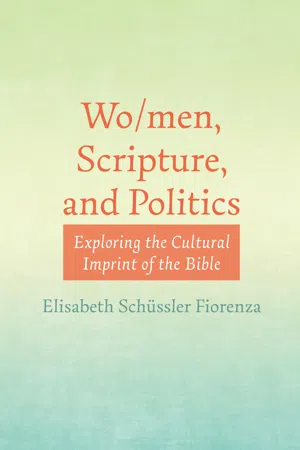
Wo/men, Scripture, and Politics
Exploring the Cultural Imprint of the Bible
- 100 pages
- English
- ePUB (mobile friendly)
- Available on iOS & Android
eBook - ePub
Wo/men, Scripture, and Politics
Exploring the Cultural Imprint of the Bible
About this book
In Wo/men, Scripture, and Politics, Elisabeth Schüssler Fiorenza, brings to bear years of trailblazing scholarship of feminist thought and hermeneutics onto the current political and cultural landscape. In this book, she seeks to articulate and use biblical interpretation as intervention into the failure of the democratic cultural-political imagination. Although such an intervention is often taboo for supposedly neutral academic scholarship, Schüssler Fiorenza argues that it is politically necessary because political argument today so often utilizes biblical rhetoric in the public square. e biblical-political analysis and suggestions of this book are developed in four chapters, each focusing on the role of the Bible in struggles over women's leadership in the present, touching on the cultural "double bind" of women in politics, sexual abuse, power, and the #MeToo movement. Schüssler Fiorenza's insights and arguments not only lead to the development of reimagined cultural biblical imprints of women in the political arena, but they also encourage her readers to add their own biblical examples to inspire them in their struggle for a biblical vision of "women in the public square." is is an insightful, challenging book written for our time by someone who has always seemed to be ahead of hers.
Information
1
The Bible and the Cultural “Double Bind”
During the 2016 presidential campaign Deborah Tannen, a feminist scholar of linguistics, pointed in a number of articles to the “double bind” that makes a woman presidential candidate like Hillary Clinton appear inauthentic and not trustworthy.22 This “double bind” affects every progressive woman who competes for public office who clearly signals that she is not a subordinate of men. To quote Tannen:
A double bind means you must obey two commands, but anything you do to fulfill one violates the other. While the requirements of a good leader and a good man are similar, the requirements of a good leader and a good woman are mutually exclusive . . . As Robin Lakoff, the linguist who first wrote about the double bind confronting women, put it, male candidates can have it both ways but women candidates can have it no ways . . .The most difficult aspect of the double bind is that it is invisible; we think we are just reacting to the candidates as individuals. Yet, even the words to talk about women are drenched in gender.23
However, I would want to qualify this statement somewhat and argue that it applies almost exclusively to progressive women, while conservative wo/men candidates are exempt because they already have proven themselves to be “good women.” Since a major cultural source of this double bind is the Bible, we need a hermeneutical lens that can detect this cultural double bind promulgated by Scripture and make this cultural inscription conscious. Biblical scholarship has the task to focus on the power relations of subordination inscribed in Scripture not just because of religious but also because of public-political reasons. In this chapter, I want to explore how Christian Scriptures continue to influence our public discourse and debates. Especially in crucial election seasons, it is important to recognize how Scriptural rhetoric and biblical ethos still shape American political discourses, public imaginations, and wo/men’s recognition.
The debates around the appointment of Judge Kavanaugh to the Supreme Court, Dr. Blasey Ford’s powerful testimony, and the courageous voices of the me-too movement that were drowned out by the high Republican approval ratings for this appointment have not been based on Scriptural references but nevertheless have been informed by the Scriptural ethos transmitted by these texts not so much concerned with the sexual abuse aspect of this debate but with the question of wo/men’s and subordinate people’s authority and power. I want to point out that despite the high approval of Senator Susan Collins who played the “good girl” or acted as the proper “white lady,” the disrespect of wo/men in authority that played out at the Senate hearings has received little attention.
In contrast to Senator Collins’s statement, North Dakota Senator Heidi Heitkamp’s decision to vote against Brett Kavanaugh’s Supreme Court confirmation cost her re-election. Senator Heitkamp revealed her reasons for voting against the nominee in an interview with CNN. She made her decision after she witnessed Kavanaugh’s exchange with Minnesota’s Senator Amy Klobuchar. The crucial point for her was how he behaved during his exchange with Senator Klobuchar, who asked Kavanaugh if he’d ever blacked out from too much drinking, to which he responded by asking her back, “Have you?” This was the decisive moment for Senator Heitkamp. She concluded that Kavanaugh did not have the demeanor for a Supreme Court Justice because he did not recognize Senator Klobuchar’s standing and authority. He could not recognize a wo/man as his superior but reacted by trying to put himself on a level superior to her. This incident drove home that wo/men in positions of authority are still not respected and recognized, but instead are belittled and put in their feminine subordinate place!24
This cultural lack of respect for wo/men in authority has deep roots in the Bible. We might remember 1 Tim 2:11–12: “Let a woman learn in silence with full submission. I permit no woman to teach or to have authority over a man, she is to keep silent!” Since the Bible is understood either as the “word of G*d” or as a revered cultural classic, it still undergirds Western cultural values and can be used in the interest of cultural and political domination. Hence, it is important to evaluate how this biblical cultural subconscious still shapes public discourses and political decisions. Bringing notions of Scripture and politics together can have an irritating, upsetting, and disturbing effect and jar religious imagination and sensibilities. Moreover, insofar as Scripture is also claimed to be the liberating word of a just and loving G*d, this rhetoric of justice stands in contradiction to and is incongruent with a scriptural rhetoric that advocates domination and submission.
Both the imperial language of domination with its violence and the democratic language of respect and love are encoded in Christian Scriptures and have shaped not only religious but also cultural self-understandings and ethos throughout the centuries and still do so today. The language of wo/men’s subordination and control is not just a language from a forgotten historical past. Rather as language of Scripture it is performative language that still determines not only Christian but also American identity and praxis. It also has determined the refusal of Judge Kavanaugh to recognize a woman senator’s authority.
This rhetoric does not need just to be understood but must also be made explicit and conscious. Since allusions to Christian ethos and Scriptures are still shaping public discourses today, this language of disrespect and domination of wo/men continues to be encoded in Western democratic political understandings, while the language of mutuality and community, which is also inscribed in the Bible, has become privatized as religious language restricted to the home and church.
This biblical rhetoric that denies wo/men’s authority and calls for subordination is implicated in the economic-ecological impact of globalization and its attendant exploitation and misery. It has engendered the resurgence of the Religious Far Right and of global cultural and religious fundamentalisms claiming the power to define the true nature and essence of religion.25 Well-financed, right-wing think tanks are supported by reactionary political and financial institutions.26 Moreover and most distressingly, right-wing religious movements around the globe have insisted in the past decades on the figuration of emancipated wo/men27 either as signifiers of Western decadence and modern atheistic secularism, or t...
Table of contents
- Title Page
- Introduction
- Chapter 1: The Bible and the Cultural “Double Bind”
- Chapter 2: Sarah, Hagar, and Their/Our Children
- Chapter 3: Wo/men, Power, and Politics
- Chapter 4: The Three Biblical Miryams (Marys) Say #MeToo
- Epilogue
- Bibliography
Trusted by 375,005 students
Access to over 1.5 million titles for a fair monthly price.
Study more efficiently using our study tools.
Frequently asked questions
Yes, you can cancel anytime from the Subscription tab in your account settings on the Perlego website. Your subscription will stay active until the end of your current billing period. Learn how to cancel your subscription
No, books cannot be downloaded as external files, such as PDFs, for use outside of Perlego. However, you can download books within the Perlego app for offline reading on mobile or tablet. Learn how to download books offline
Perlego offers two plans: Essential and Complete
- Essential is ideal for learners and professionals who enjoy exploring a wide range of subjects. Access the Essential Library with 800,000+ trusted titles and best-sellers across business, personal growth, and the humanities. Includes unlimited reading time and Standard Read Aloud voice.
- Complete: Perfect for advanced learners and researchers needing full, unrestricted access. Unlock 1.5M+ books across hundreds of subjects, including academic and specialized titles. The Complete Plan also includes advanced features like Premium Read Aloud and Research Assistant.
We are an online textbook subscription service, where you can get access to an entire online library for less than the price of a single book per month. With over 1.5 million books across 990+ topics, we’ve got you covered! Learn about our mission
Look out for the read-aloud symbol on your next book to see if you can listen to it. The read-aloud tool reads text aloud for you, highlighting the text as it is being read. You can pause it, speed it up and slow it down. Learn more about Read Aloud
Yes! You can use the Perlego app on both iOS and Android devices to read anytime, anywhere — even offline. Perfect for commutes or when you’re on the go.
Please note we cannot support devices running on iOS 13 and Android 7 or earlier. Learn more about using the app
Please note we cannot support devices running on iOS 13 and Android 7 or earlier. Learn more about using the app
Yes, you can access Wo/men, Scripture, and Politics by Elisabeth Schüssler Fiorenza in PDF and/or ePUB format, as well as other popular books in Teologia e religione & Istituzioni politiche e pubblica amministrazione. We have over 1.5 million books available in our catalogue for you to explore.