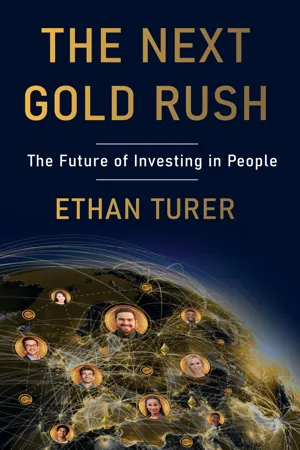
- English
- ePUB (mobile friendly)
- Available on iOS & Android
eBook - ePub
Information
Topic
EducationSubtopic
Education AdministrationPart 1
Crypto-Curious
Introduction
My Big Idea

On Saturday, May 5, 2018, (a.k.a. Cinco de Mayo) I was in attendance at the second annual Cal Poly Entrepreneurs (CPE) Officer Alumni Reunion. After serving two years on the board of the Cal Poly Entrepreneurs Club—“The best club on campus” according to Cal Poly President Jeffrey Armstrong—I was attending my first alumni event ever. I remember this weekend and that event as the spark of my big idea and the subsequent motivation for writing this book.
Some background on me and why this event was the perfect catalyst for my journey as an entrepreneur. First, I graduated from Cal Poly San Luis Obispo (SLO) in May 2018 with a degree in business entrepreneurship. My love for entrepreneurship came from the Cal Poly Entrepreneurs Club. We were a bunch of misfits who all had one thing in common: an entrepreneurial mindset. We worked hard and played harder. Nothing compares to the rush of taking an idea and making it a reality. I did this by organizing the first ever Officer Alumni Reunion, where we brought back officers from the club’s founding, eight years prior. We reminisced about the past and showed how the club had progressed in those eight years. It was so successful that this event turned into an annual tradition for officer alumni to return to San Luis Obispo and reconnect with old friends and make some new ones as well.
The second annual CPE Reunion started in the morning with a hike up Bishop’s Peak, the most popular hiking spot in town. I recall talking excitedly about the startup I was interning for, Unanimous AI. They had a unique approach to gathering the intelligence of groups using their software. People would collectively answer questions in real-time using Unanimous AI’s swarm technology. This was also the first company I worked for after graduation, so my enthusiasm was at an all-time high. I was put in charge of a cryptocurrency project where we attempted to predict the prices of Bitcoin, Ethereum, and other cryptocurrencies. The results were inconclusive, but at the time, the prospect of being able to predict prices of a very volatile market was exhilarating.
Later that evening, the alumni group reconvened at The Hothouse, a startup incubator, in downtown SLO. We ate food and talked about the glory days of being a CPE officer. Once we were done swapping funny stories about college, I made a toast to my close friend Brett Beer Tyler, who had passed away in October 2017. He was CPE’s VP of marketing, and he was a marketing genius, constantly ideating and pushing the boundaries of what was possible. Brett, a.k.a. the Pundit, was repeatedly making people laugh with his puns. Many people would recall that their first exposure to CPE was through Brett and his genuinely remarkable personality. This was the tearjerker part of the event, but he is one of my inspirations for writing this book, as I aspire to be like him and honor his memory.
Brett will always hold a special place in my heart and nothing I say will ever truly do justice to the impact he had on everyone around him. After that emotional moment, we continued the festivities with a Mediterranean-style dinner. Now this is where the fun started. Our group moved across the street to The Lofts, which was a new entrepreneurial housing community with an outdoor patio for large gatherings. There was mingling, games, interesting conversations, and networking. Imagine being around thirty inspirational people who were the next PayPal Mafia (Thiel and Masters, 2014), having fun and creating the future, all in one night.
That’s when I had my big idea for The Next Gold Rush. There must be a way to support the next generation of entrepreneurs with cryptocurrency. What if there was a way to invest in the person behind the startup? If there was a coin tied to the value of the entrepreneur, then that would take most of the risk out of the investment since most entrepreneurs continue creating, even after their first startup fails. All these ideas came to me at once, and it felt like a lightning strike to the skull. I started pitching my new idea to some of the alumni and got them curiously excited about it too.
Since that moment, when I had my epiphany, I’ve continued to research and explore the world of cryptocurrency. My idea has become increasingly refined and even more ambitious. I want to create a cryptocurrency that will allow every person to have their own coin connected to their worth. Currently, the richest people are evaluated by Forbes in their “richest people in the world” segment, based on the assets they have accumulated (Dolan, 2021). What about the rest of us? Do we want to compare each other based on everyone’s respective accumulation of wealth? If we had a method of evaluating people other than using money, wealth, profits, and stock gains, then we would be one step closer to living in a better world.
I am an early-stage entrepreneur with little to no assets and no previous experience running a company. It would be very hard, almost impossible, to find an investor who would invest in my first startup, which is statistically likely to fail (Kotashev and Cerdeira, 2021). If I instead created Ethan Coin and asked investors to buy my coin to fund the startup, then even if the first startup fails, Ethan Coin isn’t a failure. Those same investors would already be invested, via Ethan Coin, in the next company I start. Even if I do not create another company, I will still find ways to improve my quality of life over time. That’s how Ethan Coin measures value. Not just monetary quality but immaterial things like hours volunteered, my number of followers online, my health, and so much more.
It is less risky for investors because people generally bounce back over the course of their lives. Another interesting concept is that I’m creating a new asset class. People can trade coins like investing in stocks in the stock market. Except instead of trading shares of companies you are investing in people’s coins. If you think about it, what are companies except a collection of people? There are endless possibilities for how this idea can change society for the better, and I am excited to dive even deeper into those possibilities in this book.
This new economic system is limitless since every person can create their own coin, meaning that everyone may have their own mission for raising funds. The next gold rush is in cryptocurrency but it’s not investing in Bitcoin, it’s investing in people. People are the backbone of every society and human institution. We make up every community, company, government, organization, and country. Collectively, people are the global economy and have the power to shape the world. Creating a new economic system is no small feat, but it is an essential change that can lead to changing how we do everything.
The world’s richest 1 percent have more than twice as much wealth as 6.9 billion people (Oxfam 2019). According to a report by the Federal Reserve, nearly 40 percent of Americans could not cover a $400 emergency expense. While the richest people in the world have benefited from our current economic systems, the rest of the world has been struggling. The rich are getting richer faster, and income inequality has been increasing every year (HOROWITZ, IGIELNIK, and KOCHHAR, 2020). Many more alarming statistics show the current state of our economy. We need to change things for the better, or they will only get worse.
The main problem we need to tackle is our economy. Think about the economy as a machine that tells people where to spend their time, captures all their economic value, and incentivizes behaviors across the world. The global economy is the core machine, which makes it the primary problem that needs to be solved. While lawmakers and economists work to reform our current economy, cryptocurrency offers a new vision for how people can interact with each other. The ability for people to invest in one another is a win-win for the global economy because we can all win given the right incentives and human systems.
I feel compelled to write this book because ideas can change the world. I had an idea in 2018—ten years after Bitcoin was created—for a new type of cryptocurrency, and ever since then, I have become more and more excited about a future where this idea becomes a reality. That’s my motivation. I want to see this idea in the world so that we can all prosper. I am very passionate about solving problems, and my curiosity has led me to write a book geared toward doing just that: solving problems through cryptocurrency. I like to understand big picture concepts and see how all the puzzle pieces come together. As you read this book, I will do my best to show how cryptocurrency can change every aspect of our lives.
This book has three parts for three groups of people: Crypto-Curious, Crypto-Conscious, and Crypto-Capitalist. Each part builds on top of the previous one, but you can read it from start to finish or start in the section that applies to you. Crypto-Curious people are beginners. They may have heard of Bitcoin before, but that’s about it. They are curious about cryptocurrency and want to learn more. Crypto-Conscious people already know some of the basics around cryptocurrency but are intrigued about how it might become more relevant and accessible to their lives. Crypto-Capitalists are people who want to invest more of their time, money, and resources into the cryptocurrency field. These people have a more advanced understanding of cryptocurrency and want to be a part of the next gold rush in cryptocurrency.
I hope that this book will inspire you about the future of cryptocurrency and all the possibilities for positive change going forward. Reading this book is the first step to understanding a new way of living in the modern world. I want you to start asking yourself how cryptocurrency could make a difference in the world and how you could help make that change. We need to empower a generation of changemakers and problem solvers if we are ever going to have a chance at living in a world that works for all of us, not just the wealthy and powerful. If you are reading this, then you are now part of that change, and we have a lot of work to do.
Chapter 1
Bitcoin, Ethereum, and Challenge Coin
Satoshi Nakamoto and Bitcoin
“[Bitcoin is] everything you don’t understand about money combined with everything you don’t understand about computers.”
—John Oliver, Host of Last Week Tonight with John Oliver
To tell the story of Bitcoin, you must first understand that nobody knows who created it. The architect of Bitcoin used the alias “Satoshi Nakamoto,” which could either be a person or a group of people. As of this writing, we still don’t know their true identity. There are some things we do know about this mysterious founder, however (Feins 2017). We know that they released a white paper, or blueprint, explaining the technical aspects of Bitcoin and blockchain networks. Other than that, there’s been little digital footprint from Satoshi Nakamoto, who would be one of the top one hundred richest people alive today if their identity was known. Satoshi owns over 1.1 million Bitcoins, and at a value of nearly $65,000 at its peak in April 2021, that’s over $70 Billion (Phillips, 2021).
Let’s take a step back and try to understand the significance of Bitcoin and why Satoshi Nakamoto has become one of the symbols of the cryptocurrency community. In 2008, the Bitcoin white paper titled “Bitcoin: A Peer-to-Peer Electronic Cash System” was published online, and a few months later, the source code was made available for anyone to use. Also happening around that time was the 2008 financial crash, which was a result of the housing market collapsing. This juxtaposition of events is one of the most sym...
Table of contents
- PART 1 Crypto-Curious
- PART 2 Crypto-Conscious
- PART 3 Crypto-Capitalist
Trusted by 375,005 students
Access to over 1.5 million titles for a fair monthly price.
Study more efficiently using our study tools.
Frequently asked questions
Yes, you can cancel anytime from the Subscription tab in your account settings on the Perlego website. Your subscription will stay active until the end of your current billing period. Learn how to cancel your subscription
No, books cannot be downloaded as external files, such as PDFs, for use outside of Perlego. However, you can download books within the Perlego app for offline reading on mobile or tablet. Learn how to download books offline
Perlego offers two plans: Essential and Complete
- Essential is ideal for learners and professionals who enjoy exploring a wide range of subjects. Access the Essential Library with 800,000+ trusted titles and best-sellers across business, personal growth, and the humanities. Includes unlimited reading time and Standard Read Aloud voice.
- Complete: Perfect for advanced learners and researchers needing full, unrestricted access. Unlock 1.5M+ books across hundreds of subjects, including academic and specialized titles. The Complete Plan also includes advanced features like Premium Read Aloud and Research Assistant.
We are an online textbook subscription service, where you can get access to an entire online library for less than the price of a single book per month. With over 1.5 million books across 990+ topics, we’ve got you covered! Learn about our mission
Look out for the read-aloud symbol on your next book to see if you can listen to it. The read-aloud tool reads text aloud for you, highlighting the text as it is being read. You can pause it, speed it up and slow it down. Learn more about Read Aloud
Yes! You can use the Perlego app on both iOS and Android devices to read anytime, anywhere — even offline. Perfect for commutes or when you’re on the go.
Please note we cannot support devices running on iOS 13 and Android 7 or earlier. Learn more about using the app
Please note we cannot support devices running on iOS 13 and Android 7 or earlier. Learn more about using the app
Yes, you can access The Next Gold Rush by Ethan Turer in PDF and/or ePUB format, as well as other popular books in Education & Education Administration. We have over 1.5 million books available in our catalogue for you to explore.