eBook - ePub
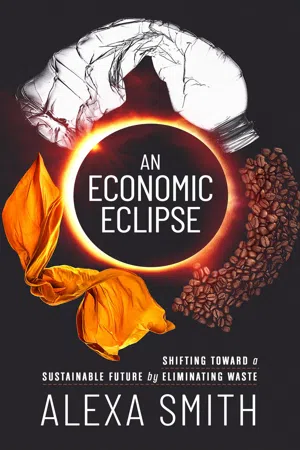
An Economic Eclipse
Shifting Toward a Sustainable Future by Eliminating Waste
- English
- ePUB (mobile friendly)
- Available on iOS & Android
eBook - ePub
Trusted by 375,005 students
Access to over 1.5 million titles for a fair monthly price.
Study more efficiently using our study tools.
Information
Phase Two
Penumbral Business Strategy
Penumbra: “a space of partial illumination (as in an eclipse) between the perfect shadow on all sides and the full light.”
Merriam-Webster
Chapter 4
DESIGN
Channeling Copernicus and Curie
“Once designed, it’s hard to reverse: ‘We can’t unscramble an omelette.’”
~Ellen MacArthur Foundation
Many a time I have found myself sitting at a cafe with friends from college discussing our roses and thorns of the week. Listening to some of my engineering friends fret about coding and computer science has left me with an unsettling regret on more than one occasion.
Was I missing out by not taking this constitutional course? If not in school, why had I not taken it upon myself to learn this sort of technology in my free time? I spend enough hours sitting in front of my computer anyway. It would only make sense.
Oh yeah, that’s right. Because it’s computer science, something I have absolutely no background in, not to mention it is one of the most competitive and difficult majors on my college campus. Getting started on this venture is not particularly intriguing to me either. All the foreign acronyms, programs, and acumen, from my perspective, seem out of reach. Even if I did have the urge to become a computer science whiz, my incompetency would surely stunt my progress.
Fortunately, research has proven otherwise. “The First 20 Hours—How to Learn Anything” is a TED Talk by number one best-selling author Josh Kaufman detailing the astounding capacity of the human brain.90 Clearly, human intellect is a distinguishing factor between us and other organisms, but in the hectic motions of daily life it can be easy to forget just how capable our minds truly are. So capable, in fact, that we can learn just about any skill in twenty hours of practice. Do you want to learn how to speak French? Bake a perfect macaron? Play the saxophone? Setting aside just twenty hours will allow you to progress steadfastly toward these aspirations.
Although I most likely won’t apply this boat of confidence to my shortcomings in computer science, the learning capabilities we inherit as humans nonetheless demonstrate our staggering capacity to adapt to new, unknown scenarios by relying on science. Even in the face of uncertainty, humans can adjust themselves and respond in a way that is efficient and logical.
In his talk, Kaufman discussed the free time he lost after having a child, which ate away at his capacity to learn new things. This is quite a common dilemma faced by new parents, especially entrepreneurs with an entirely other “child” to take care of. As a tool to combat this time crunch, Kaufman described a simple procedure he used to concentrate his energy for efficient learning:
1. Deconstruct the skill;
2. Learn enough to self-correct;
3. Remove barriers that prevent practice of the skill; and
4. Commit from the start to set aside twenty hours.91
This four-step process can be applied to many scenarios besides baking or coding. Since we urgently need to transition to a circular economy, we should employ any procedure which can get us there faster, including Kaufman’s methodology. For example, if you were to follow this sequence in attempting to go zero-waste, the shift could be much more manageable. Your Kaufman strategy may go something like:
1. Identify different areas of your life where you can reduce your waste. Auditing your trash contents for a week is a great way to get started.
2. Do some research on zero-waste bloggers, activists, and businesses in your area who can teach you about specific tactics to use in your local region.
3. Stop purchasing single-use items and invest in reusable alternatives where possible. Make sure your friends and family are aware of your lifestyle change so that they can support you in any way possible.
4. Commit to going at least twenty hours (or maybe even twenty days) without using plastic as a way to get your feet wet and fuel your long-term motivation.
While individuals may feel overwhelmed by completely changing their ways of consumption and production, our species has the capability of overcoming it with a bit of brainpower and systems-based analysis. The Industrial Revolution is evidence of this. Prior to the late 1700s, horses and carts were the main form of transportation, and primitive looms defined the textile industry. Within just a few short decades, with the invention of the steam engine and other spearheading technology, a complete economic eclipse transpired.92 The foundation and function of business was metamorphosed. From farms to factories, blue collar workers were thrust into a foreign habitat of business with a new way of designing and distributing their products. They had to think on a larger, more technological scale and revise their processes to accommodate their new clientele.
This is kindred to the proposed undertaking of circularity. Stakeholders in the production system, notably designers, are being called upon to base their assessments on an even larger scale—one that transcends humanity and encompasses our environment. Tools such as “Life-Cycle Analysis” promote this thoughtful design. New technology and apparatuses based upon these standards intend to draw in fervent purchasers during the early stages of action. Utilizing the confidence that our ancestors possessed in redesigning their economy and business culture, we can echo the calls of these consumers and progress toward a zero-waste regime.
A TRIANGLE OF OPPORTUNITY
This whole systematic process begins with analyzing the problem. For Carl Hodges and his company Seawater Works, that issue was sustainable food production. Currently, farmers, scientists, policymakers, and other professionals in the field of agriculture are battling over next steps to grow a prosperous, bountiful future of food. From organic farming to eliminating tillage, many schemes have been proposed. Seawater Works’s promising solution relies on Earth’s natural cycles and attempts to mimic these ecological relationships. This way, we can not only sustain agriculture, but also regenerate the surrounding environment.
The plot: “Use the Other 97 percent of the World’s Water.”93
Saltwater farming is not necessarily a novel idea; cultures have been trying to make use of the ocean’s bottomless waters in their plots for years, but none have successfully scaled their blueprints. That is, until an atmospheric physicist from the University of Arizona by the name of Carl Hodges came along. Prior to finding a solution to wastage from resource intensive crops, he built an educational sustainable agriculture ride called the “Land Pavilion” at Walt Disney World’s Epcot and contributed to the development of algae biofuel, a renewable plant-based alternative to traditional diesel.94 These projects demonstrate the diversity of his structural expertise, which he would then apply to Seawater Works.
Narrowing his focus to sustainable agriculture, Hodges decided to intervene in NASA’s proclaimed “triangle of conflict,” which is outlined by power, water, and food.95 This geometric hazard sparked food riots throughout Eritrea, a small state in eastern Africa. Hodges’s analysi...
Table of contents
- Introduction
- PHASE ONE. Waste Obscuration
- PHASE TWO. Penumbral Business Strategy
- PHASE THREE. Embracing Ethereal Change
- Afterword
- Bipoc Zero Waste Directory
- Acknowledgments
- Appendix
Frequently asked questions
Yes, you can cancel anytime from the Subscription tab in your account settings on the Perlego website. Your subscription will stay active until the end of your current billing period. Learn how to cancel your subscription
No, books cannot be downloaded as external files, such as PDFs, for use outside of Perlego. However, you can download books within the Perlego app for offline reading on mobile or tablet. Learn how to download books offline
Perlego offers two plans: Essential and Complete
- Essential is ideal for learners and professionals who enjoy exploring a wide range of subjects. Access the Essential Library with 800,000+ trusted titles and best-sellers across business, personal growth, and the humanities. Includes unlimited reading time and Standard Read Aloud voice.
- Complete: Perfect for advanced learners and researchers needing full, unrestricted access. Unlock 1.5M+ books across hundreds of subjects, including academic and specialized titles. The Complete Plan also includes advanced features like Premium Read Aloud and Research Assistant.
We are an online textbook subscription service, where you can get access to an entire online library for less than the price of a single book per month. With over 1.5 million books across 990+ topics, we’ve got you covered! Learn about our mission
Look out for the read-aloud symbol on your next book to see if you can listen to it. The read-aloud tool reads text aloud for you, highlighting the text as it is being read. You can pause it, speed it up and slow it down. Learn more about Read Aloud
Yes! You can use the Perlego app on both iOS and Android devices to read anytime, anywhere — even offline. Perfect for commutes or when you’re on the go.
Please note we cannot support devices running on iOS 13 and Android 7 or earlier. Learn more about using the app
Please note we cannot support devices running on iOS 13 and Android 7 or earlier. Learn more about using the app
Yes, you can access An Economic Eclipse by Alexa Smith in PDF and/or ePUB format, as well as other popular books in Economics & Sustainability in Business. We have over 1.5 million books available in our catalogue for you to explore.