eBook - ePub
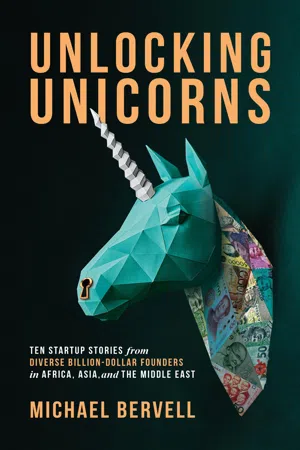
Unlocking Unicorns
Ten Startup Stories from Diverse Billion-dollar Founders in Africa, Asia, and the Middle East
- English
- ePUB (mobile friendly)
- Available on iOS & Android
eBook - ePub
Unlocking Unicorns
Ten Startup Stories from Diverse Billion-dollar Founders in Africa, Asia, and the Middle East
Information
Part 1:
Exploration
“Life is either a daring adventure or nothing at all.”
—Helen Keller
In college, I carried around Moleskin® notebooks with me everywhere I went. They were about the size of a credit card and as thick as two cracked iPhone Xs. I prided myself on buying pants with pockets to wrap my written thoughts snuggly alongside my engraved pen. Each notebook was two hundred blank pages. Lines would have been too restricting. Each varied in colors: black (freshman year), green (sophomore year), red (junior year), and yellow (senior year).
These notebooks were my brain on a page as I journeyed through Harvard.
Every semester I would choose a different prompt to inspire me to write daily:
•Freshman fall I recorded every dream I had.
•Freshman spring was a record of the life stories of every peer I had lunch with.
•Sophomore fall I found problems worth solving in the world.
•Sophomore spring my Moleskin® became a poker notebook: defining terms, recording wins, analyzing losses, developing betting strategies, and understanding the percentage-to-win ratios for different hands.
•Junior fall I learned one new vocabulary word every day.
•Junior spring I ideated on ways to optimize restaurant marketing in Harvard square.
•Senior fall I wrote one poem a day.
•Senior spring I started writing one business idea every day.
I always noticed a trend with these books: the first fourteen days were always the most difficult. Getting over the hump of writing something around a specific topic every day was a difficult task. I was forced to look for inspiration everywhere. The over-ripe banana in the dining hall became a poem on the decomposition of the human experience, and every class about Aristotle’s Nicomachean Ethics caused me to question if poker really was the “good life.” Every interaction was colored by the notebook of the moment.
After about one hundred days of carrying each notebook, its color would change: worn down by the use, friction, or the weight of ideas. Those notebooks have seen drunk nights and date nights, washing machines and walking tours, networking calls and not-so-successful interview interrogations. They viewed my life in black and white: as objective as a camera’s lens and as private as the homunculi in my head.
“A ship in harbor is safe, but that is not what ships are built for.”
—John A. Shedd
While all founders must embark on similar journeys to expand their world views before creating companies, the three founders you’ll read about in Part 1 are exceptional embodiments of exploration. They started by either intentionally or unintentionally exploring the world around them, and even as Unicorn company CEOs, continue to use their unique skills to succeed.
First is Jack Ma, the founder of Alibaba who has more than 1,001 failures. Jack’s involuntary exploration through failure forced him to develop Guanxi and enabled him to strategically use his networks to grow Alibaba from an idea to an icon in the Chinese market.
Second is Kiran Mazumdar-Shaw, the failed medical school student who is now the only self-made female billionaire in India. Through-and-through, she is a contrarian who found business success by exploring and exploiting the realms of what was possible in a male-dominated India.
Third is Mitchell Elegbe, the founder of Interswitch, a Nigerian payments company valued at more than $1 billion and the first African-founded FinTech unicorn company on the continent. More than aimlessly exploring, Mitchell embraced hindsight, foresight, and insight to capitalize on Nigeria’s movement toward a cashless economy.
“Only those who risk going too far can possibly find out how far one can go.”
—T.S. Eliot
While none of these three individuals may have carried around a Moleskin® notebook with business ideas or poetry, each has exhibited in his or her own way the importance of exploring the world before starting and while running their Unicorn companies.
Chapter Summary
Lesson 1.At the end of each chapter, you’ll find a chapter summary section that looks like this.
Lesson 2.Each chapter summary will pull out the three key lessons of the chapter.
Lesson 3.If you’re interested in learn...
Table of contents
- Introduction
- Part 1: Exploration
- Chapter 1: 1,001 Failures
- Chapter 2: Contrarian Challenger
- Chapter 3: Sanguine Seer
- Part 2: Refinement
- Chapter 4: The ABCs
- Chapter 5: Queen of Reframing
- Chapter 6: It Takes a Village
- Chapter 7: Pivot Player
- Part 3: Execution
- Chapter 8: Strategic Ambitions
- Chapter 9: Partnership Decacorn
- Chapter 10: Content-Market Fit
- Conclusion
- Acknowledgments
- Appendix
Trusted by 375,005 students
Access to over 1.5 million titles for a fair monthly price.
Study more efficiently using our study tools.
Frequently asked questions
Yes, you can cancel anytime from the Subscription tab in your account settings on the Perlego website. Your subscription will stay active until the end of your current billing period. Learn how to cancel your subscription
No, books cannot be downloaded as external files, such as PDFs, for use outside of Perlego. However, you can download books within the Perlego app for offline reading on mobile or tablet. Learn how to download books offline
We are an online textbook subscription service, where you can get access to an entire online library for less than the price of a single book per month. With over 1.5 million books across 990+ topics, we’ve got you covered! Learn about our mission
Look out for the read-aloud symbol on your next book to see if you can listen to it. The read-aloud tool reads text aloud for you, highlighting the text as it is being read. You can pause it, speed it up and slow it down. Learn more about Read Aloud
Yes! You can use the Perlego app on both iOS and Android devices to read anytime, anywhere — even offline. Perfect for commutes or when you’re on the go.
Please note we cannot support devices running on iOS 13 and Android 7 or earlier. Learn more about using the app
Please note we cannot support devices running on iOS 13 and Android 7 or earlier. Learn more about using the app
Yes, you can access Unlocking Unicorns by Michael Bervell in PDF and/or ePUB format, as well as other popular books in Business & Business Biographies. We have over 1.5 million books available in our catalogue for you to explore.