eBook - ePub
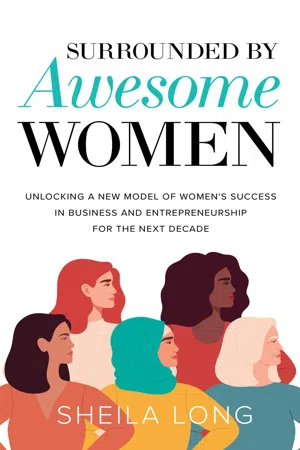
Surrounded by Awesome Women
Unlocking a New Model of Women's Success in Business and Entrepreneurship for the Next Decade
- English
- ePUB (mobile friendly)
- Available on iOS & Android
eBook - ePub
Surrounded by Awesome Women
Unlocking a New Model of Women's Success in Business and Entrepreneurship for the Next Decade
Information
Part One
Breaking Through
Chapter One
Brusque Endings Create New Professional Realities
One Fateful Day
“Oh! My fingers hurt!” I set down the phone into its cradle and gently soothed my swollen knuckles. I had picked it up ready to dial a friend to share my elation of a major professional win, but my fingers hurt too much to dial the phone number. Instead, I stared at my desk where I was a manager in a Fortune 100 communication company and contemplated the situation. I guessed I could’ve dialed with the tip of a pen, but was it worth it? My fingers were pretty important and needed some attention.
I noticed my fingers had been hard to move lately, and, while focusing on doing my job, I had been ignoring them as I didn’t want my health to deter me. Also, my ankles had been swollen for a while. Every day I noticed it was worse. That day I could not wear shoes and resorted to boots because of the excessive swelling.
How had this uncontrollable situation happened? I was challenged at work, moving up in the company, had a fun social life, and was engaged to be married. Under pressure as each required balance, I realized support was lacking. Notably, my work environment was fraught with incredible uncertainty with constant layoffs. Also, the department I managed delivered a high-stress, demanding service. When I became their leader, I noticed my staff had poor boundaries related to work-life balance and definitely lacked support and fulfillment. I witnessed how those working in the department were experiencing what researchers Fernando Bartolomé and Paul A. Lee Evans, who investigated and interviewed more than two thousand managers and their wives, coined as negative emotional spillover. In a nutshell, it is when someone brings the negativity from the office home with them and it impacts not only their personal life, but those near and dear to them.11
Because of the anxiety and uncertainty going on at the company, I did what I believe every manager should in times of crisis and massive layoffs; I took over and shielded my staff from whatever company politics I could.12 Simultaneously, I implemented process changes that transformed the delivery of our service from a high to a low-stress environment.
Women’s Fight for Equality
Looking at my situation, even though it lacked balance and support, I realized how far women have come over the past five decades. Growing up in the 1970s, women transformed the world for me. They stood up for their rights, demanded change, withstood unfair treatment, and became tough fighters for the next generation of women. They made inroads garnering more respect professionally as the rules were modified at small and large companies. These women were, are, and will continue to be my heroes.13
When women entered businesses, big and small, in the 1970s and 1980s, companies needed to adapt to meet their needs. Now, a half a century later, some still have not adapted. Nowhere is this clearer than with the pay gap. The pay gap showcases the inequities in pay as women earn far less than their male counterparts, at eight-two cents to a man’s dollar in earnings.14 Some noteworthy fields where the pay gap is glaringly evident are those of female personal financial advisors, where women earn 59 percent less than men, female administrative service managers, where women earn 62 percent less than men, female emergency medical technicians and paramedics, where women earn 66 percent less than men, and sales, where women earn 67 percent less than men.15 Employees impacted by the pay gap in firms and industries that do not address it suffer.16 Because of compensation discrimination, outdated companies operate in a world where only certain workers flourish professionally, emotionally, and financially.
The Doctor Weighs In
The stress had caught up with me, and as I attempted to make this phone call, I realized my health was now suffering. I gently picked up the phone and dialed my doctor, who told me a visit to a rheumatologist was in order. I set up an appointment for the next day with a doctor who had an opening. The next morning, my newfound doctor took two minutes to examine me.
“Hi. My name is Dr. Lert. Do not try to pronounce my full name. Just call me Dr. Lert. Show me your hands. Now your feet. Look at your ankles! Try and move them. Now the shoulders. Lift your arms. Oh, you cannot lift them more? Okay. Try harder. Wow, you really cannot bend your elbow. Why you wait so long to come see me?”
I dreaded his reply. “Can you fix this? I was hoping it would go away.”
“Maybe, I can fix this. You are now one of my patients.” He informed me I had rheumatoid arthritis and that he knew a lot about that. “You are lucky you know me. I think I can fix this. We have to wait and see. You just need to take this medication. Now, very important to go get it now. Then, you come back in one week, then in three weeks, then in five weeks and you should be back to normal. We hope. We wait and we see.”
I was beside myself with relief as the medication would miraculously reverse the signs of arthritis that had formed. If all went well, my joint movement would return. I listened as he added, “Now just one thing. No babies. That would be very bad. So, no babies.”
Shocked by what I was hearing, I stopped dead in my tracks. I wondered to myself, how could this be happening? I was thirty years old and knew the clock was ticking. With every year passing and a child not being conceived, the risks of having a healthy baby with birth defects increased. I asked him to repeat himself, hoping it was a language barrier. “Excuse me?”
Dr. Lert repeated, “Babies are very bad. You need to fix your joints now. No babies. We wait and we see.”
As I heard this diagnosis and the subsequent restriction, my mind was reeling with the injustice of it all. Because I constantly sought equilibrium of calm amidst the chaos at work, I had become physically ill with a disease that would always be with me and now I had been told may not be able to bear children.
“When will this go away? I cannot have a baby? Ever?”
Shaking his head, Dr. Lert repeated, “You come in one week, then in three weeks, then in five weeks. You are very lucky you know me. We wait and we see.”
I reflected on how this diagnosis would not impact the career of a man: he would be able to take medication and continue working while moving up t...
Table of contents
- FRONTMATTER
- Introduction
- Part 1. Breaking Through
- Part 2. Breaking Away
- Part 3. Breaking the Mold
- Part 4. Tips and Tools
Trusted by 375,005 students
Access to over 1.5 million titles for a fair monthly price.
Study more efficiently using our study tools.
Frequently asked questions
Yes, you can cancel anytime from the Subscription tab in your account settings on the Perlego website. Your subscription will stay active until the end of your current billing period. Learn how to cancel your subscription
No, books cannot be downloaded as external files, such as PDFs, for use outside of Perlego. However, you can download books within the Perlego app for offline reading on mobile or tablet. Learn how to download books offline
Perlego offers two plans: Essential and Complete
- Essential is ideal for learners and professionals who enjoy exploring a wide range of subjects. Access the Essential Library with 800,000+ trusted titles and best-sellers across business, personal growth, and the humanities. Includes unlimited reading time and Standard Read Aloud voice.
- Complete: Perfect for advanced learners and researchers needing full, unrestricted access. Unlock 1.5M+ books across hundreds of subjects, including academic and specialized titles. The Complete Plan also includes advanced features like Premium Read Aloud and Research Assistant.
We are an online textbook subscription service, where you can get access to an entire online library for less than the price of a single book per month. With over 1.5 million books across 990+ topics, we’ve got you covered! Learn about our mission
Look out for the read-aloud symbol on your next book to see if you can listen to it. The read-aloud tool reads text aloud for you, highlighting the text as it is being read. You can pause it, speed it up and slow it down. Learn more about Read Aloud
Yes! You can use the Perlego app on both iOS and Android devices to read anytime, anywhere — even offline. Perfect for commutes or when you’re on the go.
Please note we cannot support devices running on iOS 13 and Android 7 or earlier. Learn more about using the app
Please note we cannot support devices running on iOS 13 and Android 7 or earlier. Learn more about using the app
Yes, you can access Surrounded by Awesome Women by Sheila Long in PDF and/or ePUB format, as well as other popular books in Business & Entrepreneurship. We have over 1.5 million books available in our catalogue for you to explore.