eBook - ePub
The Panathenaic Games
Proceedings of an International Conference held at the University of Athens, May 11-12, 2004
- 176 pages
- English
- ePUB (mobile friendly)
- Available on iOS & Android
eBook - ePub
The Panathenaic Games
Proceedings of an International Conference held at the University of Athens, May 11-12, 2004
About this book
The papers in this volume were presented at an international conference organised in Athens (May 11-14, 2004) and focus on the study of the Panathenaic Games, a Panhellenic athletic event that lasted for nearly a millennium. An international assembly of archaeologists, art historians, ancient historians, epigraphists and classical scholars contributed to the discussion of the origins and the historical development of the Panathenaic Games in general and of individual contests in particular. The role of royal and other patrons in the Hellenistic and Roman periods, as well as the form and meaning of victory dedications and other monuments generated by the games were also examined, making this a truly interdisciplinary study into this fascinating event. Two papers are in Greek.
Information
Subtopic
Greek Ancient HistoryIndex
HistoryAthens and Herculaneum: The Case of the Panathenaic Athenas
Carol C. Mattusch
Sculptures made in traditional styles were popular among the Romans, and workshops around the Bay of Naples produced works ranging from copies of the Athenian Tyrant-Slayers to Classical masterpieces to archaistic statues and busts, some of which may have been passed off as legitimate ‘old’ works. The many owners of villas in the region provided an unlimited demand for these sculptures, and it is not unusual for more than one example of a popular work to survive.
The Villa dei Papiri, overlooking the Bay of Naples just west of Herculaneum, is the largest Roman villa that has been discovered to date, and it is by no means fully uncovered. Its public areas, which were tunneled out during the 1750’s, cover approximately 20,000 square meters or 65,000 square feet, including a large garden surrounded by a colonnade consisting of 25 × 10 columns. Excavations in the area of the atrium were conducted during the 1980’s and 1990’s, revealing two additional stories besides the single level drawn by Karl Weber in the plan that he finished in 1758.1
The Villa yielded wall paintings, floor mosaics, about 1,000 papyrus rolls, and nearly ninety bronze and marble sculptures. Most of the sculptures are classical in style, and many of them are either reproductions of well-known Greek statue-types or portraits of famous Greeks. The bronzes come in all sizes; statues, busts, and herm-heads come in all sizes, but almost all the marbles consist of life-size herm-heads and over-life-size statues.
In what appears to have been the tablinum, a vast room measuring 88 square meters with a polychrome marble floor, eight bronze busts were uncovered in the center of the room: a mellephebe (Naples National Museum 5633) and a short-haired “Polykleitan” type of athlete (Naples N.M. 5614); three life-size portraits of Romans (N.M. 5634, 5586, 5587); and small-scale busts of Demosthenes (N.M. 5469), Epikouros (N.M. 11017), and a Julio-Claudian lady, perhaps Agrippina (N.M. 5474). At one side of the room stood a colossal statue of a draped, veiled woman (N.M. 6240), evidently carved in Carrara marble. Between two columns outside the entrance to the room stood an over-life-size archaistic statue of an armed, striding Athena, carved in Pentelic marble (Fig. 1 and Colour Pl. 13). Use of the archaistic style conjures up ancient traditions and origins. As such, an archaistic image can be used to link the present context to the past, and to establish the bloodlines or the legitimacy of the present context. The statue of Athena from the Villa dei Papiri provides a fascinating range of associations.
Images of the armed, striding Athena first became popular during the Archaic period, particularly in the city of Athens. The attacking Athena in the Gigantomachy from the pediment of the large late Archaic temple on the Acropolis – the Archaios Neos2 – strides forward on her left foot, leaning aggressively over her fallen opponent. Athena’s head is bent, and her long locks fall forwards over the left shoulder, backwards over the right one. She stretches out her left arm and grabs a snake on her aegis to threaten her fallen adversary. No doubt she was wielding a spear in her right hand, aiming it at the giant. The striding Athena on a lekythos attributed to Douris is not unlike the one from the Archaios Neos: she too is about to strike a falling giant with her spear; and she too is conceived as part of a group.3
On Panathenaic amphorae of all periods, Athena maintains her archaistic character. She wields a spear and carries a shield extended in front of her as if she is on the attack, one foot usually in front of the other. At the same time, and in an apparent contradiction, she maintains an upright position. This Athena has no adversary; and her vertical stance relieves the composition of the need for another figure. The Panathenaic Athena also delivers a pointed political message: she is aggressive but unchallenged; and sport takes the place of battle.
The armed attacking Athena appears as a bronze statuette in Athens and elsewhere during the Archaic period. When striding forward, she fits the Panathenaic type. The ones that stand upright are likely to be the precursors of the colossal armed and standing Bronze Athena that Pheidias designed for the Acropolis, and that was financed from the spoils of the Persian defeat at Marathon (Pausanias 1.28.2). This famous image that stood on the Acropolis was later given the title of Promachos (Warlike), because Pheidias’s statue was, after all, a monument honoring the Athenians’ victory over the Persians. She was armed like the other Athenas, but she was never described either as being old-fashioned in style, or as striding forwards. In other words, Pheidias’s Bronze Athena of the 450’s B.C. must have been Classical in style, and she undoubtedly looked very different from the traditional Panathenaic Athenas, who were actively engaged in attack and Archaic in style.4
The archaistic striding Athena from the Villa dei Papiri at Herculaneum is about 2 meters tall, and she is one of more than twenty-five marbles and sixty bronzes that have been recovered to date from that villa. Nearly all of them were found during the eighteenth-century Bourbon excavations, though a few marbles have been found in the recent excavations.5 Most of the marbles retrieved from this vast Roman collection were in excellent condition, and, if they were broken, the pieces were recovered and reattached, with the exception of one statue’s head, which was lost (N.M. 6126).6 All in all, relatively few repairs were made, even to the noses, almost all of which survived intact beneath the mud-flows from the eruption of Mt. Vesuvius.
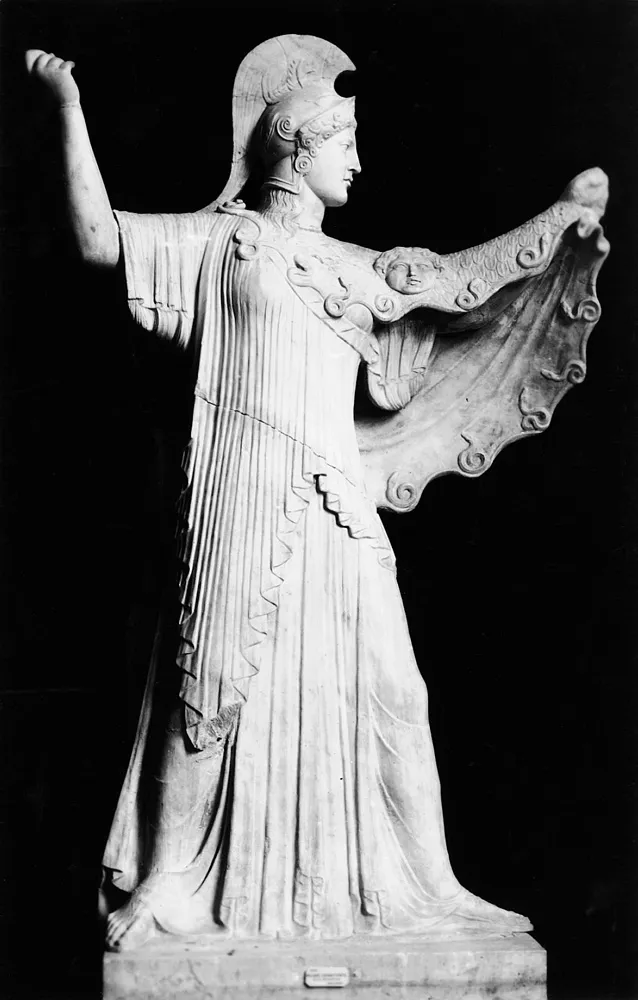
Fig. 1. Marble statue ...
Table of contents
- Front Cover
- Title Page
- Copyright Page
- Contents
- Foreword by Olga Palagia and Alkestis Choremi-Spetsieri
- Panathenaic amphoras
- Panathenaic prizes and dedications
- Gods and athletic games
- Replicating tradition: the first celebrations of the Greater Panathenaia
- Games at the lesser Panathenaia?
- The iconography of the Athenian apobates race: origins, meanings, transformation
- Torch race and vase-painting
- A unique new depiction of a Panathenaic victor
- Panathenaic prize amphorae from the Kerameikos: some new aspects and results
- “Not that the vases are easy to interpret...” Some thoughts on Panathenaic prize amphorae
- Λευκοί παναθηναϊκοί αμφορείς και μουσικοί αγώνες
- “Choregic” or victory monuments of the tribal Panathenaic contests
- Δραματικοί αγώνες και αρχιτεκτονική στη νότια κλιτύ της Ακροπόλεως
- Royal Athenians: the Ptolemies and Attalids at the Panathenaia
- The Panathenaic stadium from the Hellenistic to the Roman period: Panathenaic prize-amphorae and the Biel throne
- Athens and Herculaneum: the case of the Panathenaic Athenas
- Colourr Plates
Trusted by 375,005 students
Access to over 1.5 million titles for a fair monthly price.
Study more efficiently using our study tools.
Frequently asked questions
Yes, you can cancel anytime from the Subscription tab in your account settings on the Perlego website. Your subscription will stay active until the end of your current billing period. Learn how to cancel your subscription
No, books cannot be downloaded as external files, such as PDFs, for use outside of Perlego. However, you can download books within the Perlego app for offline reading on mobile or tablet. Learn how to download books offline
Perlego offers two plans: Essential and Complete
- Essential is ideal for learners and professionals who enjoy exploring a wide range of subjects. Access the Essential Library with 800,000+ trusted titles and best-sellers across business, personal growth, and the humanities. Includes unlimited reading time and Standard Read Aloud voice.
- Complete: Perfect for advanced learners and researchers needing full, unrestricted access. Unlock 1.5M+ books across hundreds of subjects, including academic and specialized titles. The Complete Plan also includes advanced features like Premium Read Aloud and Research Assistant.
We are an online textbook subscription service, where you can get access to an entire online library for less than the price of a single book per month. With over 1.5 million books across 990+ topics, we’ve got you covered! Learn about our mission
Look out for the read-aloud symbol on your next book to see if you can listen to it. The read-aloud tool reads text aloud for you, highlighting the text as it is being read. You can pause it, speed it up and slow it down. Learn more about Read Aloud
Yes! You can use the Perlego app on both iOS and Android devices to read anytime, anywhere — even offline. Perfect for commutes or when you’re on the go.
Please note we cannot support devices running on iOS 13 and Android 7 or earlier. Learn more about using the app
Please note we cannot support devices running on iOS 13 and Android 7 or earlier. Learn more about using the app
Yes, you can access The Panathenaic Games by Olga Palagia,Alkestis Spetsieri-Choremi, Alkestis Spetsieri-Choremi in PDF and/or ePUB format, as well as other popular books in History & Greek Ancient History. We have over 1.5 million books available in our catalogue for you to explore.