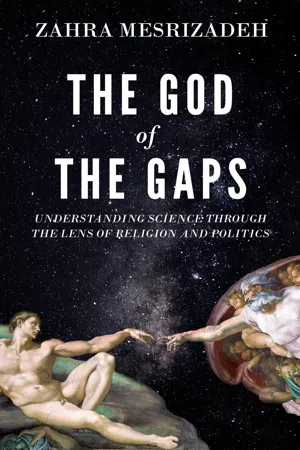
The God of the Gaps
eBook - ePub

The God of the Gaps

Understanding Science through the Lens of Religion and Politics

  1. English
  2. ePUB (mobile friendly)
  3. Available on iOS & Android
eBook - ePub

The God of the Gaps

Understanding Science through the Lens of Religion and Politics

About this book

Science: the one subject that should be untouched by human opinion and bias.

Unfortunately, the realm of science doesn't live up to this gold standard because it often gets intertwined with religion and politics. Facts are questioned in the face of political agendas and, in the presence of the unknown, mysticism swoops down. Have you ever wondered how humanity got this way? Why are we so compelled to reference a higher power and why can't we remove political bias from scientific issues like climate change?

The God of the Gaps: Understanding Science through the Lens of Religion and Politics:

  • Explores the origins of our search for spirituality
  • Tackles the question of whether we'll ever extricate science from the greedy hands of politics
  • Delves into how to discern reality in the post-truth era
  • Confronts the human penchant for ignoring cognitive barriers
  • Discusses the importance of diversity in all fields

Science is in the air you are breathing as you read this sentence. It is in your thoughts for the future of the planet that our children will inherit.Uncover how historical events, religion, and politics have influenced the interpretation of science, and how we can learn from, and overcome, these barriers as a society.

Frequently asked questions

Yes, you can cancel anytime from the Subscription tab in your account settings on the Perlego website. Your subscription will stay active until the end of your current billing period. Learn how to cancel your subscription.
No, books cannot be downloaded as external files, such as PDFs, for use outside of Perlego. However, you can download books within the Perlego app for offline reading on mobile or tablet. Learn more here.
Perlego offers two plans: Essential and Complete
  • Essential is ideal for learners and professionals who enjoy exploring a wide range of subjects. Access the Essential Library with 800,000+ trusted titles and best-sellers across business, personal growth, and the humanities. Includes unlimited reading time and Standard Read Aloud voice.
  • Complete: Perfect for advanced learners and researchers needing full, unrestricted access. Unlock 1.4M+ books across hundreds of subjects, including academic and specialized titles. The Complete Plan also includes advanced features like Premium Read Aloud and Research Assistant.
Both plans are available with monthly, semester, or annual billing cycles.
We are an online textbook subscription service, where you can get access to an entire online library for less than the price of a single book per month. With over 1 million books across 1000+ topics, we’ve got you covered! Learn more here.
Look out for the read-aloud symbol on your next book to see if you can listen to it. The read-aloud tool reads text aloud for you, highlighting the text as it is being read. You can pause it, speed it up and slow it down. Learn more here.
Yes! You can use the Perlego app on both iOS or Android devices to read anytime, anywhere — even offline. Perfect for commutes or when you’re on the go.
Please note we cannot support devices running on iOS 13 and Android 7 or earlier. Learn more about using the app.
Yes, you can access The God of the Gaps by Zahra Mesrizadeh in PDF and/or ePUB format, as well as other popular books in Politics & International Relations & Radicalism. We have over one million books available in our catalogue for you to explore.

Table of contents

  1. Author’s Note
  2. Introduction
  3. Magical Thinking
  4. The Politics of Religion
  5. Lies, Disinformation, and Conspiracy Theories
  6. Tumbling in the Dark
  7. Cellular Robots
  8. Cognitive Metastasis
  9. Rational Thinking
  10. Science and Society
  11. Invisible in Society
  12. When you Grow Up
  13. Above Them All
  14. Collective Power
  15. Conclusion
  16. Acknowledgments
  17. Appendix