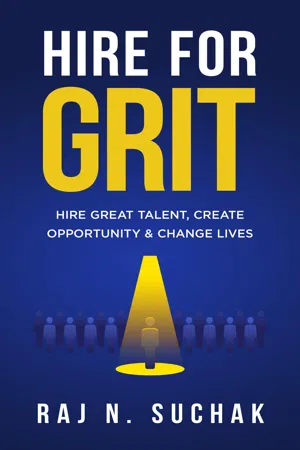
Hire for Grit explores the intersections of grit, talent acquisition, and opportunity. Recruiting, as it exists today, is broken. It's inefficient, biased, expensive, and can create a poor experience for many involved. It's time we rethink how we hire talent. Author Raj Suchak debunks hiring myths and shares insight on how to measure grit, how to use simulations before hiring, how to hire technical talent, and how using a simple texting platform can transform recruitment. An essential book for both the company leader and the hiring manager, Hire for Grit shows the way to effectively and efficiently hire amazing people.
- English
- ePUB (mobile friendly)
- Available on iOS & Android
eBook - ePub
About this book
Trusted by 375,005 students
Access to over 1.5 million titles for a fair monthly price.
Study more efficiently using our study tools.
Information
PART 1
GRIT & HIRING
CHAPTER 1
HOW WE HIRE TODAY
Hiring is hard! For most hiring managers, recruiting for their team is one of their biggest pain points and yet, a top priority.
Say you are a manager and need to hire someone for your team. What process should you follow? What should you expect?
The hiring process typically includes the following steps:
- Convincing management that there is a real need for the requisition and getting approval for it
- Crafting the right job description and criteria to evaluate applicants
- Posting the job online (or working with an outside agency) and waiting for candidates and resumes
- Reaching out to personal networks to see if anyone they know is looking for a new opportunity
- Vetting resumes and applicants
- Reviewing vetted applicants and coordinating with members of the team to get their feedback
- Phone screening and interviewing candidates
- Deciding to hire or not to hire based on the applicant’s interview performance and the team’s feedback
- Working through the offer process and convincing the candidate to join their team if they have more than one offer on the table
Wow! That is a lot of hurdles to jump through and it can be incredibly complex. According to the Bureau of Labor Statistics as of November 2020, there are over six hundred thousand open jobs in America and that number has been consistently higher than six hundred thousand in the months prior.[8] If companies generally follow the above process, consider how big of a challenge hiring is and yet, according to Predictive Index, hiring is considered a top priority for most CEOs and executives.[9]
The challenges associated with hiring people can be broken down into three broad categories.
- Hiring is time consuming and expensive
- Hiring is biased and error prone
- Hiring creates poor experiences
Let’s review each of the challenges in greater detail.
Hiring is Time Consuming and Expensive
According to the Society for Human Resources Management (SHRM) Human Capital Report the average time to fill a position is thirty-six days, the cost per hire is $4,425 and the annual overall turnover rate is 38 percent.[10] That means that after a job requisition has been approved, the average time to find and hire the right person takes over a month and operationally costs an organization a significant amount when you factor in advertising, travel, coordination and personnel costs. Those numbers can be even higher for certain industries like technology and healthcare. Organizations spend an incredible amount of time and money in recruiting the right talent just to lose 38 percent of that talent after the first year.
If the hiring process is expensive, making the wrong decision on who to hire is even more so. In the early days of Amazon.com, Jeff Bezos was asked about his hiring approach. He said, “I’d rather interview fifty people and not hire anyone than hire the wrong person.” The Department of Labor estimates the cost of a bad hire to be 30 percent of their annual compensation. So, making the wrong hiring decision adds to the high cost of hiring people in the first place.[11] However, this does not include the intangible cost of hiring the wrong person in terms of team morale, productivity and other meaningful measures. Hiring the right person can provide a well-functioning team, a strong and thriving culture and a collaborative environment that encourages hiring better than oneself.
At Cloud62 and even later at Huron Consulting Group, I experienced the disruption created by a wrong hire. The wrong hiring decision often meant that we had to deal with slipping timelines, cost overruns on projects, a drop in employee morale and unhappy customers. Thanks to our stringent hiring process, the wrong hiring decisions were a rarity. Still, they resulted in a negative impact throughout the organization.
And what about the cost of not hiring on time? If you take a look at the organization’s revenue per employee and divide that by the number of working days in the calendar year, you get the cost of not hiring on time for each day. For example, the revenue per employee for the energy industry is one million seven hundred thousand dollars and assuming two hundred twenty working days in a year, for each day that an energy company does not hire, the cost is a staggering seven thousand seven hundred dollars. The daily cost of not hiring on time for the healthcare industry is four thousand and fifty dollars.[12]
Recruiting costs can also go up when there isn’t enough talent available to hire. I recently spoke to Alicia Kenney, the VP of HR at BryLin Hospital. She, like many other HR executives, is constantly on the lookout for healthcare talent and works hard every day to ensure the talent they have is retained. Alicia and many other executives at hospitals, nursing homes, and managed care facilities have an “always hiring” policy to ensure they are keeping up with the need to be fully staffed. For healthcare organizations, hiring for registered nurses (RNs), certified nurse aides (CNAs) and license practical nurses (LPNs) is a constant challenge. A simple search on job boards like Indeed for a registered nurse (RN) position yield over 170,000 job openings.
In summary, the cost of hiring is dictated by the time it takes to hire, hiring the right person, and ensuring that there is a talent pool available to hire from. For most organizations, reducing the time to hire and putting checks and balances in place to hire right are two of the best ways to reduce the cost of hiring.
Hiring is Biased and Error Prone
Hiring is biased. According to UPenn’s team of researchers, biases exist in most steps of the hiring process.[13] From writing job descriptions, to resume evaluations and interpreting a candidate’s fit for the role, biases based on gender, name, employment status and other factors are a common occurrence in the recruiting process. In addition to bias, errors can also arise when the hiring process is not consistently defined and implemented.
What can organizations do to reduce bias and errors when hiring?
Job descriptions can be exclusionary
According to SHRM, starting with job descriptions is a good place.[14] The goal of job descriptions is to articulate what the role entails and the responsibilities of the position. Also, job descriptions describe the educational, experience requirements of the roles and set the right expectations for the candidates that are interested in applying. In some ways, job descriptions are used by companies to ensure that only qualified people apply. However, who determines if they are qualified? Number of years of experience? Educational background? The candidate themselves? The recruiter?
Can job descriptions increase bias and reduce candidate diversity?
According to the Journal of Personality and Social Psychology the use of certain male dominated words in job descriptions significantly reduces the likelihood of women applying for the role.[15] Examples of such male dominated words in technology job descriptions are “ninja,” “champion,” and others. For a full list of male and feminine oriented words that organizations should be mindful of, see https://www.hiremorewomenintech.com/.
Qualifications limit the pool
In addition to the words used in the job description, the “qualifications” part of the job description can also lead to bias and error in judgement when considering candidates. Research has shown that men apply for a job when they meet at least 60 percent of the qualifications, while women tend to apply if they meet 100 percent of the qualifications.[16] Creating qualification criteria that is overly selective can sway a candidate pool’s gender diversity.
The qualifications part of a job description not only leads to bias, but the actual qualifications are often times just a guess of what is required. For example, if a job description has five years of experience as one of the requirements for the role, could someone with three years of experience truly be less qualified? Years of work experience is a prime example of how arbitrary criteria can turn away qualified candidates and reduce diversity.
Biases associated with job descriptions are just the tip of the iceberg. Resumes are also a big source of bias in the hiring process.
Are resumes even relevant?
For starters, candidates and recruiters often play the resume keyword game.
Given the limited resources and time to review all applications for a position, a recruiter may be forced to quickly scan for keywords across the resumes received for the position. Candidates are well aware of that strategy and often create a resume packed with keywords that may result in their resume showing up on a recruiter’s radar. This approach to zeroing in on the right candidate is fundamentally flawed because a candidate may jam pack their resume with the right keywords for it to be picked up by a biased algorithm or recruiter while other more qualified candidates may never even be considered. As a candidate, knowing how to play the resume keyword game means that you are likely to be on top of the stack while people who may be more qualified or capable may never get their chance.
To reduce dependence on keywords, some companies leverage the power of case studies in hiring talent. McKinsey & Company (considered one of the most successful consulting organizations in the world) is known to hire from the top schools and gets thousands of candidates who apply for their associate position.
According to Caitlin Storhaug, leader of McKinsey’s global recruiting programs, “[McKinsey] recruits from the programs that everyone has heard about like Wharton, Stanford and MIT but also from other schools around the world that might have a really excellent program in something we are looking for, like a great engineering, digital or agriculture program.”[17] Kerry Casey is the Director of Americas Recruiting for McKinsey. Casey explains, “We look for analytical people who want to create positive results for our clients.”[18] An important part of the hiring process at McKinsey involves a case exercise that qualified candidates are asked to work on and present to the hiring team. The case study helps hiring teams see how a candidate analyzes and logically thinks and communicates to help them determine how they could perform in front of clients.
The larger question is, does a resume really represent a candidate? Just like how a traditional job description can’t fully represent and describe what it is like to work at a company, resumes are a poor way to create more than a ‘one-dimensional’ view of a candidate. Not only is it hard to get to know the candidate in order for a company to make an informed decision, but it is hard for the candidate to truly demonstrate and explain why they are the right fit for the role.
Resumes can also lead to conscious or subconscious biases. Biases can arise based on names, gender and other identifiable information that can easily be gleamed from a resume. According to researchers at Harvard and Princeton University’s department of economics, female musicians, in the past, have faced discrimination when applying for symphony orchestra jobs if the musician isn’t given a chance to demonstrate their capabilities.[19] If blind auditions were used in the evaluation process such that a candidate gender and name were not revealed there was a substantial increase in female musician new hires.
So what can we learn from that? One strategy an organization can use is to remove references to names, gender, and other identifiable information and give every single candidate the same chance to demonstrate their fit for the role. It’s a step in the right direction, yet bias can still creep into the process when a candidate meets face-to-face with the company.
Another strategy to reduce bias is to remove dependence on the same types of backgrounds and qualifications from the pool of candidates that the organization has hired from. Some of the top companies in the world take a very proactive approach to reducing bias this way. At Goldman Sachs, one would expect them to hire people with top financial backgrounds. However, according to a recruiter (name withheld) who worked in Goldman Sachs securities division, people that have demonstrated excellence in economics and financial internships are not necessarily the most ideal candidates.[20] They are considered plug and play candidates who are not exciting. Goldman Sachs prefers to hire people with unusual and diverse profiles. If you have a background in English Literature and have demonstrated success, you are just as likely to be considered as someone who has a finance degree with top grades. At Goldman, there is a big emphasis on character and the pursuit of excellence. Grades and a top school background...
Table of contents
- Contents
- Introduction
- Part 1. Grit & Hiring
- Part 2. Hire for Grit Framework
- Part 3. Hire for Grit Considerations
- Acknowledgments
- Appendix
- Notes
Frequently asked questions
Yes, you can cancel anytime from the Subscription tab in your account settings on the Perlego website. Your subscription will stay active until the end of your current billing period. Learn how to cancel your subscription
No, books cannot be downloaded as external files, such as PDFs, for use outside of Perlego. However, you can download books within the Perlego app for offline reading on mobile or tablet. Learn how to download books offline
Perlego offers two plans: Essential and Complete
- Essential is ideal for learners and professionals who enjoy exploring a wide range of subjects. Access the Essential Library with 800,000+ trusted titles and best-sellers across business, personal growth, and the humanities. Includes unlimited reading time and Standard Read Aloud voice.
- Complete: Perfect for advanced learners and researchers needing full, unrestricted access. Unlock 1.5M+ books across hundreds of subjects, including academic and specialized titles. The Complete Plan also includes advanced features like Premium Read Aloud and Research Assistant.
We are an online textbook subscription service, where you can get access to an entire online library for less than the price of a single book per month. With over 1.5 million books across 990+ topics, we’ve got you covered! Learn about our mission
Look out for the read-aloud symbol on your next book to see if you can listen to it. The read-aloud tool reads text aloud for you, highlighting the text as it is being read. You can pause it, speed it up and slow it down. Learn more about Read Aloud
Yes! You can use the Perlego app on both iOS and Android devices to read anytime, anywhere — even offline. Perfect for commutes or when you’re on the go.
Please note we cannot support devices running on iOS 13 and Android 7 or earlier. Learn more about using the app
Please note we cannot support devices running on iOS 13 and Android 7 or earlier. Learn more about using the app
Yes, you can access Hire for Grit by Raj N Suchak in PDF and/or ePUB format, as well as other popular books in Business & Human Resource Management. We have over 1.5 million books available in our catalogue for you to explore.