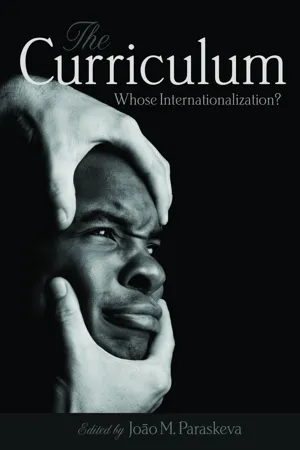
The Curriculum: Whose Internationalization? asks a series of important questions in the re-examination of the internationalization of curriculum studies. It reflects the work of the Internationalization of Curriculum Studies Task Force – created at the American Association for the Advancement of Curriculum Studies annual meeting in New Orleans in 2011 – in the context of new theoretical avenues such as the Itinerant Curriculum Theory (ICT) to help address issues related to the problematic nature of internationalization and globalization.
- 230 pages
- English
- PDF
- Available on iOS & Android
eBook - PDF
About this book
Information
Table of contents
- Cover
- Contents
- Chapter One: The Curriculum: Whose Internationalization? (João M. Paraskeva)
- Chapter Two: Beyond Abyssal Thinking: From Global Lines to Ecologies of Knowledges (Boaventura de Sousa Santos)
- Chapter Three: Curriculum: The Need for a Radical Copresence (João M. Paraskeva)
- Chapter Four: Las Etapas de la Educación y Revolución: Literacy, Communism, and Democracy from Raúl Ferrer to Tao Xingzhi (Todd Alan Price)
- Chapter Five: Tasanhak, Korean Neo-Confucianism, and Curriculum Studies: Complicating Conversations in Human Nature, Knowledge, and Justice (Seungho Moon)
- Chapter Six: The Internationalization of Curriculum Studies: The Contribution of Jamaica’s Marcus Mosiah Garvey (Andrea Baldwin)
- Chapter Seven: Indonesian Curriculum Theorist: Ki Hadjar Dewantara (Dinny Risri Aletheiani)
- Chapter Eight: In the Third Moment in Curriculum Studies: A Dialogue between Seikatsu Tsuzurikata and Critical Pedagogy (Kaoru Miyazawa)
- Chapter Nine: Anton Semyonovich Makarenko: A Few Western Myths Debunked (Oksana Jackim)
- Chapter Ten: Curriculum Counter-strokes and Strokes: Swimming in Nonexistent Epistemological Rivers Dialoguing with Sousa Santos (Elizabeth Janson and João M. Paraskeva)
- Conclusion: Itinerant Curriculum Theory: A Reiteration (João M. Paraskeva)
- Contributors
Trusted by 375,005 students
Access to over 1.5 million titles for a fair monthly price.
Study more efficiently using our study tools.
Frequently asked questions
Yes, you can cancel anytime from the Subscription tab in your account settings on the Perlego website. Your subscription will stay active until the end of your current billing period. Learn how to cancel your subscription
No, books cannot be downloaded as external files, such as PDFs, for use outside of Perlego. However, you can download books within the Perlego app for offline reading on mobile or tablet. Learn how to download books offline
Perlego offers two plans: Essential and Complete
- Essential is ideal for learners and professionals who enjoy exploring a wide range of subjects. Access the Essential Library with 800,000+ trusted titles and best-sellers across business, personal growth, and the humanities. Includes unlimited reading time and Standard Read Aloud voice.
- Complete: Perfect for advanced learners and researchers needing full, unrestricted access. Unlock 1.5M+ books across hundreds of subjects, including academic and specialized titles. The Complete Plan also includes advanced features like Premium Read Aloud and Research Assistant.
We are an online textbook subscription service, where you can get access to an entire online library for less than the price of a single book per month. With over 1.5 million books across 990+ topics, we’ve got you covered! Learn about our mission
Look out for the read-aloud symbol on your next book to see if you can listen to it. The read-aloud tool reads text aloud for you, highlighting the text as it is being read. You can pause it, speed it up and slow it down. Learn more about Read Aloud
Yes! You can use the Perlego app on both iOS and Android devices to read anytime, anywhere — even offline. Perfect for commutes or when you’re on the go.
Please note we cannot support devices running on iOS 13 and Android 7 or earlier. Learn more about using the app
Please note we cannot support devices running on iOS 13 and Android 7 or earlier. Learn more about using the app
Yes, you can access The Curriculum by João M. Paraskeva in PDF and/or ePUB format, as well as other popular books in Pedagogía & Educación de adultos. We have over 1.5 million books available in our catalogue for you to explore.