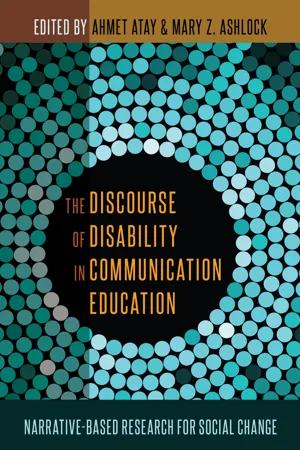
This book examines the ways in which communicative practices influence the lives of students and faculty with disabilities in higher education. Offering their own experiences as teachers and students, the authors use qualitative research methods, mainly narrative and autoethnography, to highlight the intersections among communication, disability, diversity, and critical communication pedagogy. While embodying and emphasizing these connections, each chapter defines the notion of disability from a different point of view; summarizes the relevant literature; provides suggestions for different ways of improving the experiences of people with disabilities in higher education; promotes social change; and in some cases, promotes policy change. Overall, the volume promotes more effective, mindful, honest, and caring interaction between able-bodied and disabled individuals.
eBook - PDF
The Discourse of Disability in Communication Education
Narrative-Based Research for Social Change
- 206 pages
- English
- PDF
- Available on iOS & Android
eBook - PDF
The Discourse of Disability in Communication Education
Narrative-Based Research for Social Change
About this book
Information
Table of contents
- Cover
- Contents
- Acknowledgments
- Introduction (Ahmet Atay and Mary Z. Ashlock)
- Chapter One: Communication, Teaching and Learning, and Faculty Disability: Lessons from a Personal Narrative (Peter M. Kellett, Alison N. Buckley and Melissa J. Frame)
- Chapter Two: Navigating Communication Courses: The Impact of Visual Impairment on the Teacher-Student Relationship in Communication Classrooms (Deleasa Randall-Griffiths and Kelsey Nicolay)
- Chapter Three: Should I Tell My Students I Am Brain-Injured? (Kelly Coyne, Paul Siegel and Heather Warner)
- Chapter Four: Disability Subjectivity in Educational Contexts (Sandra L. Pensoneau-Conway and Julie S. Cosenza)
- Chapter Five: Walk in Our Shoes: Bridging the Cultural Abyss (Vernon Humphrey)
- Chapter Six: Retard: Learning to Lean (Julie Cosenza)
- Chapter Seven: Caught in the Rhetoric: How Students with Disabilities Are framed by DSS Offices in U.S. Higher Education (Kathryn Golsan and Kyle Rudick)
- Chapter Eight: Teaching College Student with Disabilities: Where Do I Go from Here? Effective Communication Strategies in the Classroom (Mary Z. Ashlock)
- Chapter Nine: A Personal Journey to Understanding the Discourse of Disability: Making Connections Possible through New Media Technologies (Ahmet Atay)
- Chapter Ten: Difference through Documentary (Stacey O. Irwin)
- Chapter Eleven: Zero Degrees of Separation: Managing the Advisor Role as Student Demands Increase (Stacey Peterson)
- Contributing Authors
- Index
Trusted by 375,005 students
Access to over 1.5 million titles for a fair monthly price.
Study more efficiently using our study tools.
Frequently asked questions
Yes, you can cancel anytime from the Subscription tab in your account settings on the Perlego website. Your subscription will stay active until the end of your current billing period. Learn how to cancel your subscription
No, books cannot be downloaded as external files, such as PDFs, for use outside of Perlego. However, you can download books within the Perlego app for offline reading on mobile or tablet. Learn how to download books offline
Perlego offers two plans: Essential and Complete
- Essential is ideal for learners and professionals who enjoy exploring a wide range of subjects. Access the Essential Library with 800,000+ trusted titles and best-sellers across business, personal growth, and the humanities. Includes unlimited reading time and Standard Read Aloud voice.
- Complete: Perfect for advanced learners and researchers needing full, unrestricted access. Unlock 1.5M+ books across hundreds of subjects, including academic and specialized titles. The Complete Plan also includes advanced features like Premium Read Aloud and Research Assistant.
We are an online textbook subscription service, where you can get access to an entire online library for less than the price of a single book per month. With over 1.5 million books across 990+ topics, we’ve got you covered! Learn about our mission
Look out for the read-aloud symbol on your next book to see if you can listen to it. The read-aloud tool reads text aloud for you, highlighting the text as it is being read. You can pause it, speed it up and slow it down. Learn more about Read Aloud
Yes! You can use the Perlego app on both iOS and Android devices to read anytime, anywhere — even offline. Perfect for commutes or when you’re on the go.
Please note we cannot support devices running on iOS 13 and Android 7 or earlier. Learn more about using the app
Please note we cannot support devices running on iOS 13 and Android 7 or earlier. Learn more about using the app
Yes, you can access The Discourse of Disability in Communication Education by Ahmet Atay, Mary Z. Ashlock, Mary Z. Ashlock, Ahmet Atay in PDF and/or ePUB format, as well as other popular books in Education & Inclusive Education. We have over 1.5 million books available in our catalogue for you to explore.